

Melamine faced board is often purchased as a colour. But it is a finished panel system. In addition, the decor paper, press texture, core, reverse face, edge band and press lot all affect the final part. So, if only the colour and thickness are stated, the factory must guess the rest.
That gap creates costly defects. For example, doors may not match under shop lighting. At the same time, grain may turn at the cabinet joint. Edge bands may match the paper but not its gloss. A strong sample may also hide a weak bulk-run core. So, a sound order starts with a panel code, not a screen swatch.
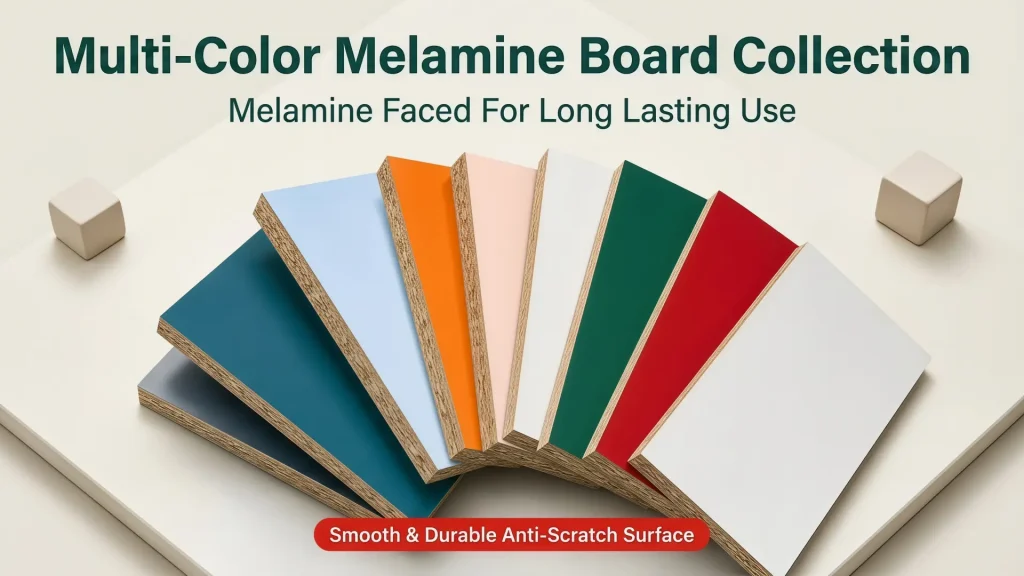
Melamine Faced Board in One Buying Answer
First, state melamine faced board with seven linked fields: substrate and grade, finished size and tolerance, decor source and code, texture and gloss, one- or two-sided face build, edge-band system, and compliance plus lot records. Then approve a pressed, edge-banded part made on the actual core. As a result, this method controls the look, cutting and repeat supply in one order spec.
A decor code names a design. It does not, by itself, guarantee the finished colour, texture, gloss or match between press lots.
| Control field | State on the order | Proof before release |
|---|---|---|
| Core | Panel type, mill, grade and target market | Data sheet, certificate and cut-edge sample |
| Size | Finished thickness, length, width and tolerance | First-off measurement and lot record |
| Decor | Paper maker or approved source, decor code and colour family | Signed master and pressed sample |
| Surface | Texture code, gloss range and grain run | Actual press sample under agreed light |
| Faces | One or two decor faces and reverse-face rule | Build sheet and flatness check |
| Edge | Type, code, thickness, texture and bonding route | Edge-banded factory part |
| Release | Emission rule, lot identity, packing and labels | Panel passport and packing photos |
The Swatch Is Not the Specification
For example, a screen image can start a design talk. However, it should not release a bulk order. Screens alter colour, while camera settings alter it again. Moreover, even a printed paper chip does not show how the pressed panel will look.
Heat and pressure change the resin-rich paper into the finished surface. At the same time, a steel press plate creates the texture and controls gloss. The Composite Panel Association explains thermally fused laminate as resin-treated decor paper fused directly to a substrate. Particleboard and MDF provide uniform bases for this process.
As a result, two panels with the same printed design may not look the same. The paper source may vary. The press plate may be matt, smooth or deeply embossed. The core colour can affect a pale decor at a cut edge. Also, a second press line can shift gloss.
So, the safe sign-off unit is a finished panel part. Next, view it beside the matching edge band. Use daylight-like D65 light and the main light used in the final room. Finally, record which sample controls the order.
Decode Melamine Faced Board Names First
In contrast, trade names often mix the surface with the core. That creates false comparisons. So, before pricing, turn each name into a clear physical build.
Match the Trade Name to the Physical Build
| Market name | Usual build | Best buying question |
|---|---|---|
| MFC or melamine chipboard | Melamine decor paper on particleboard | Which particleboard grade and mill sit below the surface? |
| MFM or melamine MDF | Melamine decor paper on MDF | Is the MDF standard, moisture resistant or made for a set use? |
| TFL panel | Thermally fused decor paper on a compatible panel | Which decor paper, press texture and surface class apply? |
| Melamine faced plywood | Melamine decor surface on a plywood core | How is the face made, and what ply build is below it? |
| HPL-faced board | A separate high-pressure laminate sheet bonded to a core | Is the higher-wear surface needed on every part or only selected zones? |
Do Not Treat a Market Name as a Grade
But these terms are not quality grades. For example, “MFC” does not state density, internal bond or screw strength. Likewise, “melamine plywood” does not state veneer species, ply build, bond class or face process.
This distinction also prevents a common quotation error. For instance, one supplier may quote direct-pressed melamine particleboard. By contrast, another may quote an HPL sheet bonded to MDF. Both can carry the same decor name, yet their cost and duty differ.
The melamine board product range includes faced plywood, MDF and particle board routes. Nevertheless, a firm quote must name the exact face and core build.
Build the Seven Field Purchase Code
For this reason, a useful order line should let a new inspector name the product without reading old emails. It should also split fixed rules from supplier choices.
18 mm x 1220 x 2440 mm, two-sided [decor code], [texture code], [substrate and grade], matched [edge code], [emission rule], [packing rule], approved master sample [ID].
The sequence matters. First, name the finished thickness rather than a loose nominal figure. Next, name the core and grade. Then lock the decor, texture and face build. Last, add the edge, proof and packing rule.
However, do not write “same as sample” unless the sample has an ID, date and custody record. Likewise, do not allow a later email image to replace the signed master. Otherwise, the control sample cannot protect either party.
For repeat orders, state which changes need written sign-off. In particular, paper source, substrate mill, texture plate and edge-band source belong on that list. Otherwise, a silent swap can change cutting or colour even when the sales name stays the same.
Melamine Faced Board Substrates Change the Result
Although the decor face changes the look, it does not upgrade the core below it. The core still controls weight, edge quality, local fixing strength and much of the panel’s stiffness. So, choose it from the finished part backwards.
Choose the Core from the Finished Part
| Finished part | Sound starting route | Reason to choose it | Point to prove |
|---|---|---|---|
| Cabinet carcass and divider | Melamine faced particle board | Fast flat-part output and good value | Core quality at cams, dowels and edge screws |
| Wardrobe door or long panel | Faced particleboard or MDF in the right grade | Broad, even face with many decor choices | Flatness, hinge system and door size |
| CNC-cut decor flat part | Melamine faced MDF | Fine, even core around close cuts | Chip control and sealing of exposed cuts |
| Fixture needing repeated fixing | Right plywood-based build | Ply build may suit local fixing and lighter parts | Veneer build, voids and face bond |
| Shelf | Grade chosen from span and load | Panel name alone does not predict long-term sag | Loaded shelf test with actual supports |
| Sink or vanity component | Moisture-resistant core with sealed details | It slows damage when wet risk cannot be removed | Cut-outs, holes, joints and leak path |
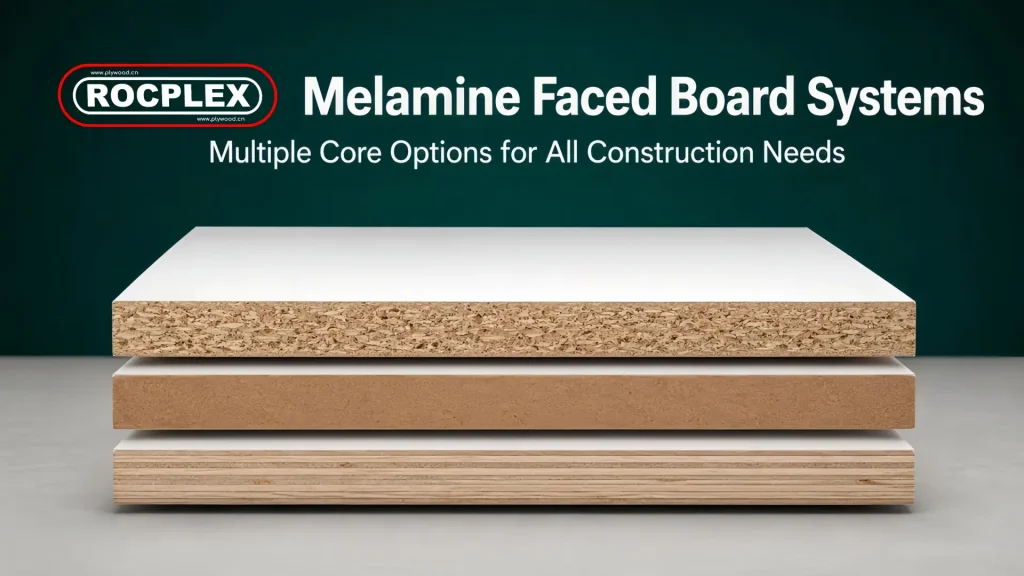
What Each Core Adds to Melamine Faced Board
Melamine faced particle board is often the practical choice for straight, edge-banded cabinet parts. But its cut edge must be dense and even enough for the planned fittings. After all, a good face cannot rescue a coarse or broken core.
Melamine faced MDF gives a fine cross-section and clean cuts. Yet it is often heavier, and raw cut areas still need care. Therefore, it earns its cost when that finer core solves a real part need.
Melamine faced plywood can suit parts that need a plywood core, lower mass or stronger local fixing. Still, plywood build varies widely. Therefore, buyers should state veneer species or group, ply count or build, bond class, void limit and thickness tolerance. The plywood product range shows why the word “plywood” must lead to a more exact core spec.
Finally, approve the full part in every route. A loose 100 mm swatch cannot prove a tall door, drilled rail or loaded shelf.
Colour Control for Melamine Faced Board
First, colour sign-off should move through a clear ladder. Each step answers its own question.
Approve Colour in Five Steps
- Screen concept: Is the design family right for the project?
- Source decor chip: Is the printed colour and pattern fit for use?
- Pressed panel: Do texture, gloss and core create the right result?
- Edge-banded part: Do the face, edge and corner read as one component?
- Run master: Does the first approved lot become the control for repeat supply?
Control Texture, Light and Lot Mixing
Moreover, this ladder is vital for woodgrains. The decor code controls the print, while the texture controls how light moves across it. If the embossed pore must follow the printed grain, state a registered or synced texture. Then mark the grain run on the cutting plan and pallet label.
Similarly, matching needs a tolerance rule. A face, edge band and HPL sheet can be well matched without looking alike at every angle. Therefore, approve them together in the final light. In addition, set the viewing distance and reject rule before the bulk run.
For large projects, use one approved master and one limit sample at each allowed colour edge. As a result, this creates a clear range. It is far better than words such as “close match” or “no clear difference.”
Finally, control lot mixing. Place front doors and drawer fronts from one decor lot where possible. If more than one lot is needed, map it by room, unit or wall. Otherwise, random mixing turns a small shift into a clear patchwork.
Edge Banding Completes the Panel
Edge banding is part of the melamine faced board system. It hides the core, guards handling edges and completes the colour set. Still, it does not make the panel waterproof.
Specify the Edge as a System
First, an edge spec should name the type, supplier or approved source, decor code, thickness, surface, glue route and finished radius. It should also state where thicker impact edges are needed. After all, cabinet fronts, shelves and hidden backs rarely need the same edge.
For example, EVA hot melt is common and low in cost. By contrast, PUR can give a finer bond line and better heat or moisture resistance when the line is run well. However, the glue name is not enough. Board heat, edge dust, glue spread, pressure and cure time all affect the bond.
Read Edge Failures as Process Signals
| Failure seen on the part | Likely control gap | Release check |
|---|---|---|
| White or dark line at the joint | Glue line, poor colour match or open edge | Corner sample under normal room light |
| Band lifts after storage | Dust, low heat, weak pressure or poor cure | Peel check after the stated conditioning time |
| Chipped face beside the band | Sawing or trimming damage | First-off edge at normal line speed |
| Edge looks darker than the face | Mismatched colour, gloss or type | Face-edge set approved together |
| Swelling at a sink cut-out | Open hole, joint or water path | Sealed cut-out and wet-detail review |
For wet-risk furniture, start with the right moisture-resistant core. Next, seal cut-outs, drilled holes, joints and damaged corners. In addition, design the cabinet so leaks can be seen and standing water cannot remain.
Where Melamine Faced Board Fits Best
In practice, melamine faced board works well in cabinet carcasses, wardrobes, office furniture, closets, shelving and retail fixtures. It brings a ready surface into cutting, drilling and edge banding. Therefore, it can remove several coating steps from the factory.
Yet one surface should not be forced into every duty. A tall wardrobe side has less risk than a service counter. For example, a school desk faces more impact than a closet shelf. Therefore, for high-wear tops, hot-item zones or harsh cleaning, compare the right HPL, compact laminate or other tested face.
Instead, the correct decision rests on the duty, not the room name. First, state expected wear, heat, stain, scratch, impact and cleaning exposure. Then ask for test values or a use trial that matches the risk.
Moreover, moisture-resistant does not mean waterproof. This point matters in kitchens and bathrooms. A moisture-resistant core may slow swelling, but an open edge or pipe cut-out can still admit water. Therefore, good detailing remains the first defence.
Standards Test the Surface and the Substrate
First, surface proof and core proof should be checked on their own. For European interior uses, EN 14322:2021 covers melamine faced boards made from wood-based panels. It sets surface rules and size limits. In addition, EN 14323:2021 gives linked test methods.
Therefore, do not accept a statement such as “EN standard” without the number, year and report scope. Next, check which surface property was tested. For example, project concerns may include scratch, stain, abrasion, cracking, impact and colour change. Yet not every use needs the highest result in every test.
In addition, the core needs its own panel standard and grade. It also needs the emission proof for the target market. For US trade, the EPA TSCA Title VI guidance covers hardwood plywood, MDF and particleboard. It also sets out labels, lot links and record duties across the supply chain.
Therefore, ask for the producer, product type, lot, third-party certifier number where needed, compliance statement and linked invoice record. Then keep those details tied to the shipped panels. Otherwise, a certificate from the right firm but the wrong mill or product is not sound proof.
Release the Lot with a Panel Passport
First, a sample sign-off proves a design choice. By contrast, a panel passport proves what entered the container. Therefore, it should travel with each press lot and connect the decor face to the hidden core.
The passport should record:
- purchase order and approved master sample ID;
- substrate maker, plant, panel type, grade and lot;
- decor source, code and paper lot;
- texture code, face build and grain run;
- press date, line or batch reference;
- finished thickness, size and inspection result;
- edge-band code when parts are supplied finished;
- emission and surface reports linked to the product;
- pallet number, sheet count and packing date.

Use three release holds. First, approve the build and master before bulk pressing. Next, approve the first bulk panel and edge-banded part. Finally, match pallet labels, check records and packing to the lot passport before loading.
In addition, packing guards the faces. Use clean cover sheets, corner guards and dry supports. Meanwhile, keep straps from marking the face. Moreover, place pallet IDs on two seen sides. As a result, an importer can isolate a lot without opening each pack.
As a result, this trace system shortens claims. If a colour, edge or core issue appears, the buyer can trace the affected lots. Without it, however, a small defect can place the whole shipment on hold.
Melamine Faced Board RFQ Checklist
Before requesting a firm quote, confirm the following points:
- exact panel build and finished use;
- substrate type, maker or sign-off rule, grade and density range if relevant;
- finished length, width, thickness and tolerances;
- one or two decor faces and reverse-face rule;
- decor source, code, texture, gloss and grain run;
- signed master, limit samples and viewing light;
- edge-band type, code, thickness, radius and glue route;
- part drawing, drilling, hardware, shelf span and load where relevant;
- wet-risk details and sealing responsibility;
- surface test needs linked to the actual duty;
- target-market emission rule and trace documents;
- quantity by decor, lot-mixing rule and overage;
- pallet size, cover sheets, labels and container plan;
- first-off sign-off, lot passport and claim record process.
Although the wood panel Resources centre can support early material checks, the final RFQ should describe the finished furniture part. After all, that is where surface, core and edge risks meet.
Melamine Faced Board Questions Buyers Ask
What is melamine faced board?
In short, it is a wood-based panel finished with resin-treated decor paper. Heat and pressure create a hard, ready-to-use face. However, the buyer must still name the core, surface class, texture and face build.
Is melamine faced board the same as laminate board?
Not always. For example, the broad term “laminate board” may include HPL bonded as a separate sheet. By contrast, direct-pressed melamine or TFL uses decor paper fused to the panel. Therefore, state the build instead of relying on the sales name.
Which core is best for kitchen cabinets?
There is no single best core for every part. For example, faced particleboard often suits straight carcass parts. Meanwhile, faced MDF can suit fine cutting. Plywood-based panels may suit set fixing or weight needs. Finally, wet zones need the right grade and sealed details.
Can melamine faced board be waterproof?
Standard products are indoor boards, not waterproof panels. Although a moisture-resistant core can slow damage, cut edges, holes, joints and leaks still need control.
Does edge banding stop moisture?
Good edge banding reduces exposure at a straight edge. However, it does not seal every hole, corner, joint or damaged area. Moreover, it cannot prevent damage from standing water.
How should a buyer approve the colour?
First, approve a source pressed panel on the actual core. Next, add the matching edge band and view it under agreed light. Finally, keep a signed master and agreed limit samples for bulk control.
Should both faces use the same decor?
Not in every design. However, the reverse face and balance must be stated. Because a one-sided build can affect cost, look and flatness, ask the supplier to confirm a stable approved build.
What should be checked before loading?
First, match the product to the master sample, lot passport and reports. Then check thickness, flatness, surface, edge state, grain run, labels, sheet count, dry packing and pallet care.
Turn a Decor Choice into a Repeatable Product
Overall, the best melamine faced board order connects three things. It fixes what the customer sees, what the factory machines and what the importer can trace. However, a decor code alone cannot do that.
First, start with the finished part. Next, lock the seven-field purchase code. Then approve the pressed face, matching edge and real core as one unit. Finally, release each shipment against a panel passport.
Send the part drawings, sizes, decor and texture codes, edge details, target market, quantity and delivery port. The ROCPLEX team can review the panel build, prepare samples and quote a traceable supply plan.
Email: roc@plywood.cn
WhatsApp or Call: +86 15152013388
Contact ROC
Post time: Sep-14-2026