

useful LVL vs solid timber review starts with a clear job for each beam. Both can carry loads. However, the better choice depends on the grade, size, moisture level, usable lengths and cost of doing that job.
The cheapest cubic metre can lead to the higher framing cost. However, paying more for LVL does not ensure a saving. So its higher price must buy a clear benefit, such as a better cut plan or less fitting work.
We recommend pricing two named grades against the same beam list. This guide shows how to compare them. In either case, the final choice must follow local design rules and the data for the actual grade.
Choose structural LVL when its tested grade, offered sizes or straightness solve a clear design need. Choose graded solid timber when it meets the same duty with sound moisture control and lower fitted cost. Neither material name establishes the better beam.
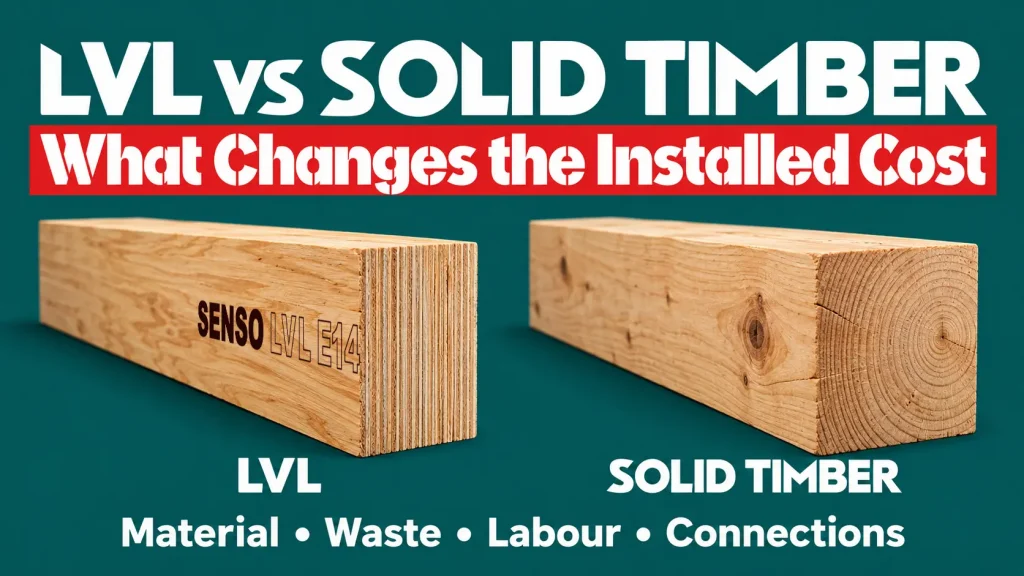
LVL vs Solid Timber: Start with Two Grades
“Solid timber” covers many species, grades and drying states. For example, a sawn pine framing beam and a large graded hardwood beam may suit very different jobs. Neither represents every solid timber option.
Likewise, LVL comes in a range of grades and veneer layouts. A beam grade can also differ from LVL made for packing or furniture. The layered edge alone does not prove that a piece meets a beam design.
APA’s guide to structural LVL explains how thin veneers form a bonded member. Most grain runs along its length. Product tests also set its strength and stiffness data. For the product range, see our laminated veneer lumber page.
In contrast, solid timber uses a grading system to sort pieces into design grades. The USDA chapter on stress grades explains that link. A knot is not an automatic fail. Its size, place and type must fit the rules for the grade.
Therefore, a fair LVL vs solid timber review starts with two named grades, rather than two broad labels.
What both quotes must state
| Buying question | Structural LVL | Graded solid timber |
|---|---|---|
| Which grade is offered? | Named maker, product and tested grade | Species or species group, grade and grading proof |
| Which design data apply? | The named product report or approved design data | The grade data and local timber design rules |
| How straight must it be? | Agreed limits for bow, spring and twist | Agreed limits under the grade rules and order |
| How dry must it be? | Product-based moisture test and agreed check stage | Correct moisture test and agreed drying state |
| Which lengths can be used? | Offered lengths, cut plan and rules for cuts | Stock lengths, grade checks and cut plan |
| What permits the planned use? | Product report, treatment and design details | Species durability or treatment, plus design details |
| What makes the costs match? | Cost to supply and fit the agreed beam list | Cost to supply and fit the same approved duty |
This table sets the basis for the review. However, it does not assign a strength value or moisture limit to either unnamed grade.
Strength and Stiffness Need Separate Checks
LVL vs Solid Timber: Separate Strength from Stiffness
Strength tells you how a beam resists loads. Stiffness tells you how much it bends under load. Because these are different checks, either one can set the beam size.
A quote may highlight a high bending value. However, that number cannot replace the modulus of elasticity, usually written as E. E alone also cannot prove shear, bearing or joint strength.
For an LVL vs solid timber check, first match the units and the basis of the data. Mean stiffness, characteristic strength and allowable stress are different types of value. Therefore, keep each one tied to its stated design method.
Also check which E the maker lists. It may be apparent E or shear-free E. APA’s note on apparent and true E explains the difference. Then use values on a common basis with the right method for beam movement.
Similarly, a species average from small, clear wood samples is not the design value for every sawn beam. The USDA chapter on wood strength explains how wood varies and how growth features affect it. So use the design data for the grade you will buy.
How Beam Depth Changes LVL vs Solid Timber Cost
For a rectangular section, the second moment of area is I = bh³/12. Here, b is width and h is depth. Bending stiffness also depends on the grade’s E through EI. The USDA structural analysis chapter covers basic beam design methods.
Now compare the same width at two depths. A 10% increase in depth raises I by 33.1%, because 1.10³ = 1.331. The section modulus rises by 21%, because it depends on depth squared.
These are geometric ratios from a simple section check. However, they are not strength gains for a named grade. Shear, bearing, stability and the actual design data still need checks.
As a result, extra depth can change the price comparison. A deeper, approved solid timber beam may compete with a shallower LVL beam. However, a tight headroom limit may make the LVL grade more useful.
For your LVL vs solid timber review, compare both options within the space the building allows. Our LVL span guide explains the load and support checks behind span choice.
Straightness Has a Time Stamp
A straight beam at the mill is a good start. However, the carpenter needs it to fit at the site. Storage, rain and handling can affect the beam before that point.
Therefore, ask when each straightness claim will be checked. For an LVL vs solid timber order, agree both the test method and the check stage.
LVL vs Solid Timber Checks at Dispatch
Before dispatch, record the moisture readings, test method and sample points with the load. Also state the final sizes and agreed limits. A label such as “kiln dried” does not prove the current state of every beam.
Wood takes up and loses moisture because its surroundings change. USDA’s chapter on moisture explains the roles of heat, humidity and the water already in the wood. So a reading at dispatch is one point in a longer journey.
During Storage: Keep the Wood Dry and Level
During storage, use the bearer spacing and cover the maker calls for. Keep the supports level and the wood clear of the ground. Also allow the airflow needed under the cover.
The USDA guide to drying and moisture control covers storage, transit and site work. Sound handling helps both LVL and solid timber keep their agreed state. If a pack gets wet, record the event before using it.
LVL can also change size as its moisture level changes. APA’s note on LVL size changes covers this behaviour. Therefore, use clear size limits rather than a broad promise that LVL never moves.
LVL vs Solid Timber Checks Before Enclosure
Before the linings hide the frame, check its moisture level, straightness and fit again. Also check visible damage under the rules for the grade. Deal with any failed beam before another trade builds over it.
Use the meter method for the actual LVL product. For example, Metsä Wood’s Kerto moisture guide gives meter advice for its own products. It also describes swelling and possible warping where moisture differs across a member. Its figures apply to the named Kerto products.
Then compare the state at the mill with the state at the site. That makes an LVL vs solid timber stability claim testable.
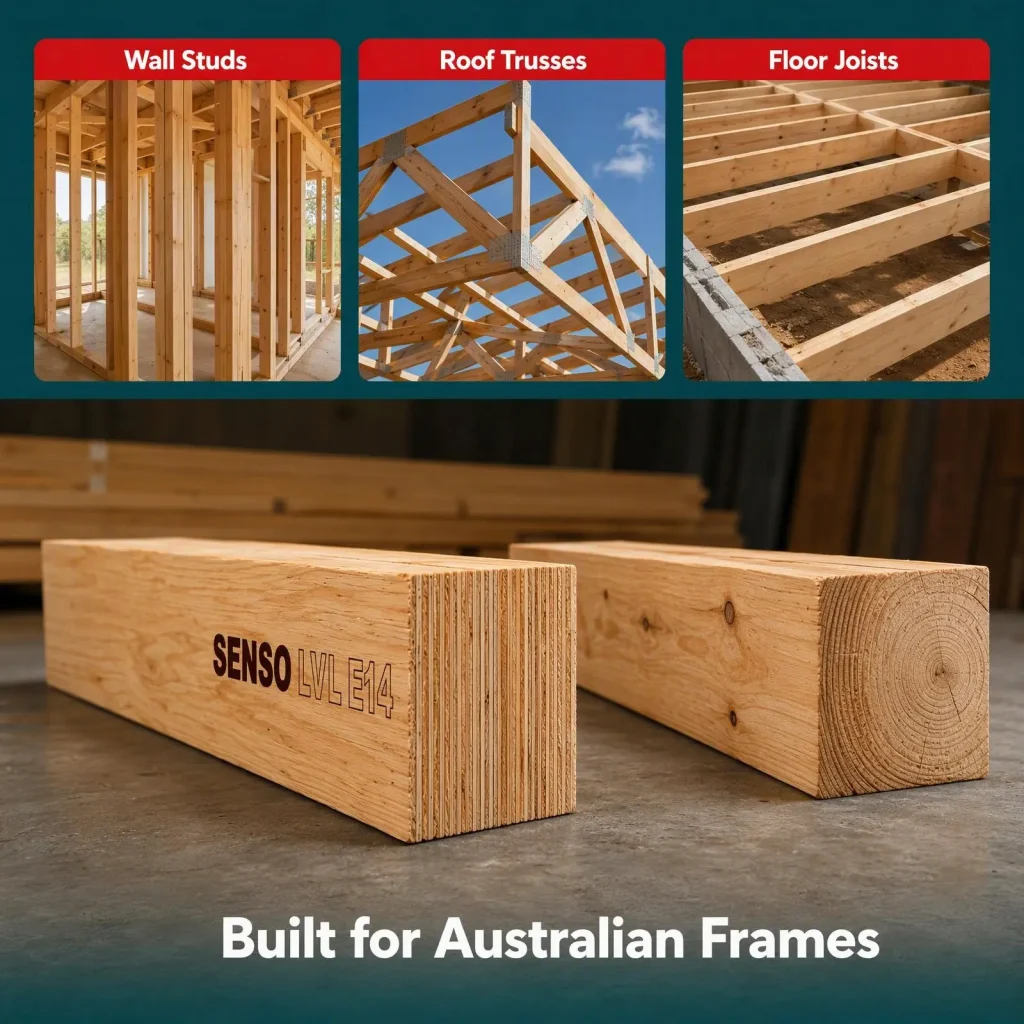
LVL vs Solid Timber Cost: Test the Price Premium
A wood quote often ends at delivery. However, the job still needs cutting, sorting, fitting and final checks. Compare the cost of those steps for the same approved output.
For example, one beam family can use this budget measure:
Comparable installed cost per scheduled metre = total cost allocated to that member family ÷ approved installed metres.
Add the wood, freight, shop work, fitting, joints and extra work shown by site records. Count each cost once. Also use the same tax and currency basis for both options.
If the beam sizes or roles differ, price the whole beam or framing pack instead. A metre of one size does not equal a metre of every other size. Therefore, cubic-metre prices alone cannot settle an LVL vs solid timber choice.
A worked example with stated assumptions
Assume the job needs 240 fitted metres within one beam family. Both options have the same final size and an approved design for the same duty. The order lengths differ because of the assumed cut plans and handling needs.
All figures below are invented teaching inputs in USD. They are not market quotations, typical waste rates or SENSO prices.
| Cost item | Solid timber option | LVL option |
|---|---|---|
| Required approved installed length | 240 m | 240 m |
| Ordered length, with the assumed extra stock | 264 m | 252 m |
| Delivered wood price per ordered metre | USD 12.00/m | USD 13.00/m |
| Wood bill | USD 3,168 | USD 3,276 |
| Extra sorting, fitting and remedial handling | USD 300 | USD 150 |
| Common installation and connector costs | USD 1,000 | USD 1,000 |
| Compared installed total | USD 4,468 | USD 4,426 |
| Cost per approved installed metre | USD 18.62/m | USD 18.44/m |
In this case, the LVL price per metre is about 8.3% higher. Yet the fitted total is USD 42 lower. Less extra stock and less handling create that small saving.
Find the break-even point
In this case, the LVL wood bill is USD 108 higher. Therefore, it costs less overall only if the other costs fall by more than USD 108.
If handling costs were equal, solid timber would cost USD 108 less under these order assumptions. So the claimed saving depends on the actual cut plan and site work.
For LVL vs solid timber pricing, state why each cost differs. Then update the budget when the size, stock lengths, freight terms or fitting method changes.
Give delay risk its own line
A missing header can hold up work beyond the cost of a new beam. However, an invented delay charge will weaken the cost check. Use the stated lead time and a job-based cost for the work that would stop.
Keep that figure apart from wood and labour costs. Otherwise, the same delay may be counted twice. Available replacement stock can sometimes outweigh a small material saving.
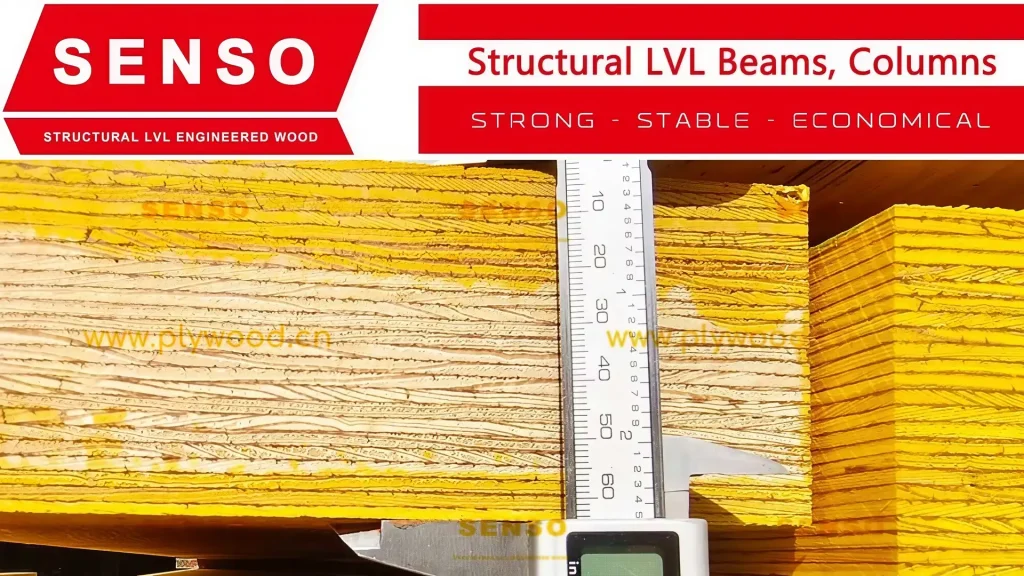
LVL vs Solid Timber Cutting Yield
A cut plan shows how lengths fit together. However, it does not prove that each piece meets the design. A usable piece must also have the right grade, state, size and allowed use.
Start with the actual length mix. For example, a 4.8 m member cut from 6.0 m stock leaves about 1.2 m before kerf. That offcut has value only if it has a valid use in the job.
However, short offcuts cannot form one long beam through an unplanned splice. Likewise, cutting out a defect can change the needed size or grade. Check the rules for cuts and joints before counting any recovered wood.
Grade checks come before a waste factor
Before cutting LVL, check whether trimming or ripping keeps the tested grade and required marks valid. For solid timber, assess knots and damage under the grade rules. An allowed knot should not become an invented waste rate.
Also measure failures against the agreed limits for bow, spring and twist. If the pack passes, do not charge it with the fail rate from a different job.
An honest LVL vs solid timber yield check uses the offered lengths, a valid cut plan and actual grade checks. It does not give each wood type a fixed waste rate.
For order sizes and length lists, see our LVL beam sizes guide.
Connections and Exposure Can Change the Cost
A beam change may alter hanger fit, bolt spacing or the needed bearing length. For example, a narrower beam can need a new joint detail. Multiple plies can also add screws, fitting time and checks.
Therefore, include those costs in the offered option. The designer must also check the joint with the actual product. Matching outside sizes alone cannot prove the same joint strength.
Also check the service limits. An exterior-grade adhesive describes the bond. It does not alone permit permanent outdoor use. APA notes that most SCL products are approved for dry use, with exceptions for named products.
For exposed or treated work, ask for proof covering the actual product and use. Then include the required cover, detailing and upkeep in the cost. Similarly, apply the same checks to solid timber.
A coloured coating also needs a stated purpose. A brand mark, temporary rain cover and preservative treatment do different jobs. Check what the actual finish provides.
These checks belong in the LVL vs solid timber budget. A low wood bill has little value if the beam cannot meet its joint or service needs.
Where Each Wood Type Earns Its Place
A standard repair can favour stocked solid timber
Suppose the designer approves a graded solid timber beam held in local stock. It is dry enough, and its treatment suits the job. The lengths are on hand, so the crew can follow the existing approved detail.
Solid timber may offer the better result through price, lead time and ease of repair. An LVL option should therefore show a clear gain before the order changes.
LVL vs Solid Timber for a Shallow Header
Now consider an opening with a tight depth limit. An approved LVL grade may meet the design within that space. By comparison, the solid timber option may need more depth or a new support layout.
Price all the effects: headroom, supports, joints and shop work. The gain is the approved layout the project can use. In that case, keeping the layout can justify a higher wood price.
Repeat work can reward steady sizes
For repeat framing work, trial cuts and fitting can show the value of steady sizes. Record fitting time, fixes and passed pieces. Then apply that result to the actual order size.
If LVL performs better in the trial, the saving has proof. However, dry, graded solid timber may perform just as well. In that case, its lower quote may win.
The best LVL vs solid timber choice may also use both. For example, use suitable solid timber for regular framing. Then use LVL where its tested grade solves a clear design need. Match the joints and movement details through the approved design.
How to Compare LVL vs Solid Timber Quotes
Send one brief with both design-approved options named. Include:
- The market, planned use and design reference for each option.
- The named LVL product or solid timber species group and grade.
- Final beam sizes, cut lengths and piece counts.
- The moisture check stage, size limits and test method.
- Exposure, treatment, joint details and rules for cuts.
- Freight terms, currency, lead time, cut plan and stock for repairs.
Ask each supplier to state any gap in its offer. Then price that gap before ordering. Also agree how proposed grade changes will be reviewed.
This brief turns an LVL vs solid timber enquiry into a fair cost check. It lets each supplier support its quote with useful data.
LVL vs Solid Timber: Buyer Questions
Is LVL always stronger than solid timber?
No single ranking fits all grades. First compare the named LVL product with the solid timber grade on a common design basis. Bending, shear, bearing and joints can give different results.
Does LVL stay straight after getting wet?
Moisture can change LVL size and straightness. Therefore, follow the product’s rules for storage, exposure and checks. A straight beam at the mill may change before fitting.
Is solid timber always cheaper?
It may cost less to buy. However, the fitted cost also depends on size, cut plan, grade checks and site work. Compare both options for the same approved output.
Can the same-size member be swapped directly?
The designer must approve the offered change. The same size does not prove equal grade data, joints, treatment or allowed use. Also check each part of the changed detail.
Can LVL and solid timber be used in the same frame?
Yes, if the design permits both and matches their joints and movement. For example, each wood type can serve the beam roles that suit it best.
Which price unit is most useful?
First use the same delivered price basis. Then price the whole approved beam or framing pack. Cost per fitted metre helps within one defined beam family.
Send Us Your LVL Beam List
We supply SENSOframe structural LVL beams. Send the market, approved product, final sizes, cut lengths and piece counts. We can then quote against that beam list and state which product data are available for review.
For your LVL vs solid timber review, request our lengths, freight terms and technical data together. Your buyer can then cost the LVL option alongside the graded solid timber quote.
Request a structural LVL quotation.
🌐 www.plywood.cn
✉️ roc@plywood.cn
📱 WhatsApp/Call: +86 15152013388
Post time: Oct-08-2026