

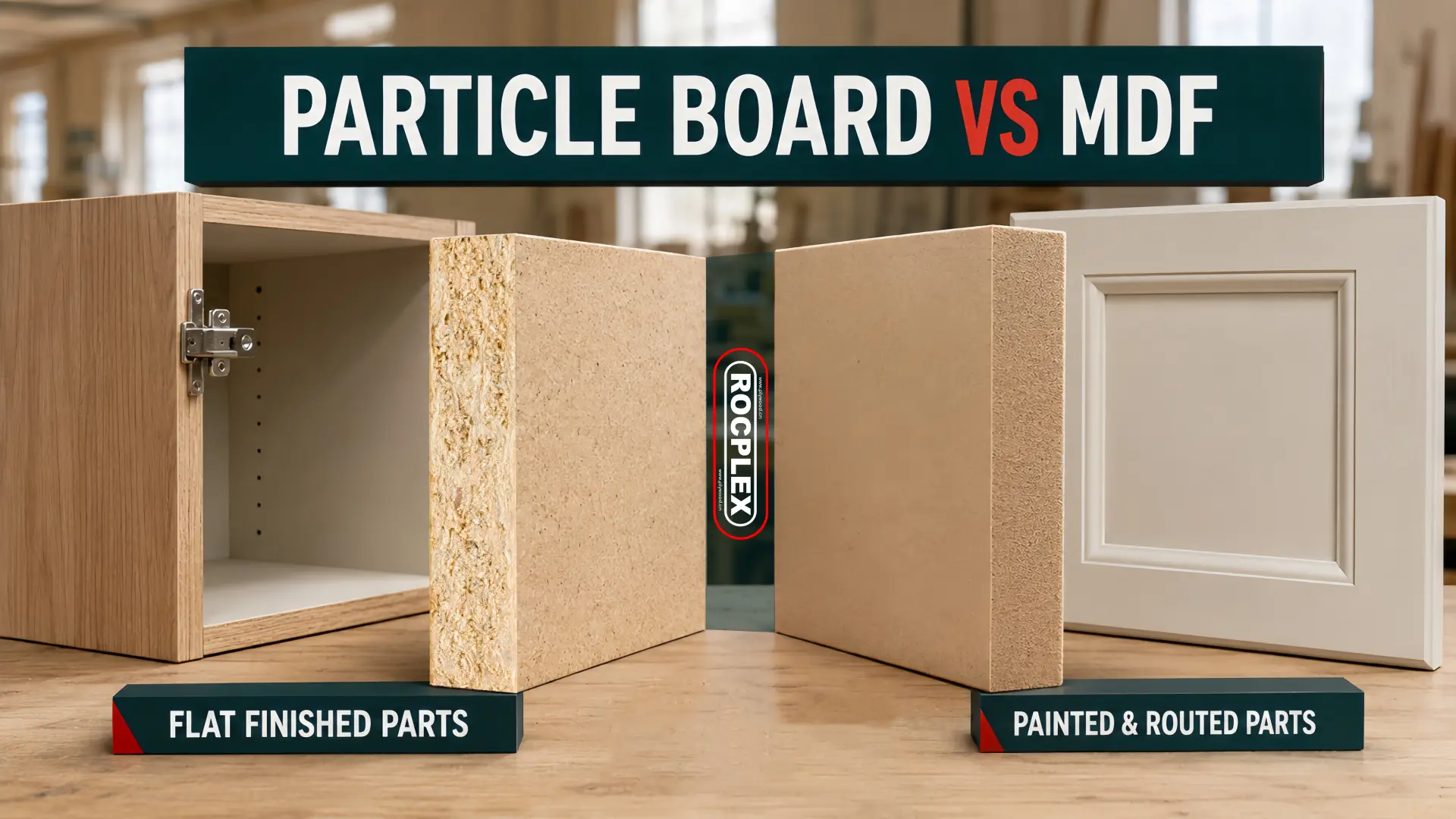
Particle board vs MDF is not a contest with one winner. Particle board usually gives better value for straight, finished components such as cabinet carcasses. MDF usually earns its cost when a part must be routed, painted or shaped. The correct choice depends on the face, edge, fixing and load.
That distinction matters because a cabinet is not one job. A door needs a clean face and a stable shape. A side panel needs to stay flat and join fast. A shelf must resist sag. A hinge zone must survive repeated use. One board may make buying seem easy. However, it can raise cost and move risk into the weakest part.
Particle Board vs MDF in One Practical Answer
Choose particle board for flat, edge-banded parts with a ready-made face. Choose MDF for routed shapes, painted doors and parts with exposed shaped edges. For shelves, high-load fittings and damp zones, neither panel name is enough. Test the grade, thickness, span, edge detail and hardware as one system.
| Decision | Particle board is usually stronger when | MDF is usually stronger when |
|---|---|---|
| Surface route | Melamine, laminate or veneer arrives ready to use | Paint or a routed decorative face is required |
| Part geometry | The part stays flat with straight cut edges | The edge or face needs a moulded profile |
| Factory flow | Cutting, drilling and edge banding run at volume | CNC routing, sanding and coating add value |
| Cost target | Sheet yield and ready-made surfaces lead the decision | Less paint preparation offsets higher board cost |
| Main caution | Coarse core, edge damage and fitting choice | Higher mass, fine dust and edge moisture uptake |
The fastest answer is therefore not “MDF is better” or “particle board is cheaper.” It is this: select the panel after the component drawing is fixed.
Particle Board vs MDF Begins at the Wood Element
Particle board uses discrete wood particles. A typical furniture panel has fine particles near the faces and coarser particles in the core. MDF starts with refined wood fibers. Those fibers form a more uniform material that can be machined across the face and edge.
The USDA Wood Handbook chapter on wood-based composites explains this difference at board level. It notes that particle size, fiber form, density, resin and layer order can all change the result. It also states that fiberboard makes fuller use of the natural strength of wood fiber.
This creates a useful buying rule. Particle board acts like a layered panel. MDF acts more like even stock for cutting and shaping. However, that rule does not predict every grade. A good particle board can beat weak MDF in a real fitting or shelf test.
Three Working Zones in Particle Board vs MDF
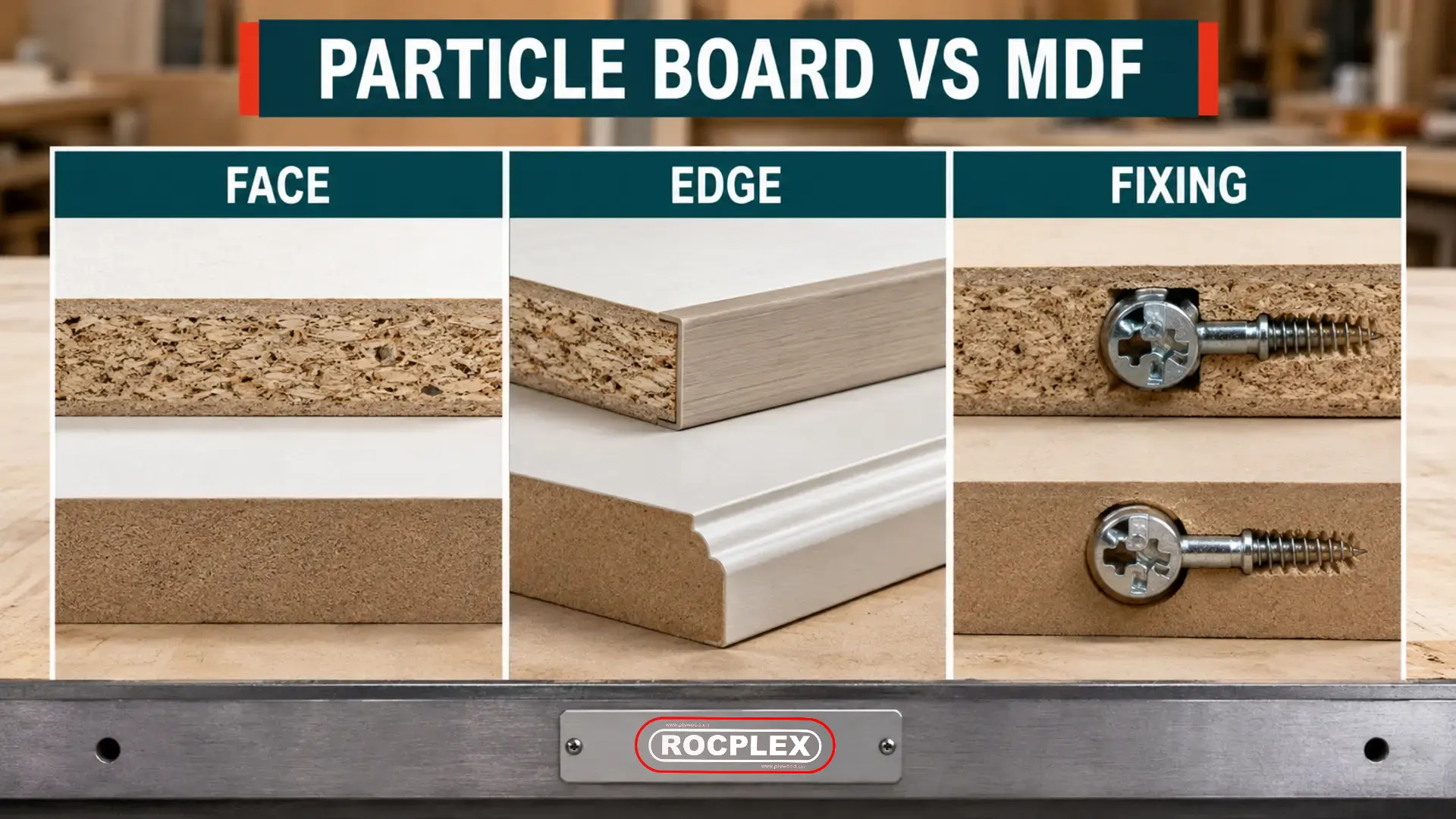
Most particle board vs MDF failures begin in one of three zones. They start where the board meets a finish, an edge or a fitting. Judge the board at those points, not by a sample held in the hand.
The face decides the finish
Raw MDF has a fine and even face. Therefore, it is a strong base for primer and paint. It also supports shallow routing and decorative details with little particle show-through.
Particle board has a smooth pressed face, but its best surface value often comes from a factory-applied finish. Melamine faced particle board can enter cutting and drilling with no spray line. In that system, comparing raw faces gives the wrong commercial answer.
The edge decides shape and water risk
MDF produces a more continuous routed edge. Still, that edge is porous and needs a suitable sealer before painting. If coating build is too low, the edge can look duller than the face.
Particle board edges expose larger core pieces. As a result, they are often hidden by edge banding, a solid lipping or another detail. A clean band protects the look, but it cannot repair a loose core. It also cannot seal an open joint or damaged corner.
The fixing zone decides service life
Hardware loads a small area of the panel. Face screws, edge screws, confirmat screws, inserts and cam fittings do not stress the board in the same way. Pilot-hole size and distance from the edge also matter.
MDF has a more even core, yet a screw can strip the fibers when it is too tight. Particle board works well with fittings made for its core, but weak zones can reduce edge holding. Therefore, the useful winner is the board and fitting pair that passes the real build cycle.
Particle Board vs MDF Performance Map
| Property | Particle board | MDF | What the buyer should verify |
|---|---|---|---|
| Internal structure | Fine faces with a coarser particle core | Refined fibers with a more even cross-section | Cut-edge consistency across several sheets |
| Raw face | Smooth enough for overlays and some coatings | Very smooth and suited to paint preparation | Surface absorption and finish trial |
| Edge profiling | Limited; usually covered | Strong choice for routed and shaped profiles | Tool wear, edge fuzz and paint build |
| Straight cutting | Efficient for flat furniture parts | Accurate but often heavier to handle | Chip-out, squareness and cutting speed |
| Screw holding | Depends strongly on core and fitting design | More even, but can strip if pilot holes are wrong | Face and edge tests with production hardware |
| Shelf performance | Grade and span control the result | Grade and span control the result | Long-term deflection under the stated load |
| Water exposure | Raw edges swell first | Raw edges absorb water quickly | Grade, sealing detail and leak path |
| Ready-made surfaces | Widely used with melamine and laminate | Also available faced, but raw MDF adds value for paint | Compare finished panel, not only raw board |
| Typical cost logic | Lower-cost route for flat finished parts | Higher-cost route when machining and paint add value | Finished-part cost and reject rate |
The map shows why broad rankings fail. MDF may win the shaping row but lose the freight row. Particle board may win the carcass row but lose a routed-edge design. The part decides which row matters most.
Particle Board vs MDF Density Changes Freight
MDF is often heavier than particle board at the same thickness. Yet “MDF is always heavier” is not a purchase spec. Both boards come in different densities. Moisture also changes sheet mass.
Buyers can estimate mass with one simple formula:
Sheet mass = length × width × thickness × declared density
A particle board vs MDF weight check should therefore start with the declared density, not a broad product label.
For example, a 2440 × 1220 × 18 mm sheet has a volume of about 0.0536 m³. At a sample density of 650 kg/m³, it weighs about 34.8 kg. At 750 kg/m³, it weighs about 40.2 kg. Those figures are examples, not product promises.
The 5.4 kg gap affects hand lifts, pallet weight, truck limits and load plans. However, it does not prove that the heavier sheet holds screws better or sags less. Ask for the test linked to the part. Then use density as a control value.
Particle Board vs MDF for Cabinet Boxes and Doors
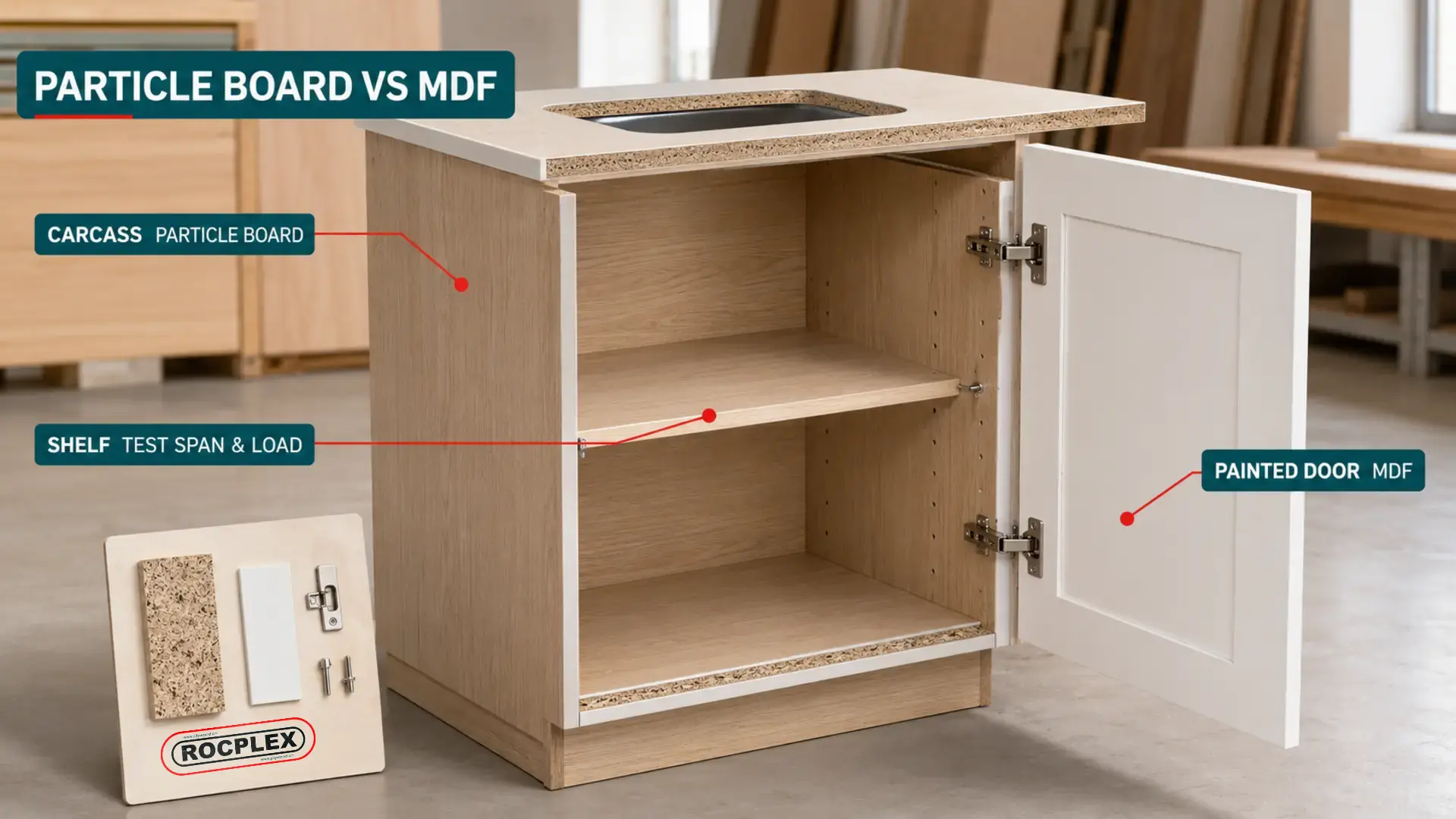
The strongest particle board vs MDF decision is often a mixed-panel cabinet. This is not a compromise. It puts each board where it gives more value.
| Cabinet component | Preferred starting point | Reason | Approval test |
|---|---|---|---|
| Melamine carcass side | Particle board | Ready finish, flat part and efficient edge banding | Hinge cycle and edge-band quality |
| Painted flat door | MDF | Even face and predictable paint base | Primer absorption and surface flatness |
| Routed shaker door | MDF | Continuous fibers support shaped profiles | CNC edge quality and coating trial |
| Adjustable shelf | Either stated furniture grade | Span and load matter more than the name | Loaded span test |
| Drawer side with fittings | Either, based on hardware | Connector design controls local stress | Assembly and pull-out test |
| Sink cabinet panel | Moisture-grade panel with sealed details | The leak path controls failure | Edge, hole and joint exposure test |
| Narrow loaded rail | Consider plywood or a reinforced detail | Local load may exceed both panel systems | Structural check and fitting test |
This part map avoids a common factory error. A supplier may approve a cabinet from the door sample alone. Yet the costly failure may occur at a shelf pin, hinge cup or sink cut-out. Sign-off should follow the full parts list.
When a part needs exposed edges, many screw changes or more local strength, compare a suitable plywood option. Do not force either panel into the job.
Particle Board vs MDF for Shelves Is a Creep Problem
Shelf choice is often reduced to thickness. That is incomplete. A shelf can look straight on the day of assembly and sag months later. Long-term deflection depends on span, load, thickness, support layout, panel stiffness, temperature and humidity.
The Composite Panel Association publishes shelf guidance for both panel types. Its use of span tables reflects the right method. Design the shelf as a part under load. Do not choose it by board name.
For a long shelf, buyers should state:
- clear span between supports;
- shelf depth and finished thickness;
- expected distributed and point loads;
- single-span or centre-supported layout;
- edge lipping or front rail;
- finish on one or both faces;
- acceptable long-term deflection.
A thicker panel helps because stiffness rises fast with thickness. Still, a short centre support may give more value than a heavier sheet. A front rail can also make the shelf stiffer and guard the edge.
Compare Finished Part Cost, Not Sheet Price
Particle board normally starts with a lower sheet price. MDF often costs more and may add freight because it can weigh more. That does not make particle board the lowest-cost choice for every part.
For a painted routed door, MDF can cut filling and repair work. For a melamine carcass, particle board can remove the paint line. So, use this particle board vs MDF cost test:
Finished-part cost = board share + surface finish + machining + edge treatment + fittings + rejects + freight
This sum changes the buying talk. It also shows hidden costs. A cheap panel can cause more chipped edges, slow routing, extra primer, loose fittings or more rejects. By contrast, a costly panel can waste money when the part only needs a straight cut and hidden edge.
Ask each supplier to quote the same finished spec. Then compare good parts per sheet, cycle time and reject rate. The engineered wood product range can help buyers match the panel to the work.
Standards and Emission Evidence Are Separate Checks
Do not order particle board and MDF under one vague “furniture board” label. In North America, current CPA references include ANSI A208.1-2022 for particleboard and ANSI A208.2-2022 for MDF used indoors. The Composite Panel Association standards page also lists notes on shelf design, warp, storage and changes in size.
Strength and emissions are separate checks. A low-emission panel can still hold screws poorly. Likewise, a strong panel can fail the target market rule.
For US supply, the EPA TSCA Title VI guidance lists limits of 0.09 ppm for particleboard, 0.11 ppm for MDF and 0.13 ppm for thin MDF. These legal limits apply to set product types. They do not mean that one board type will always emit more. Buyers must check the real certificate, mill, product type, test method and lot records.
For other markets, name the standard and test method on the order. Terms such as E0, E1, eco board or green board are not enough on their own.
A Five Sample Approval Method
One small showroom sample cannot prove a bulk particle board vs MDF order. A better sign-off plan uses five samples. Each one has a job.
- The face sample tests the finish. Apply the real melamine, laminate, veneer, primer or paint system.
- The edge sample tests shaping. Cut, route and edge-band it with normal factory tools and feed speed.
- The fitting sample tests local strength. Drill the production hole pattern, fit the real hardware and repeat the assembly cycle.
- The shelf sample tests time under load. Use the stated span, support and load for a defined period.
- The lot sample checks repeat supply. Take sheets from different pallet spots and match them to labels and reports.
Set clear pass limits before the trial. Useful limits include thickness range, flatness, chip size, edge-band gaps, screw torque, fitting cycles and shelf sag. Photos alone are not a release rule.
Particle Board vs MDF Questions Buyers Ask
Is particle board or MDF better for cabinets?
Particle board is often the better starting point for melamine cabinet boxes. MDF is often better for painted or routed doors. High-load shelves, hinge zones and wet details still need part-level tests.
Which panel holds screws better?
Neither panel wins every screw test. MDF has a more uniform core, while furniture particle board is designed for fittings such as confirmat screws and cams. Test the real face or edge fixing with the planned pilot hole and torque.
Is MDF stronger than particle board?
MDF makes fuller use of wood fibers and can give stronger, more even stock for shaping. However, grade, density and test values vary. Match strength to bending, core bond or fixing demand.
Which panel is better for shelves?
Choose from the stated stiffness, span, thickness, load and support layout. Either panel can sag when the shelf is too long or heavily loaded. A centre support or front rail may be the better solution.
Which panel is more water resistant?
Standard MDF and standard particle board are both interior panels. Moisture-resistant grades can slow damage, but neither becomes waterproof. Seal cut edges, drilled holes, joints and sink cut-outs.
Is MDF always more expensive?
Its raw sheet price is often higher. Yet MDF may cut shaping and finish cost on painted routed parts. Compare the whole finished part, not only the board bill.
Can one factory use both panels in one cabinet?
Yes. A melamine particle board carcass and painted MDF door are a common, rational system. Each panel is used where its structure gives the best production value.
What documents should an importer request?
Request the full product standard, grade, thickness range, strength data, emission certificate, mill and lot ID, face spec, packing plan and trial results for the final part.
Choose by Part Then Approve by Test
Particle board vs MDF is best decided from the finished part backwards. Start with its shape, finish, edge, fittings, span and water path. Then select the grade and test the factory system.
Particle board often gives the best route to flat, finished furniture parts. MDF often gives the cleanest route to painted and shaped parts. A mixed-panel design can beat a one-board rule in cost, quality and service life.
Buyers can use the plywood and engineered wood Resources centre to compare related panels and prepare a clearer specification.
Send the part drawing, size, thickness, finish, edge detail, fittings, target market, quantity and port. ROC can check the parts list before sample sign-off or container pricing.
Email: roc@plywood.cn
WhatsApp or Call: +86 15152013388
Contact ROC
Post time: Sep-07-2026