

Plywood vs solid wood is best judged by the job of each part. Plywood often suits wide cabinet panels where a stable length and width help keep joints and gaps aligned. Solid wood offers depth for shaped edges, visible grain and later repairs. Because both products respond to moisture, the joint must suit the wood and its use.
A door that fits well in a dry workshop may bind when the room becomes more humid. A tabletop can stay sound while pulling against a base that holds it too firmly. In both cases, the choice of wood and the joint need to work together. The useful question is how much a part may change, which way it moves, and where the design lets that change occur.
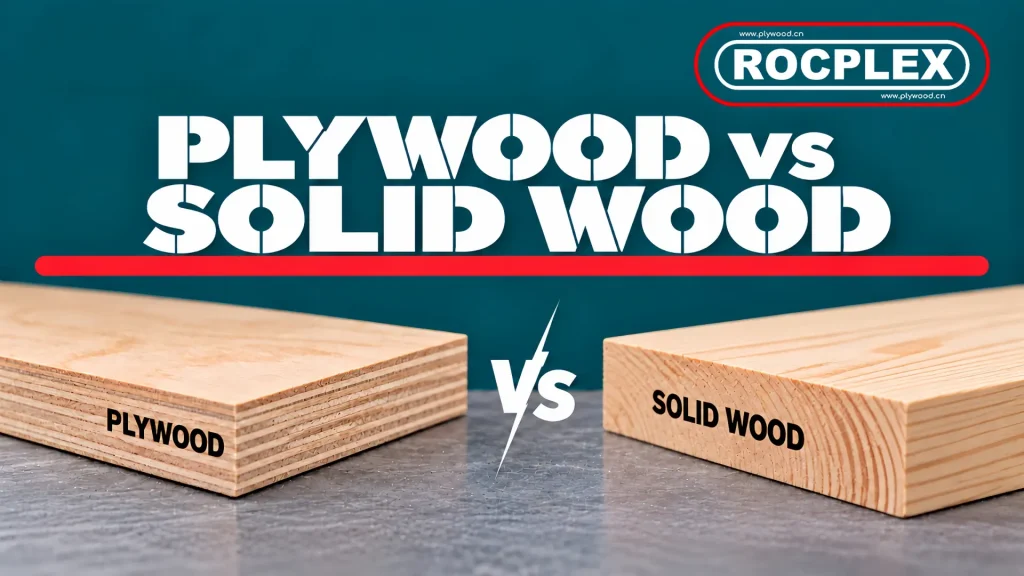
Plywood vs Solid Wood Depends on Grain Direction
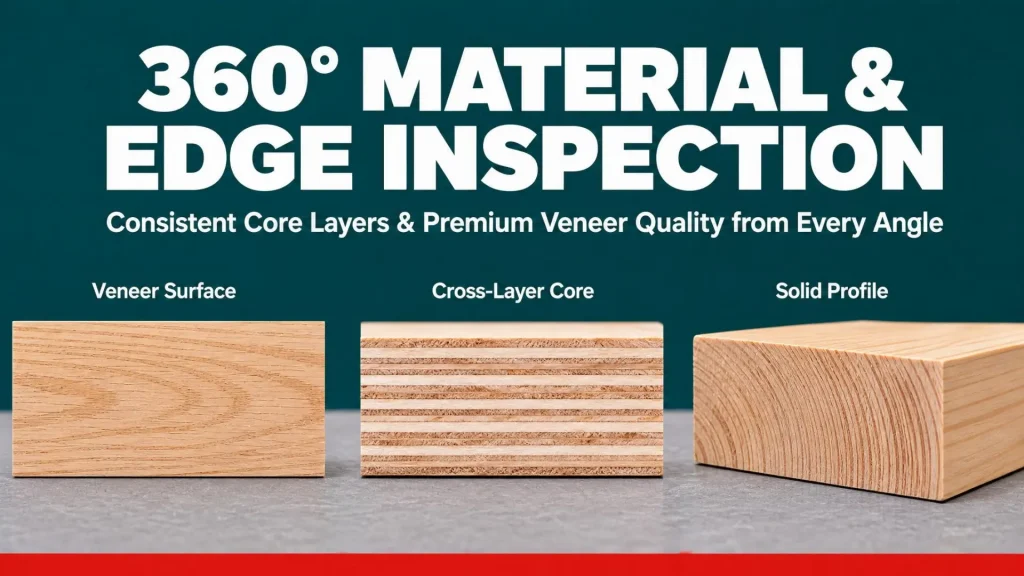
A solid wood part is cut from timber. Its grain means it reacts one way along the fibres and another across them. Plywood uses thin wood veneers bonded in layers, usually with the grain crossing between them. APA’s plywood guide explains how this layup reduces shrinkage and swelling when the panel gains or loses moisture.
For solid wood, use three grain axes. Longitudinal means along the grain. Radial runs across the growth rings, while tangential follows their curve. The USDA Wood Handbook shows that normal moisture changes cause much more size change across the grain than along it. Radial and tangential size changes also differ.
That is why a narrow rail and a wide panel from the same species need different details. Width matters because the same strain produces more travel across a wider piece.
Edge-gluing several boards into a panel does not create a plywood layup. If their grain runs largely in the same direction, the wide panel still needs room to move across it.
Plywood also responds to moisture. Its smaller change in length and width should not be confused with fixed thickness or proof against wetting. APA’s dimensional-stability topic treats linear expansion and thickness swelling as separate effects.
Calculate the Movement Before Choosing a Detail
A statement such as “oak moves” gives the designer too little to use. If you know the width, grain layout and service moisture range, you can estimate the change.
The following example uses published wood data. It is an illustration for design review, rather than a test result from a supplied panel.
A 400 mm White Oak Example
Assume a white oak panel is 400 mm wide at 8% wood moisture content and later reaches 12%. That is a rise of four percentage points. Moisture content is water mass as a percentage of dry wood mass; it is not room humidity.
USDA Chapter 13, Table 13–5 gives the following coefficients for its white oak entry. Each coefficient is a fractional size change per percentage-point change in wood moisture content.
| Ideal width direction | Coefficient from USDA | Estimated growth over 400 mm |
|---|---|---|
| Tangential, as in a flatsawn width | 0.00376 | 400 × 0.00376 × 4 = 6.016 mm, about 6.0 mm |
| Radial, as in a quartersawn width | 0.00194 | 400 × 0.00194 × 4 = 3.104 mm, about 3.1 mm |
The estimate follows Equation 13–3: change in width = starting width × coefficient × change in moisture content. The source bases the coefficients on dimensions at 10% moisture content and uses the method within the 6–14% range.
Real growth-ring angles and individual pieces vary. Therefore, these figures show why the cut matters; they do not prescribe a finished joint gap. The coefficients also belong to solid wood. Do not apply them to plywood.
The Fixed Point Decides Where the Gap Goes
The 6.0 mm estimate describes a change across the whole width. So the fixing layout decides where each edge moves.
If the ideal panel stays fixed at its centre and grows equally towards both edges, each edge travels about 3.0 mm. If one edge stays fixed, nearly all the width change appears at the other edge. This is a geometric consequence of the chosen fixed point.
Now apply that logic to a joint. A slot needs useful travel along the part’s planned axis. The screw shank takes up some of its length, so check the travel left around it. A washer, clip or recess must also remain able to do its job throughout that travel.
These checks turn a movement estimate into a detail review. They still need the actual fitting, room range and making tolerances. A nominal 3 mm slot is not the same as 3 mm of available movement.
We suggest marking the fixed point and travel axis on the drawing. That makes the planned action clear to the factory and fitter.
Three Details That Change Plywood vs Solid Wood Choices
For mixed furniture, look at how the parts meet before ranking the two woods. These three details show why the joint matters.
Detail One: A Tabletop Fastened to Its Base
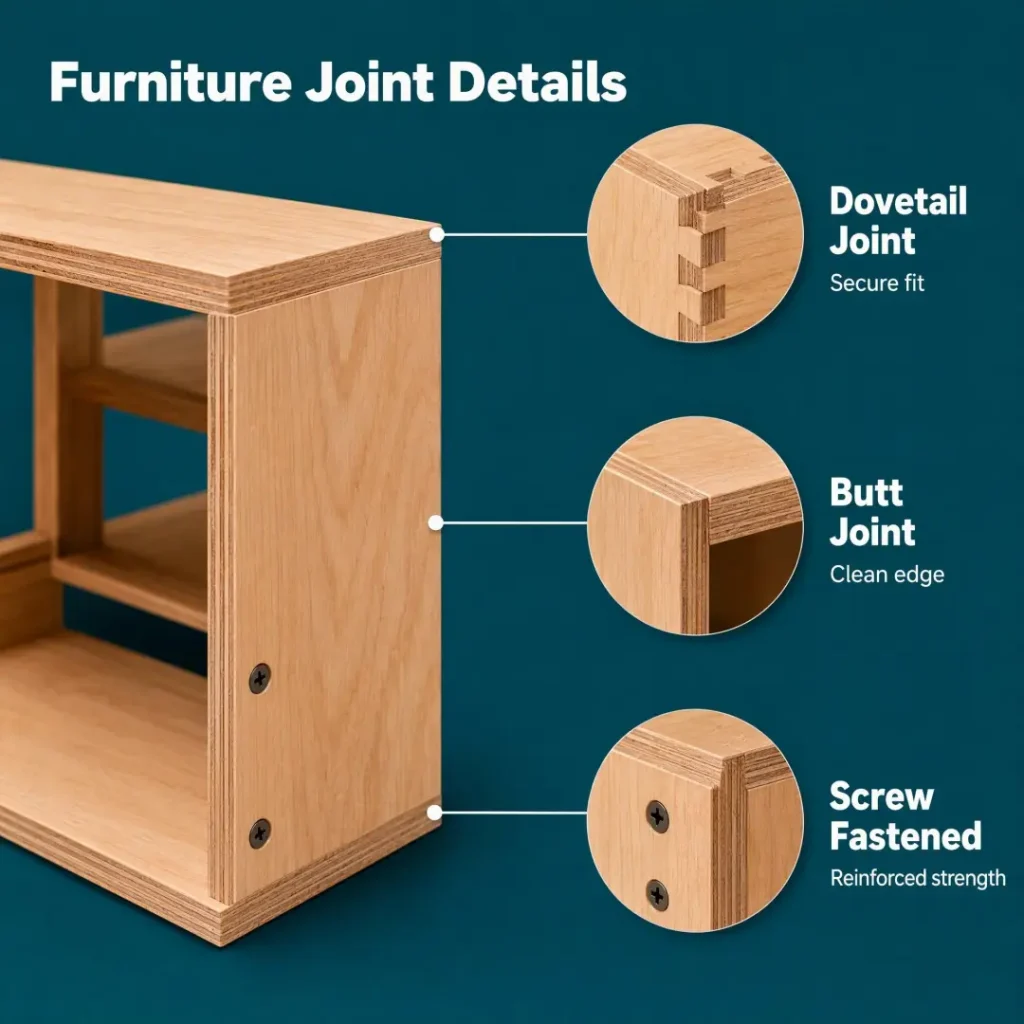
A wide solid wood top may need to change width while the base keeps its legs and rails aligned. The joint must hold the top securely while allowing it to change width.
Lee Valley’s expansion-washer design is one example of hardware made for this task. It uses an elongated slot for seasonal panel movement. Other systems use clips or wood buttons. Choose the detail around its own fitting instructions and the furniture loads.
If the top’s grain runs across that of a base rail, a broad, rigid glue joint can create a conflict. More glue or a stronger screw does not remove the top’s need to change width.
For a plywood top, the balance of concerns changes. The edge build, face quality, span and fixing still matter, but the solid-oak movement estimate above no longer applies.
In a plywood vs solid wood review, therefore, compare the top with its base and fixings. A sound solid wood design can allow travel. A sound plywood design can use the panel’s in-plane stability. Each needs support and joints suited to the actual part.
Detail Two: A Solid Panel Held Inside a Door Frame
Frame-and-panel joinery separates two jobs. The frame defines the door’s outline, while its corner joints keep that outline intact. The centre panel fills the field and may need room to change width within it.
For a solid wood centre, review the groove depth, panel overlap and space at the expected dry and humid states. If the panel grows, it needs room before it bears hard against the frame. If it shrinks, enough edge must remain held in the groove.
The details must also keep the panel located and quiet in use. Any retaining parts should suit the planned travel. A floating panel is a controlled part of the door, with both retention and movement considered.
Lee Valley’s account of panel joinery describes using plywood panels and tongue-and-groove solid panels for different movement needs. The panel choice changes the joint too.
A plywood centre can give the designer a more stable field. However, the solid wood rails and stiles still have grain, width and moisture conditions of their own. Review the full door before deciding how to secure its panel.
Detail Three: A Hardwood Border on a Stable Panel
Solid wood can add a shaped edge, a comfortable hand contact or depth for a repair at the border of a plywood part. This can be a useful way to give each type of wood a clear role.
However, the parts may grow and shrink by different amounts. A narrow lipping strip along a panel edge is a different detail from a broad rail laid across the grain. The strip’s width, grain and glue area affect how much movement the joint must deal with.
Start by marking the grain on both parts. Then mark which pieces can change width and which joints hold them back. This makes a possible conflict visible before the edge finish hides the joint.
For instance, fixing a broad solid wood field tightly to a stable plywood backing can block its change in width. The backing’s stability does not cancel the solid wood’s response. The design may instead need a different build-up, an allowed sliding detail or a veneer face made for that substrate.
In plywood vs solid wood furniture, mixed construction deserves its own review. Using both well means making that joint work.
Appearance and Strength in Plywood vs Solid Wood
Once the movement detail works, the buyer still has to define what the customer sees and what the part must carry. These are separate parts of the brief.
The Face Grain Does Not Identify the Whole Piece
A decorative wood veneer is real wood. On plywood, it can provide the visible species and grain while other veneers form the core. A solid wood part has depth of the selected wood through the section.
Therefore, ask what “oak furniture” describes in the quotation. It may refer to a solid oak frame, an oak veneer face, an oak top or a mixture of those parts. Name each important component and its build.
With plywood, for example, agree the face species, grain pattern, matching, repairs and edge treatment. For solid wood, also agree the sawn grade, knot limits, grain selection and joints between boards. A colour sample should be read with those requirements.
Cost follows this visible brief. Matching wide solid boards and making shaped joints add different work from facing and edging a plywood panel. Premium face veneers and a carefully selected core also have a cost.
We suggest paying for solid wood where its depth, profile or grain is part of the design. For a broad veneered field, judge the plywood against the agreed look and service needs.
A Plywood vs Solid Wood Strength Claim Needs a Direction
Solid wood can carry substantial loads along its grain, while cross-grain behaviour differs. Plywood has veneers with crossed grain, but the layup and load axis still affect its strength. Neither name gives a full load rating.
The USDA chapter on mechanical properties sets out how grain affects strength. For plywood, APA’s selection guidance links panel properties to the product, thickness and strength axis.
Thus, an oak face veneer does not establish the strength of a plywood shelf. Equally, a solid oak label does not state its usable span. The section, grain, supports, joints and named grade still need to match the load.
Furniture performance also includes how much a part bends and how its joints carry the load. For a shelf, leg or frame rail, compare data and a design suited to that role. A generic “stronger than” claim leaves too many of those details open.
Buy for the Room and the Years Ahead
The making process, service climate and care of the piece all affect the result. A panel that looks right at dispatch has only met one point in its working life.
Match Moisture Content to the Service Climate
Kiln drying is a past process. Wood moisture content is a present condition. The receiving room can change that condition again.
For context, USDA Table 4–2 gives reference equilibrium wood moisture contents of about 6.9% at 21.1°C and 35% relative humidity, and 12.0% at the same temperature and 65% relative humidity. These are reference values, not instant readings for a particular piece.
The example explains why a heated dry room and a more humid room can demand different gaps for growth. Wood takes time to respond, and its moisture history also matters.
We suggest agreeing the likely service range before setting the drying and storage brief. For mixed plywood and solid wood work, check that the parts are in a suitable state when joined.
Also agree how moisture will be measured and where the samples will be taken. A surface reading alone may not describe the centre of a thick timber part. The meter and method must suit the material.
Specify the Finish and the Next Repair
A finish helps control wear, dirt and moisture exchange. However, a coating should not be treated as a lock on wood size. The Wood Handbook’s drying chapter notes that protective coatings slow dimensional change without preventing it.
For plywood, the face veneer and its remaining thickness affect the scope for future sanding. For solid wood, greater depth may allow more reshaping or refinishing, provided the part, joints and damage permit it. Neither route promises endless repairs.
Agree how the face, edges and reverse will be finished. Also consider which surfaces can be reached if a repair is later needed. A replaceable panel and a deeply shaped solid edge can have different service strategies.
This gives the plywood vs solid wood cost review a longer view. Include the planned finish, access for upkeep and realistic repair options. A long service life comes from the wood, detail and care working as one; it cannot be read from its name alone.
Specify Plywood vs Solid Wood by Component
We supply ROCPLEX plywood for furniture and interior work. If your design also uses solid wood, show where the two materials meet so the panel choice can be reviewed with that joint in mind.
For a plywood vs solid wood enquiry, send the part drawing, visible face requirements, edge profile, intended load and service climate. Include the proposed grain directions, fixing detail, quantities and destination.
Contact us to discuss the panel build and quote scope. A clear part brief helps us propose plywood for the role it needs to perform within the finished piece.
🌐 www.plywood.cn
✉️ roc@plywood.cn
📱 WhatsApp / Call: +86 15152013388
Post time: Nov-09-2026