

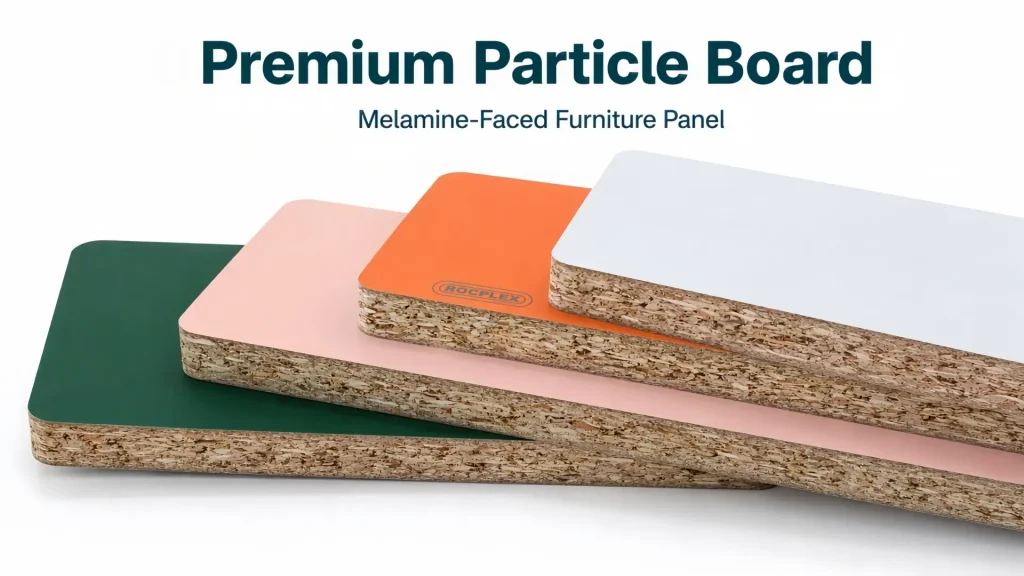
What is particle board? It is a wood panel made from small wood particles, resin and heat. The mill presses these parts into a flat sheet. Fine particles form the faces, while larger particles form the core.
Particle board is not MDF, OSB or plywood. MDF uses wood fibres. OSB uses long wood strands. Plywood uses thin wood veneers. So, each panel cuts, bends, holds screws and reacts to water in its own way.
Particle board is often sold as a low-price furniture board. But price is only one part of the choice. The grade, core, face, edge band and fittings must suit the final job. Also, the answer to what is particle board must state the final use.
What Is Particle Board in One Clear Answer
Particle board works best as part of a planned indoor furniture system. It gives plants flat sheets, steady thickness and good cutting yield. It also provides a smooth base for melamine, laminate, veneer and other finishes.
In practice, the board and its fittings must work together. For example, a wardrobe side and a long shelf may come from the same sheet. Yet the shelf must resist long-term sag, while the wardrobe side must hold hinges and connectors.
Standard furniture grades are not waterproof. They are also not structural sheets. For current raw and finished options, buyers can review the ROC particle board range.
How Particle Board Structure Controls Results
A simple edge view helps answer what is particle board. It is a layered sheet, not a solid block.
A flat-pressed sheet is not the same from face to core. First, the mill places fine particles on the two faces. Next, it places larger particles in the middle. The hot press then makes the face zones denser than the core.
The USDA Wood Handbook chapter on wood-based panels describes this fine-face and coarse-core build. As a result, the panel has a smooth face for a finish and a lighter core for cost and weight control.
| Board zone | Main job | Buyer check |
|---|---|---|
| Fine face particles | Form a smooth, closed surface | Clean finish with little show-through |
| Dense face zone | Add face hardness and bending strength | Smooth cutting and firm face fixing |
| Larger core particles | Form the body of the sheet | Core bond and edge screw holding |
| Cut edge | Holds fittings and takes in water first | Chipping, swelling and edge strength |
Resin and wax run through every zone. Yet their spread may not be equal in a poorly made sheet. So, two boards with the same mean density may not give the same result.
Average density is only a starting check. Particle size, face density, core bond and resin spread decide how the sheet works.
What Is Particle Board Made From at the Mill
The raw mix may include clean wood chips and sawmill by-products. The mill must remove bark, dirt and metal. It must also control particle size and moisture before pressing.
- First, the mill cleans and cuts the wood. Clean raw wood protects tools and helps the board stay even.
- Next, screens sort the particles by size. Fine parts go to the faces, while larger parts go to the core.
- Then, the mill adds resin and wax. Resin bonds the wood. Wax slows short-term water take-up.
- After that, forming heads build the mat. They place each particle group in the right zone.
- The hot press then sets the bond. Heat, time and pressure shape the density profile.
- Last, the board cools, rests and gets sanded. The mill then cuts it to the stated size.
Sanding helps the mill reach the right thickness. But too much sanding can remove part of the dense face. The sheet may look smooth but have a weaker surface.
For this reason, one good sample does not prove steady bulk supply. Repeat orders need control of the wood mix, resin dose, press cycle, moisture and final sanding.
Where Particle Board Creates Real Value
Particle board gives the best value when a part needs a flat face and a set finish. It also works well when the edge will be banded and hidden.
A clear answer to what is particle board used for starts with the parts below.
| Furniture part | Why the board fits | Main risk to control |
|---|---|---|
| Cabinet and wardrobe sides | Flat sheet with a ready finish | Hinge zones, edge band and water risk |
| Office and flat-pack furniture | Steady drilling and low waste | Fitting type and repeat assembly |
| Shelves | Good face yield at a fair cost | Span, load, thickness and sag |
| Worktop base | Thick, flat support under laminate | Sink cut-outs and sealed edges |
| Retail and wall panels | Wide choice of colours and textures | Fire rule, fixing and impact |
Particle board price should be compared at the finished-part level. For example, a cheap raw sheet may need more sanding, more edge work or a better fitting. It may also create more cutting waste. So, buyers should compare the cost of the finished part, not only the sheet price.
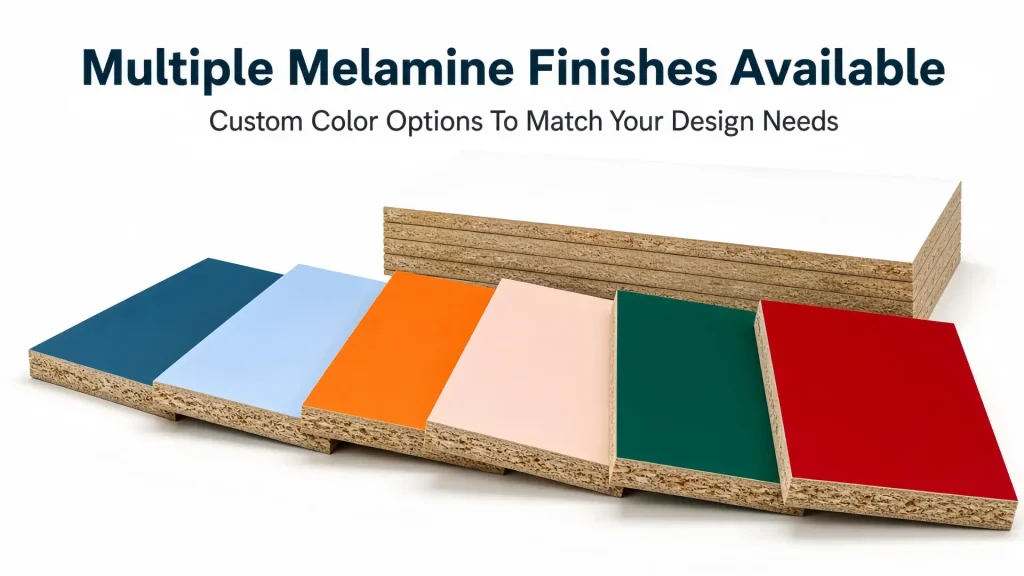
Melamine faced chipboard can remove a few finishing steps. But the melamine face cannot repair a weak core. It also cannot seal drilled holes or raw cut edges.
Particle Board Moisture Edge and Load Limits
Water enters through cut edges
Standard furniture board is made for dry indoor use. When water reaches a raw edge, the wood parts swell. Some of that swell may remain after the board dries.
As a result, a small leak can damage the edge before the broad face looks wet. A humid-use grade can lower the risk. Still, it is not an outdoor or waterproof sheet.
So, buyers should seal sink cut-outs, back edges and drilled holes where needed. They should also keep the pallets dry during storage and shipping.
Screws load the core
Face fixing and edge fixing are not the same. A dense face may hold a face screw well. By contrast, a weak core may give poor edge holding.
Particle-board screws, confirmat screws, inserts and cam fittings can all work. Still, the right choice depends on board thickness, edge distance and load. For high-load fittings, test the real board with the real fitting.
Edge banding protects and finishes the edge. But it does not make a weak core strong.
Shelves sag over time
A short factory test may show no sag. Yet a shelf can bend after months under load. Span, thickness, load, heat, moisture and support all affect the result.
So, “18 mm is enough” is not a full shelf spec. The buyer must state the shelf size, load and support layout.
Furniture board is not always structural board
Some stated particleboard grades can carry building loads. But normal furniture board should never be treated as a structural sheet. Structural use needs a named grade, design data and local approval.
Particle Board Grades Buyers Should Name
EN 312 groups particleboards by their stated use. The type number gives far more value than claims such as “high quality” or “moisture proof.”
| EN 312 type | Stated use | Main limit |
|---|---|---|
| P1 | General use in dry areas | Not a furniture strength claim |
| P2 | Indoor fittings and furniture in dry areas | Non-load-bearing |
| P3 | Non-load-bearing use in humid areas | Moisture-resistant, not waterproof |
| P4 | Load-bearing use in dry areas | Building design is still needed |
| P5 | Load-bearing use in humid areas | Moisture and load rules both apply |
| P6 | Heavy load-bearing use in dry areas | Higher stated duty |
| P7 | Heavy load-bearing use in humid areas | Highest duty in this EN 312 group |
A green core is not proof of a humid-use grade. Instead, the grade report and lot records prove what the board is.
Why P2 needs a full name
The term P2 can cause a costly order error. EN 312 Type P2 means an indoor, non-load-bearing furniture panel. CARB Phase 2 is a formaldehyde rule for California. They test separate things.
So, never write only “P2” on an order. Write “EN 312 Type P2” or “CARB Phase 2 and EPA TSCA Title VI compliant,” based on the real need.
Why Density Alone Cannot Prove Quality
Many buyers weigh one sheet and treat the result as a pass or fail score. But a heavier board is not always better. Extra weight can raise freight and handling cost without improving the core bond.
Instead, match each test to the final part:
- Check mean density and sheet weight to track mill control.
- Check internal bond to judge core strength.
- Check bending strength and stiffness for shelves.
- Check face and edge screw holding with the planned fittings.
- Check thickness swell for the stated moisture grade.
- Check flatness and thickness before adding a finish.
- Last, cut and drill the sample with the buyer’s own tools.
This is why what is particle board cannot be answered by one density figure. In other words, the right test list comes from the job the board must do.
Particle Board Emission Rules Need Exact Evidence
Low-emission terms need a full standard and valid test report. For example, “E0,” “E1,” “eco board” and “low formaldehyde” do not state the test method on their own.
For the United States, EPA guidance for composite wood products sets a TSCA Title VI limit of 0.09 ppm for particleboard. Also, a panel or bundle label must show the producer, lot number, approved third-party certifier number and compliance statement.
For the European Union, Commission Regulation EU 2023/1464 applies from 6 August 2026. Under its stated test terms, furniture and wood-based articles must not exceed 0.062 mg/m³, subject to the rule’s scope and exemptions.
Yet the US and EU figures use units and test terms that do not match. They also cover the market in separate ways. So, buyers should not convert one label into the other with simple maths.
How to Order and Check Particle Board
A clear order starts with the final part. Then it names the board, finish, edge and fitting system.
| Order line | What to state |
|---|---|
| Final part | Cabinet side, shelf, desk, worktop base or wall panel |
| Use area | Dry indoor, humid indoor or another stated setting |
| Standard and grade | Full standard name and type |
| Size | Length, width, finished thickness and allowed range |
| Face | Raw, melamine, veneer, laminate or coating |
| Strength checks | Core bond, bending, screw holding or swell as needed |
| Fittings and edges | Screw type, pilot hole, edge band and cut-out seal |
| Emission proof | Target rule, test method, labels and lot records |
| Packing | Dry pallets, wrap, corner guards, marks and loading plan |
Do not order “18 mm particle board, E1.” State the grade, final part, fitting, edge system, use area and target market.
Before bulk release, use the following checks:
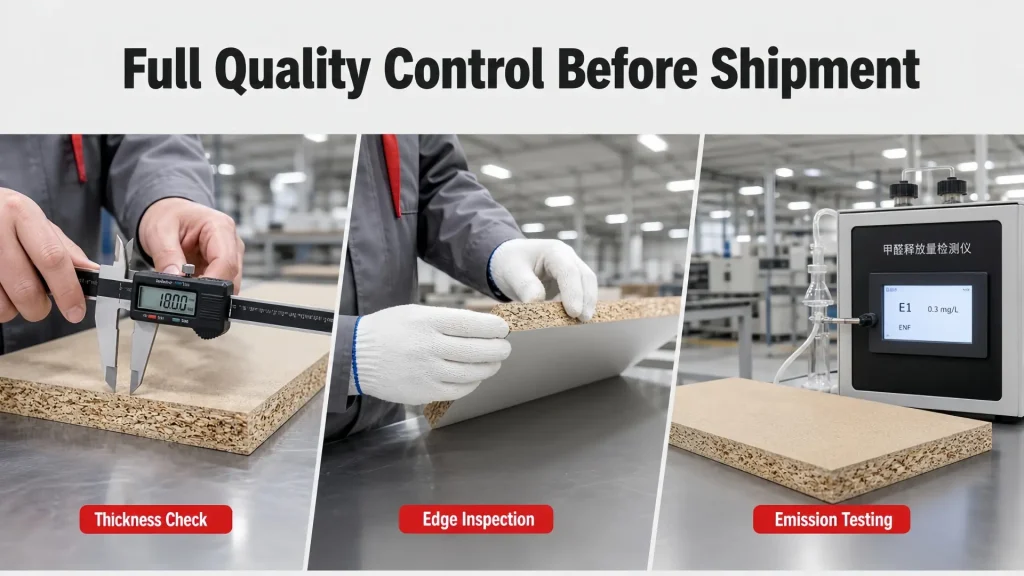
- First, match labels with reports. Check the mill, product, lot, grade and emission claim.
- Next, measure the full sheet. Check a few points, not only one corner.
- Then, compare sheet weights. Look for unusual changes within and between pallets.
- Also, read the cut edge. Check for weak zones, dirt, large pieces and an uneven build.
- After that, test the real fittings. Drill, tighten and cycle the fitting used by the customer.
- Last, trial the finish. Cut, laminate and edge-band sheets with normal mill settings.
A quick water test can reveal a weak detail. But it cannot replace a lab test made to the stated standard. Also, buyers should take samples from more than one pallet position.
What Is Particle Board Best Suited For
Particle board is a sound choice for dry indoor parts that need flatness, a finished face and steady cutting. A stated humid-use grade may suit damp indoor areas when every cut edge receives proper care.
But another board may work better when the part needs exposed edges, frequent screw removal or high impact strength. A stronger shelf at the same thickness may also need a stronger panel. The plywood and particle board comparison explains those choices by furniture part.
In many cases, one product should use more than one panel. For example, particle board may suit a melamine carcass. MDF may suit a routed painted door. Plywood may suit a narrow rail that carries more load.
So, good buying does not force one board into every part. It places each board where its own build gives the best result.
Frequently Asked Questions
What is particle board made from?
Particle board is made from small wood particles, resin and usually wax. The mill sorts the particles, forms a mat, hot presses it, sands it and cuts it into sheets.
Is particle board the same as chipboard?
In many furniture markets, both names mean the same wood panel. But “chipboard” can also mean a paper-based board in North America. Export orders should use “wood particleboard” and name the standard.
Is particle board good for cabinets?
Yes. A suitable furniture grade works well for cabinet and wardrobe bodies. But hinges, shelves, sink areas and repeat assembly need the right fittings and edge care.
Is particle board waterproof?
No. Humid-use grades resist damp air better than standard grades. But raw edges and holes still need sealing against water.
What makes one particle board better than another?
Good board needs clean wood, the right particle sizes, an even resin spread, a strong core and steady pressing. Also, the stated grade must stay stable across the full order.
Does melamine make particle board waterproof?
No. Melamine protects the broad faces from normal wear and brief water contact. But it does not seal joints, drilled holes or cut edges.
What should an importer request before ordering?
Request the full grade, size range, strength data, emission proof, face details, fitting test, edge plan, lot records and packing plan. Also, approve a sample taken from normal bulk work.
Specify the Job Before the Sheet
What is particle board in buying terms? It is a flat wood panel that works well when the grade, face, edge and fittings form one planned system. Its low price can help. But steady results create the real value.
ROC can help importers, panel sellers and furniture plants review raw or melamine faced particle board. Support can cover samples, order checks, packing and container plans. Buyers can also return to the engineered wood Resources centre for related panel guidance.
Send the final part, size, thickness, face, target grade, market, fittings, quantity and port.
Email: roc@plywood.cn
WhatsApp or Call: +86 15152013388
Post time: Aug-31-2026