

What is plywood? It is an engineered wood panel made from thin wood veneers bonded together in layers. In most sheets, each veneer layer runs across the grain direction of the next layer. This cross grain structure helps the panel stay strong, flat, and stable.
For global buyers, this material is more than a simple board. It affects furniture quality, formwork results, export safety, cabinet finish, project cost, and supply stability. A buyer who only checks size and price may miss the real value of the sheet.
A good panel depends on its face, core, glue, moisture level, thickness tolerance, sanding, edge condition, pallet strength, and loading plan. These details decide how the sheet cuts, holds screws, resists damage, and performs in use.
Quick Answer for Buyers
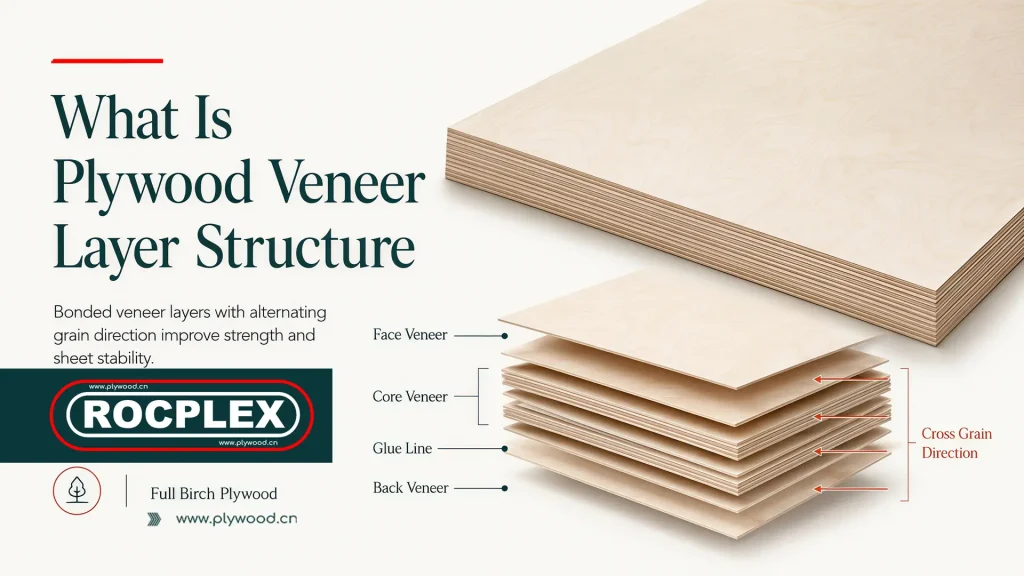
This type of panel is made from bonded veneer layers. Its crossed grain layout improves strength, balance, and sheet stability. Buyers use it for furniture, cabinets, formwork, export cases, flooring, wall panels, marine work, transport floors, and many construction uses.
What a Plywood Sheet Is Made From
The product starts with veneer. A veneer is a thin sheet of wood peeled or sliced from a log. These veneers are dried, sorted, glued, and pressed together to form a finished panel.
The visible top layer is the face veneer. The bottom layer is the back veneer. The inner layers form the core. Glue lines bond the layers into one panel. The edge shows the full layer structure.
Most sheets have an odd number of layers. Common structures include 3 ply, 5 ply, 7 ply, 9 ply, and 11 ply. More layers do not always mean better quality. Core quality, veneer thickness, layup control, and bond strength matter just as much.
Common core materials include poplar, eucalyptus, hardwood, birch, combi core, and full birch. A buyer should always ask what core is inside the sheet. Two panels with the same face can perform very differently if the core is different.
Key Parts of a Plywood Panel
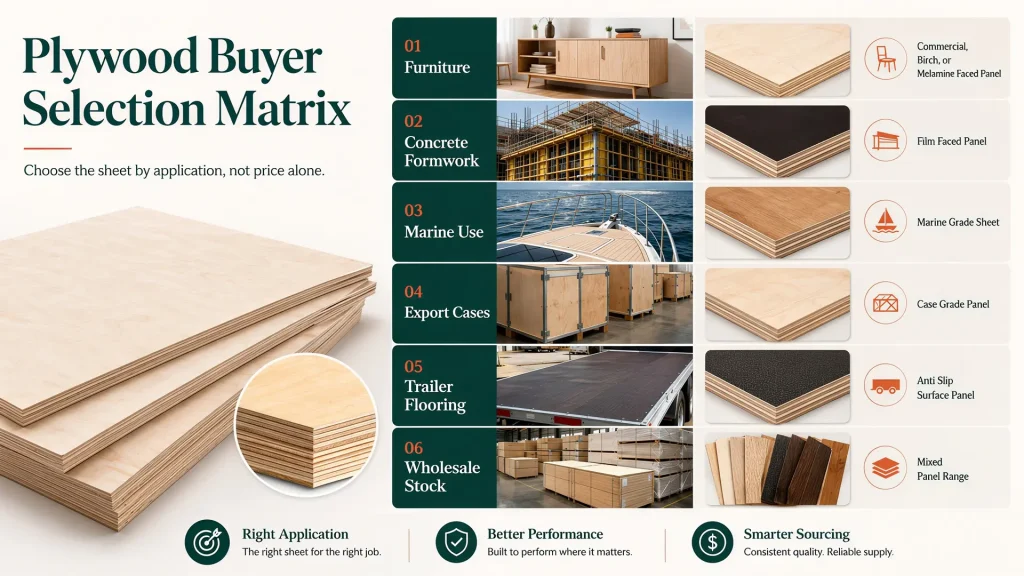
If you buy in bulk, learn the basic parts first. These terms help you compare offers with more control.
| Part | What it means | Why buyers should care |
|---|---|---|
| Face veneer | The front surface of the sheet | Controls appearance, sanding, painting, and visible grade |
| Back veneer | The rear surface of the sheet | Matters for two side use, panel balance, and quality control |
| Core | The inner layers of the panel | Affects strength, screw holding, cutting quality, and flatness |
| Glue line | The bond between veneer layers | Affects moisture resistance and delamination risk |
| Edge | The exposed side of the panel | Shows gaps, overlaps, voids, and layer quality |
| Thickness | The final panel thickness | Affects load, fit, machining, and container quantity |
This simple anatomy is useful during inspection. A buyer can learn a lot by checking the surface, edge, weight, thickness, moisture, and sample cutting result.
From Log to Finished Sheet
Production has many steps. Each one affects the final panel. A low price can hide risk if one step is poorly controlled.
- Log selection. Logs are selected by species, diameter, quality, and target product.
- Veneer peeling. Logs are peeled into thin layers.
- Veneer drying. Veneers are dried to a controlled moisture range.
- Veneer grading. Face, back, and core veneers are sorted by quality.
- Repair and jointing. Some veneers are repaired, clipped, or joined.
- Glue spreading. Glue is applied to form strong bonds between layers.
- Layup. Veneers are stacked with a planned grain direction and core structure.
- Hot pressing. Heat and pressure bond the sheet.
- Trimming and sanding. The panel is cut to size and sanded.
- Inspection and palletizing. Thickness, face, core, moisture, marks, and export pallets are checked.
Buyers often focus on the finished sheet. Manufacturers focus on the chain. If veneer drying, glue spread, press time, or core layup is weak, the final sheet may look fine at first but fail during use.
Why the Layered Structure Works
Wood is stronger along its grain than across it. This panel uses that fact in a smart way. By crossing the grain direction from layer to layer, it spreads stress across the sheet.
This structure helps resist splitting. It also helps the sheet hold shape better than a wide solid wood board. That is why it works well in large panels, furniture parts, formwork sheets, export cases, and floor bases.
The sheet also gives a useful balance of strength and weight. The exact result depends on species, veneer quality, glue, thickness, and grade. A full birch panel will not perform like a low cost case sheet. A film faced formwork panel will not perform like standard interior board.
The key point is simple. Strength comes from structure, not only from wood species. Buyers should judge the whole panel, not only the face veneer.
Main Plywood Product Types
Different panel types serve different buyer needs. The best choice depends on use, market, certificate rules, and cost target.
| Product type | Common use | Key buying point |
|---|---|---|
| Commercial plywood | Furniture, interior panels, cabinets, export cases | Check face grade, core quality, glue, and thickness |
| Birch plywood | Furniture, CNC cutting, drawers, fixtures, durable panels | Check whether it is full birch or birch face only |
| Marine plywood | Boat work, wet areas, outdoor joinery, premium panels | Check waterproof bond, veneer quality, and standard claim |
| Film faced plywood | Concrete formwork and shuttering | Check phenolic film, core, glue, edge sealing, and reuse cycles |
| Structural plywood | Construction, flooring, roofing, bracing | Check structural rating and market standard |
| Melamine plywood | Cabinets, shelves, wardrobes, interior furniture | Check surface color, scratch resistance, core, and edge quality |
| Anti slip plywood | Trailer floors, truck floors, platforms, walkways | Check surface pattern, wear layer, bonding, and slip need |
| Case grade plywood | Crates, pallets, export boxes, machine protection | Check cost, basic strength, moisture, and loading safety |
One mistake is to ask for the “best board” without naming the job. There is no single best sheet for all uses. A good supplier should help match product structure to the final application.
Common Uses by Industry
This panel is widely used because it gives strength, sheet size, workable surface, and cost balance. Furniture factories use it for cabinets, drawers, shelves, bed frames, tables, and shopfitting.
Construction buyers use it for wall panels, flooring bases, roof support, bracing, and temporary work. Formwork contractors use film faced panels to cast concrete. They care about panel strength, film release, edge sealing, glue bond, and reuse.
Export buyers use the material for crates, pallets, and machine cases. They care about cost, weight, load safety, and damage risk. Interior contractors use it for wall panels, partitions, doors, decorative bases, and backing panels.
Transport buyers use anti slip and heavy duty panels for trailers and truck floors. Marine and exterior users need stronger bonding, better veneer quality, and good edge protection.
How Plywood Compares With Other Panels
This sheet belongs to a wider wood panel family. Buyers often compare it with MDF, OSB, particle board, and solid wood. Each product has its own strength.
| Material | Best at | Common limit | Buyer note |
|---|---|---|---|
| Plywood | Strength, screw holding, sheet stability, broad use | Price varies with core, glue, and grade | Best when structure and durability matter |
| MDF | Smooth surface, painting, routing, cabinet doors | Moisture risk and heavy weight | Good for painted furniture and interior use |
| OSB | Roof sheathing, wall sheathing, structural panel use | Rougher surface than plywood | Often chosen for cost effective building panels |
| Particle board | Low cost furniture panels and melamine boards | Lower screw holding and edge strength | Common in flat pack furniture and shelves |
| Solid wood | Natural appearance, machining, premium joinery | Movement, knots, size limits, higher waste | Best for visible timber parts and premium work |
The layered sheet is often safer when buyers need strength, screw holding, and panel balance. MDF may be better for painted surfaces. OSB may fit sheathing. Particle board may fit cost driven furniture. Solid wood may fit visible timber parts.
For product range planning, wholesalers often need more than one material. A plywood product range can be supported by OSB board, MDF board, particle board, and LVL timber for wider market coverage.
Plywood Buyer Selection Matrix
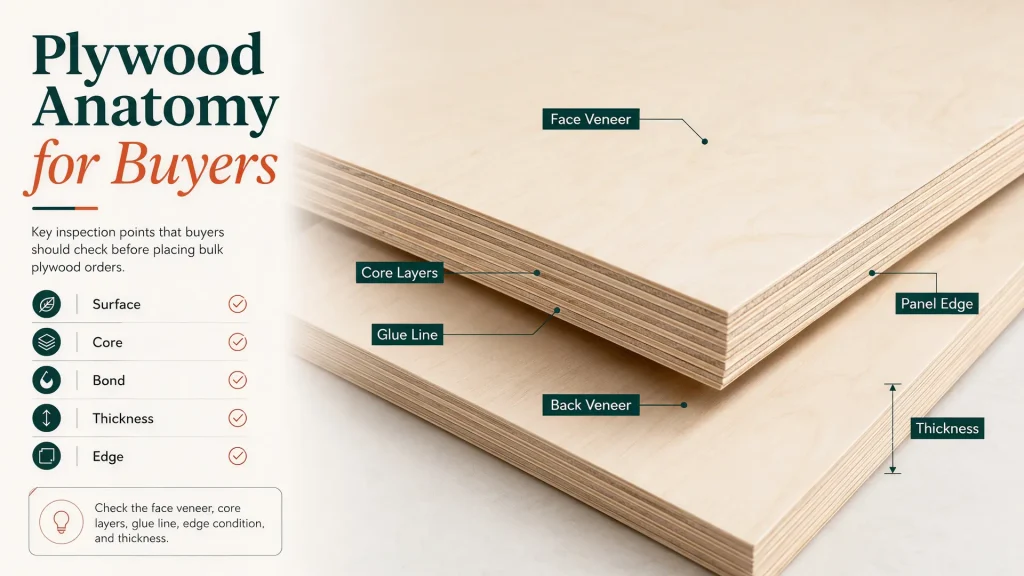
Start with the final use. Then work back to sheet structure. This is better than starting with price alone.
| Buyer need | Better choice | Why it fits |
|---|---|---|
| Cabinet boxes | Commercial grade, birch, or melamine faced panel | Stable core, workable surface, good screw holding |
| Painted furniture | Birch sheet or MDF depending on design | One gives strength, the other gives smooth painting |
| Concrete formwork | Film faced panel | Film surface, sealed edges, strong core, repeat use |
| Wet or marine use | Marine grade sheet | Better bond quality and veneer control |
| Export cases | Case grade panel | Cost balance, basic strength, crate performance |
| Trailer flooring | Anti slip surface panel | Wear surface and safer walking grip |
| Wholesale stock | Mixed panel range | Serves furniture, building, export, and project buyers |
When comparing two offers, ask for the full spec. Size and price are not enough. You need thickness, tolerance, core species, face grade, glue type, emission class, moisture range, pallet plan, marks, and certificates.
Quality Checklist for Wholesale Orders
A clear checklist helps reduce complaint risk. This is useful for importers, distributors, builders, formwork buyers, and furniture factories.
- Application: Confirm the final use before choosing the sheet.
- Size: Check length, width, squareness, and market size needs.
- Thickness: Confirm actual thickness and tolerance.
- Face grade: Check color, repairs, sanding, splits, and patches.
- Core quality: Check gaps, overlaps, voids, and layer balance.
- Glue: Confirm MR, WBP, phenolic, melamine, or emission class.
- Moisture: Check moisture range before palletizing and shipment.
- Bonding: Ask how glue bond is tested or controlled.
- Edges: Check edge damage, sealing, and visible core defects.
- Export protection: Confirm pallet strength, wrapping, straps, marks, and loading plan.
- Documents: Check invoice, pack list, certificate, and shipping documents.
This checklist is especially important for repeat orders. A buyer may accept small defects in a one time shipment. A wholesaler cannot accept batch to batch instability. Stable control protects brand trust.
Common Sourcing Mistakes
Many panel problems begin before production. They begin with unclear buying terms.
- Only comparing sheet price. A cheaper sheet can cost more if defect rate is high.
- Ignoring core quality. Good face veneer cannot fix weak core layup.
- Not checking glue type. Wrong glue can cause moisture and bond issues.
- Ignoring thickness tolerance. Poor tolerance can slow furniture and site work.
- Skipping sample checks. Samples help confirm structure before bulk order.
- Not confirming export pallets. Weak pallets can damage edges during transport.
- Using one sheet type for every job. Different uses need different panels.
The best order is not always the lowest priced order. It is the order that matches the job, arrives safely, cuts well, performs well, and reduces complaints.
How ROC Supports Global Buyers
ROC works as a plywood led engineered wood supply platform. The main product axis is supported by OSB, MDF, particle board, LVL timber, H20 beams, I joists, and other engineered wood products for wider project and wholesale needs.
For buyers, ROC focuses on product matching, clear specs, inspection, pallet safety, and export supply. The goal is not only to quote a sheet price. The goal is to help buyers choose a panel that fits the market and reduces order risk.
A furniture buyer may need better face and stable machining. A formwork buyer may need film faced panels with strong core, phenolic bond, and sealed edges. A distributor may need a stable product range across several sizes and grades. A project buyer may need certificates, loading data, and repeat supply.
This is where a supplier should add value. Good supply means clear specs, stable output, strict checks, safe pallets, correct documents, and fast response when a buyer needs support.
FAQ
What is plywood made of?
It is made of thin wood veneers bonded together in layers. Most sheets use a cross grain structure for better strength and stability.
Is a plywood panel stronger than MDF?
It usually has better screw holding and impact strength than MDF. MDF is often better for smooth painted surfaces and routed designs.
Which plywood sheet is best for furniture?
Birch, commercial, hardwood, and melamine faced sheets are common furniture choices. The best option depends on surface, core, finish, and cost.
Which type is best for concrete formwork?
Film faced panels are commonly used for concrete formwork. Buyers should check film quality, core strength, glue bond, edge sealing, and reuse performance.
Can the sheet be used outdoors?
Some sheets can be used outdoors if they have suitable glue, surface protection, and edge sealing. Always match the product to the exposure level.
How should wholesale buyers choose the right grade?
Start with application, size, thickness, core, glue, grade, and certificates. Then check samples, pallets, loading plan, and supplier quality control.
Practical Sourcing Advice
At its simplest, this material is a bonded veneer panel. In real buying, it is a product system. The face, core, glue, moisture, thickness, export protection, and supplier control all decide how the sheet performs.
If you are building a panel range, start with the job your customer needs to solve. Then choose the right type, grade, core, glue, and thickness. Use samples and checks to confirm the structure before container orders.
For more product support, visit the Resources center, review plywood products, or compare options with OSB board, MDF board, and LVL timber. To request a quote, send your size, thickness, grade, quantity, destination port, and certificate needs through the contact page.
Official References for Further Reading
Post time: Jun-05-2026