

Plywood vs MDF is one of the most common questions in wood panel buying. Both products are widely used in furniture, cabinets, wall panels, shelves, doors, shopfitting, and interior projects. Yet they are not the same material, and they do not solve the same problems.
Plywood is made from thin wood veneers bonded in layers. MDF is made from wood fibres bonded with resin and pressed into a dense, smooth board. This difference in structure affects strength, screw holding, surface finish, moisture resistance, weight, machining, cost, and final use.
For global buyers, the better choice depends on the application. Plywood is often better when strength, screw holding, edge durability, and lower weight matter. MDF is often better when a smooth painted surface, routing, and low cost interior furniture are more important.
Quick Answer for Buyers
Plywood is usually the better choice for strength, screw holding, structural furniture parts, shelves, formwork, packing, and panels that need better edge performance. MDF is usually the better choice for smooth painted cabinet doors, routed profiles, decorative panels, and low cost interior furniture where moisture exposure is limited.
What Plywood Is
Plywood is an engineered wood panel made from veneer layers. Each veneer is a thin sheet of wood. These layers are bonded together under heat and pressure. In most plywood sheets, the grain direction changes from one layer to the next.
This crossed grain structure gives plywood good strength, balance, and sheet stability. It also helps the panel resist splitting better than many solid wood boards. The final performance depends on core species, face grade, glue type, veneer quality, thickness, and factory control.
Common plywood types include commercial plywood, birch plywood, marine plywood, film faced plywood, structural plywood, melamine plywood, anti slip plywood, and packing plywood. Buyers can review the broader product family in the types of plywood guide.
What MDF Board Is
MDF means medium density fibreboard. It is made from wood fibres, resin, and wax. These materials are pressed into a dense board with a smooth surface and uniform structure.
MDF does not have visible veneer layers like plywood. Its structure is more even from face to core. This makes it useful for painting, routing, cutting decorative profiles, and producing cabinet doors or interior panels with a smooth finish.
However, standard MDF can be heavy. It also needs good edge sealing and surface protection when used in areas with moisture risk. Buyers should match MDF grade, density, thickness, and emission class with the final market need. ROC also supplies MDF board for buyers who need smooth interior panel solutions.
Plywood and MDF Structure Comparison
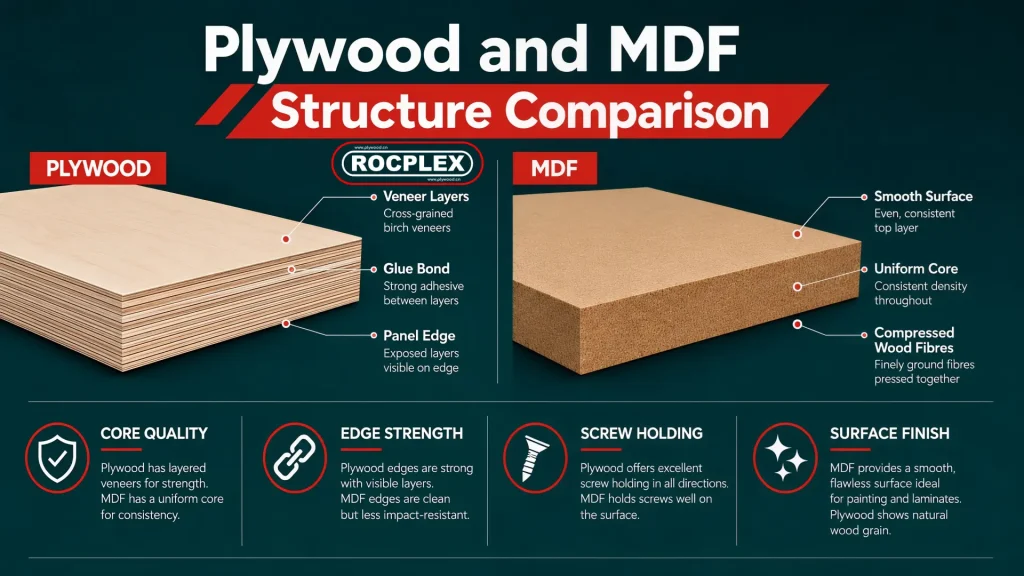
The main difference starts inside the board. Plywood has layered veneers. MDF has compressed fibres. This structure decides how each panel behaves during cutting, screw fixing, painting, transport, and long term use.
| Factor | Plywood | MDF | Buyer meaning |
|---|---|---|---|
| Core structure | Layered wood veneers | Compressed wood fibres | Plywood is more structural. MDF is more uniform. |
| Surface | Wood veneer or finished surface | Smooth fibre surface | MDF is often easier to paint. |
| Edge | Visible layers | Smooth but absorbent edge | Plywood edges can be stronger. MDF edges need sealing. |
| Screw holding | Usually stronger | Moderate, weaker at edges | Plywood suits hardware and load points better. |
| Weight | Varies by core | Often heavier | MDF may increase handling and freight weight. |
| Moisture risk | Depends on glue and grade | Standard MDF is moisture sensitive | Both need correct grade for wet areas. |
Strength and Load Performance
Plywood is usually stronger than MDF when panels must carry load, resist impact, or hold fasteners. Its veneer layers spread stress across the sheet. Better grades can also offer good bending strength and edge durability.
This makes plywood a strong choice for shelves, cabinet carcasses, drawer boxes, bed frames, platform parts, wall backing, crates, and formwork panels. In these uses, buyers often care about screw holding, bending resistance, and edge strength.
MDF can still be strong enough for many interior products. It works well in cabinet doors, decorative panels, wall linings, furniture parts, and painted components. Yet it is usually not the best option where the panel edge must carry heavy screws or repeated stress.
Screw Holding and Hardware Fixing
Screw holding is a major issue in furniture and cabinet buying. Hinges, drawer slides, handles, brackets, and shelf pins all place stress on the board. Poor screw holding can lead to returns and complaints.
Plywood usually performs better with screws, especially near panel edges. The veneer layers give screws more structure to grip. This is useful for cabinet boxes, transport cases, furniture frames, and panels that need repeated assembly.
MDF can hold screws well on the face when the right screw and pilot hole are used. Edge fixing needs more care. MDF edges can split, crumble, or weaken if fasteners are poorly placed. Buyers should test the exact hardware before bulk production.
Surface Finish and Painting
MDF has a clear advantage for smooth painting. Its surface is even and has no natural grain pattern. It is widely used for painted cabinet doors, routed profiles, wall panels, decorative mouldings, and interior furniture parts.
Plywood can also be painted or laminated, but veneer grain, face repairs, patches, and core quality can affect the final finish. Higher grade plywood, birch plywood, and prefinished plywood can give a better surface, but the cost may be higher.
For visible natural wood appearance, plywood may be the better choice. For a flat painted look, MDF often gives a cleaner result with less surface preparation.
Moisture Resistance and Durability
Moisture performance depends on grade, glue, surface protection, and edge sealing. Standard plywood and standard MDF are not the same as exterior or moisture resistant grades.
Plywood can perform well in tougher conditions when it uses suitable glue, good core control, sealed edges, and the right grade. Marine plywood, exterior grade plywood, and film faced plywood are selected for higher moisture risk or demanding use.
Standard MDF is more sensitive to water. It can swell if moisture enters the surface or edges. Moisture resistant MDF can improve performance, but it still needs correct use, sealing, and market grade checks.
Buyers should not choose by product name alone. They should confirm exposure level, glue type, emission class, surface finish, edge sealing, and test requirements before placing container orders.
Weight and Handling
Weight affects transport, warehouse handling, installation speed, and labour cost. MDF is often heavier than many plywood panels of the same thickness. This can matter in cabinets, wall panels, furniture, and container loading.
Plywood weight varies by core. Poplar plywood is lighter. Hardwood and birch plywood are heavier and stronger. MDF density can also vary, but buyers should expect higher weight in many standard boards.
For high volume orders, weight affects freight planning, pallet strength, forklift handling, and unloading safety. It should be part of the buying decision, not an afterthought.
Cutting and Machining
MDF cuts and routes cleanly when the right tools are used. It is popular for shaped cabinet doors, profiles, grooves, and painted decorative parts. Its uniform fibre structure makes routing more predictable.
Plywood cutting quality depends on face veneer, core quality, glue line, and saw blade. Good plywood can cut cleanly. Poor core panels may show gaps, overlaps, rough edges, or tear out.
For CNC work, buyers should test samples. A low cost sheet may save money at purchase but create waste during cutting. Stable machining matters more than the first quoted price.
Cost and Total Value
MDF is often cheaper than high grade plywood for smooth interior furniture parts. This makes it popular in cost sensitive cabinet lines, shelves, painted doors, and decorative panels.
Plywood may cost more, but it can offer better strength, screw holding, lighter handling, edge performance, and durability. In some applications, the higher sheet price can reduce failures and complaints.
Buyers should compare total value, not sheet price alone. The real cost includes cutting yield, defect rate, labour, hardware failure, transport damage, moisture risk, customer claims, and repeat order stability.
Best Uses for Each Panel
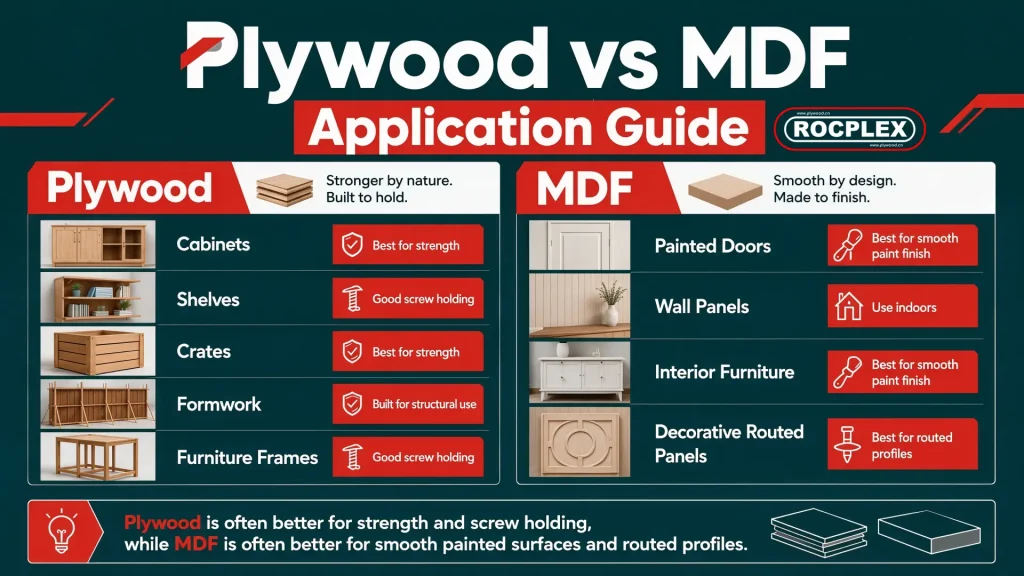
The best choice depends on where the panel will be used. The table below gives a practical buyer view.
| Application | Better choice | Reason |
|---|---|---|
| Cabinet carcasses | Plywood or MDF | Plywood for strength. MDF for low cost interior use. |
| Painted cabinet doors | MDF | Smooth surface and clean routed profiles. |
| Heavy shelves | Plywood | Better bending resistance and screw holding. |
| Wall panels | Plywood or MDF | MDF for smooth finish. Plywood for stronger backing. |
| Furniture frames | Plywood | Better fastener strength and impact resistance. |
| Decorative mouldings | MDF | Easy routing and painting. |
| Crates and export cases | Plywood | Better structure and impact resistance. |
| Wet areas | Suitable plywood grade or moisture resistant MDF | Grade, glue, and sealing must match exposure. |
| Concrete formwork | Film faced plywood | Designed for concrete surface and site use. |
| Wholesale stock range | Both | Different customers need different panel solutions. |
Buyer Decision Matrix
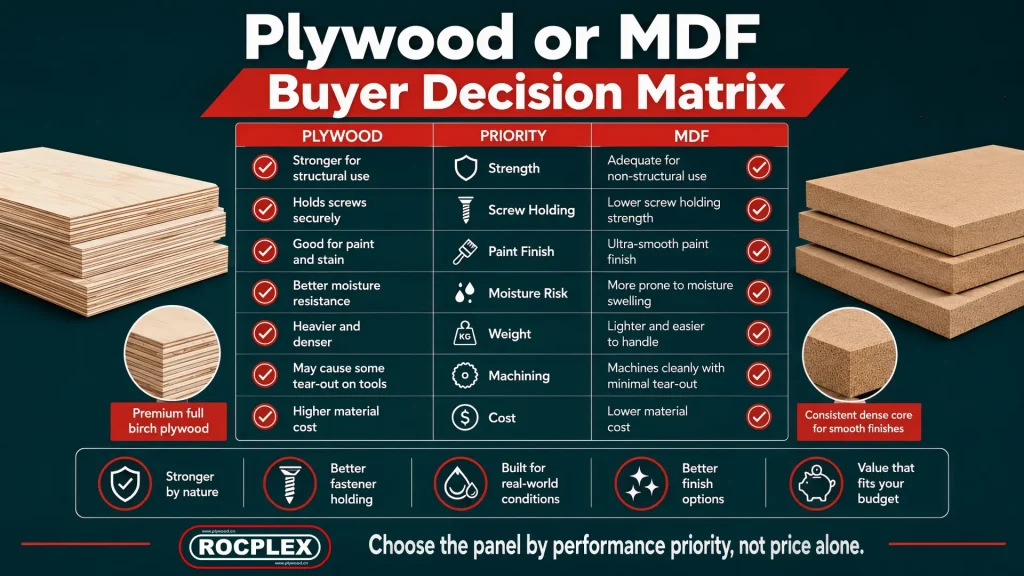
A good sourcing decision starts with the final job. Buyers can use this matrix before asking for prices.
| Buyer priority | Choose plywood when | Choose MDF when |
|---|---|---|
| Strength | The panel carries load or impact | The part is decorative or lightly loaded |
| Screw holding | Hardware fixing and edge screws matter | Face fixing is enough and edges are protected |
| Paint finish | A natural or laminated wood surface is acceptable | A smooth painted finish is the main goal |
| Moisture risk | A suitable plywood grade is available | Moisture resistant MDF fits the use and is sealed |
| Weight | Lighter handling is important | Extra weight is acceptable |
| Machining | Cut panels and structural parts are needed | Routing, shaping, and profiles are needed |
| Cost control | Long term failure risk matters more | Interior price point is the main concern |
Common Buyer Mistakes
Many panel claims start with the wrong product choice. The material may not be bad. It may simply be used in the wrong place.
- Using standard MDF in areas with moisture risk.
- Choosing low grade plywood only because the surface looks acceptable.
- Using MDF edges for heavy screw fixing without testing.
- Choosing plywood for painted routed doors when MDF may finish better.
- Comparing price without checking density, core, glue, and thickness.
- Ignoring weight when planning container loading and handling.
- Not checking emission class for furniture and interior markets.
- Skipping sample cutting before bulk orders.
These mistakes can reduce margin. They may also create waste, slow production, damage buyer trust, or lead to customer complaints.
Wholesale Sourcing Checklist
Before ordering plywood or MDF, buyers should confirm the full use case and quality target.
- Confirm the final application and exposure level.
- Confirm sheet size, thickness, and tolerance.
- Check plywood core species or MDF density.
- Confirm face grade, surface finish, or painting need.
- Check glue type, moisture resistance, and emission class.
- Test screw holding if hardware fixing is important.
- Cut samples to check edge quality and machining.
- Review pallet strength, wrapping, marks, and loading plan.
- Confirm certificates and documents before shipment.
- Compare total cost, not only sheet price.
How ROC Supports Panel Buyers
ROC works as a plywood led engineered wood supply platform. Plywood remains the main product axis, while MDF, OSB, particle board, LVL timber, H20 beams, I joists, and other products support wider buyer needs.
For panel buyers, ROC helps match the product to the application. A furniture factory may need smooth MDF for painted doors and stronger plywood for cabinet carcasses. A wholesaler may need both products to serve different customer groups. A project buyer may need plywood for strength and MDF for interior finish.
The goal is not only to quote a board price. The goal is to reduce sourcing risk through clear specs, stable quality, sample checking, export packing, and product matching.
For wider product knowledge, read what is plywood, types of plywood, and the Resources center. Buyers can also review plywood products, compare MDF board, or send sourcing details through the contact page.
FAQ
Is plywood better than MDF?
Plywood is usually better for strength, screw holding, shelves, frames, packing, and load bearing parts. MDF is often better for smooth painted surfaces and routed profiles.
Is MDF cheaper than plywood?
MDF is often cheaper than high grade plywood for interior furniture parts. The real value depends on application, waste, hardware performance, and complaint risk.
Which is better for cabinets?
Plywood is often better for cabinet boxes that need strength and screw holding. MDF is often better for painted cabinet doors and smooth decorative parts.
Which panel is better for shelves?
Plywood is usually better for heavy shelves because it has stronger bending resistance and better screw holding than standard MDF.
Can MDF be used in wet areas?
Standard MDF is not ideal for wet areas. Moisture resistant MDF may be used in suitable interior conditions if it is sealed and matched to the exposure level.
Which panel should wholesalers stock?
Many wholesalers stock both. Plywood serves strength and structural needs. MDF serves smooth interior, painted, and decorative panel needs.
Official References for Further Reading
Post time: Jun-11-2026