

Plywood vs OSB is a key question for builders, wholesalers, panel importers, furniture buyers, and project suppliers. Both are engineered wood panels. Both are used in construction, packaging, wall panels, flooring bases, roofing, and general panel work. Yet they are built in very different ways.
Plywood is made from thin wood veneers bonded in layers. OSB, or oriented strand board, is made from long wood strands arranged in layers and pressed with resin. This difference in structure affects strength, moisture behaviour, edge quality, surface finish, price, weight, fastener holding, and end use.
For global buyers, plywood vs OSB is not a simple price question. Plywood is often preferred when edge strength, appearance, screw holding, cutting quality, and broad application range matter. OSB is often preferred for cost effective sheathing, wall panels, roof decks, subfloors, packaging, and structural panel use where the rougher surface is acceptable.
Quick Answer for Plywood vs OSB Buyers
Plywood is usually better for stronger edges, better screw holding, smoother faces, furniture parts, formwork, crates, and panels that need cleaner cutting. OSB is often better for cost effective roof sheathing, wall sheathing, subfloors, packaging, and building panels where a strand surface is acceptable.
What Plywood Is
Plywood is an engineered wood panel made from veneer layers. Each veneer is a thin sheet of wood peeled or sliced from a log. These veneers are dried, graded, glued, and pressed together. In most plywood sheets, each layer runs across the grain direction of the next layer.
This crossed grain structure gives plywood good strength, balance, and sheet stability. It also helps reduce splitting and improves screw holding. The final panel quality depends on face grade, core species, veneer quality, glue type, thickness, moisture level, and factory control.
Plywood is used in furniture, cabinets, concrete formwork, structural work, packaging, flooring bases, wall panels, transport floors, and marine applications. Buyers can review the wider panel family in the types of plywood guide or start from what is plywood.
What OSB Board Is
OSB means oriented strand board. It is made from long wood strands bonded with resin and pressed into a panel. The strands are usually arranged in layers, with strand direction planned to improve panel strength and stiffness.
OSB has a clear strand pattern on the surface. It does not have veneer layers like plywood. Its surface is rougher, but its structure can be efficient for sheathing and building panel use.
Many buyers use OSB for roofing, wall sheathing, subfloors, temporary hoarding, packaging, and general construction panels. It is often chosen when cost control, large sheet supply, and structural sheathing performance are more important than a smooth decorative face. ROC also supplies OSB board for buyers who need engineered panel options beside plywood.
Plywood vs OSB Structure Comparison
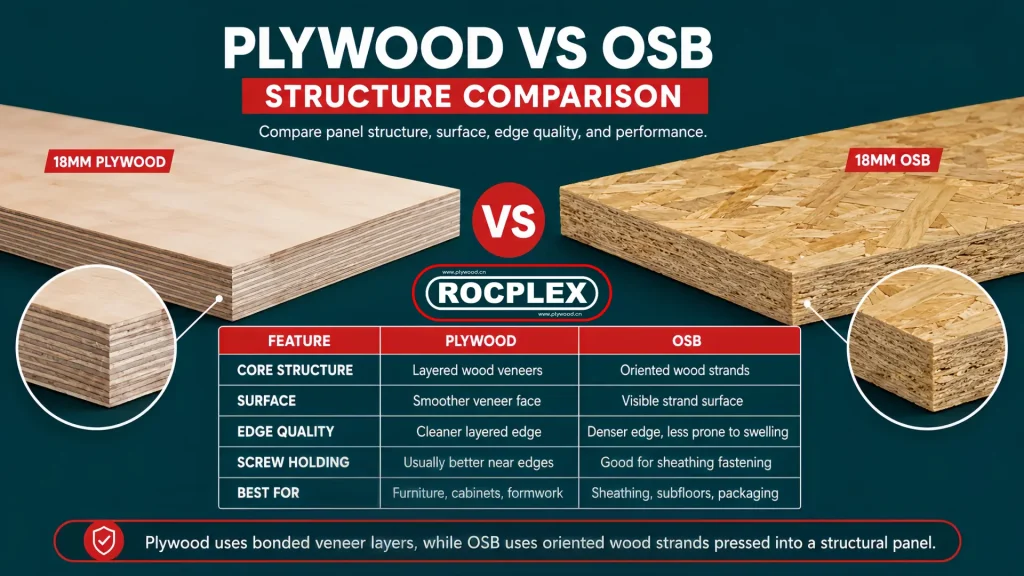
The biggest difference in plywood vs OSB starts inside the panel. Plywood uses continuous veneer sheets. OSB uses long wood strands. This structure changes how each board cuts, holds screws, handles edges, resists moisture, and performs in project use.
| Factor | Plywood | OSB | Buyer meaning |
|---|---|---|---|
| Core structure | Layered wood veneers | Oriented wood strands | Plywood has veneer layers. OSB has a strand based structure. |
| Surface | Wood veneer face or finished face | Visible strand surface | Plywood is better for cleaner visible use. OSB suits sheathing. |
| Edge | Layered edge with better cutting finish | Strand edge that can swell if wet | Plywood often gives better edge quality. |
| Strength | Strong across broad applications | Strong for sheathing and structural panels | Both can work well when grade matches use. |
| Screw holding | Usually better in edges and hardware points | Good for sheathing fastening when used correctly | Plywood is often safer for furniture and hardware fixing. |
| Cost | Often higher depending on grade | Often more cost effective | OSB can reduce cost in sheathing and packaging. |
Plywood vs OSB Strength and Structural Use
Both plywood and OSB can be used in structural applications when they meet the required grade and standard. The correct product must be selected for the project, not only by name.
Plywood has a long record in construction, formwork, flooring bases, bracing, transport floors, and many load related uses. Its veneer layers help spread stress across the panel. Good plywood also performs well when buyers need better edge strength and screw holding.
OSB is widely used for roof sheathing, wall sheathing, and subfloor panels. It can provide stable panel performance at a competitive cost. In many building systems, OSB is a practical choice when the grade, thickness, and installation method are correct.
In a plywood vs OSB structural comparison, the right answer depends on grade, span, load, fastening, moisture exposure, and local building rules. Buyers should not use general grade panels for structural jobs without checking compliance.
Plywood or OSB for Moisture Resistance and Edge Swelling
Moisture is one of the most important differences in real use. Both plywood and OSB can be affected by water if the wrong grade is used or if the panel is poorly protected. Yet their moisture behaviour is not the same.
Plywood can perform well in wet or demanding use when it has suitable glue, good veneer quality, proper core control, surface protection, and sealed edges. Marine plywood, exterior plywood, and film faced plywood are common choices for higher moisture risk.
OSB can be made for structural sheathing and building use, but its edges may swell if exposed to moisture for too long. Good installation, correct grade, dry storage, and edge protection are important. Buyers should confirm whether the OSB grade matches the exposure level.
For importers and project buyers comparing plywood vs OSB, moisture risk should be discussed before ordering. Ask about storage, shipment protection, jobsite exposure, and whether the panel will be covered quickly after installation.
Plywood Compared With OSB for Surface Finish
Plywood usually has a more suitable surface when appearance matters. The face can be sanded, veneered, laminated, filmed, melamine faced, or finished for furniture and visible panel work.
OSB has a visible strand surface. This can be acceptable for sheathing, packaging, hoarding, industrial panels, and some design projects. However, it is not usually chosen when the buyer needs a smooth furniture face or a clean painted cabinet surface.
If the final customer will see the panel, plywood is often easier to specify. If the panel will be hidden behind walls, roofs, floors, or packaging, OSB may offer a better cost balance.
Plywood vs OSB Screw Holding and Edge Quality
Screw holding matters in cabinets, furniture, crates, wall backing, floor bases, and construction panels. Plywood often has an advantage near edges because the veneer layers give screws more solid material to grip.
OSB can hold fasteners well in sheathing applications when fastener spacing, edge distance, and installation rules are followed. Yet its strand edge may not be as clean as plywood for furniture parts, repeated hardware fixing, or exposed edge details.
For buyers supplying furniture factories or packaging users, sample testing is important. Cut the board, fix screws near edges, check splitting, and review edge finish before bulk orders.
Weight and Handling
Weight depends on density, wood species, resin, thickness, and panel type. OSB can be heavy in some grades. Plywood can be light or heavy depending on whether the core is poplar, hardwood, eucalyptus, birch, or mixed veneer.
For builders, panel weight affects site handling. For importers, it affects container loading and pallet strength. For wholesalers, it affects warehouse storage and delivery cost.
Buyers should check actual weight per sheet or weight per cubic metre before ordering. This is especially important for container planning, manual handling, and heavy panel applications.
Cutting and Machining
Plywood often cuts cleaner than OSB when the panel has a good core and suitable face veneer. It is better for furniture parts, cabinet components, router work, edge finishing, and visible panel edges.
OSB can be cut for construction and packaging uses, but the strand edge is rougher. It may not be ideal for fine joinery or high appearance furniture parts. It works best when edge appearance is not the main concern.
For factories using CNC or repeated panel cutting, buyers should test cutting speed, edge quality, dust, tool wear, and rejection rate. A lower price can become expensive if machining waste is high.
Plywood vs OSB Cost and Total Value
OSB is often more cost effective than plywood in sheathing, roof deck, wall panel, packaging, and temporary construction uses. This makes it attractive for price sensitive projects.
Plywood may cost more, but it can deliver better edge quality, surface options, screw holding, appearance, moisture choices, and application range. In many uses, the higher panel price can reduce failures, improve finish, and lower complaint risk.
The right plywood vs OSB buying question is not only which board is cheaper. Buyers should ask which board gives the lowest total cost for the job. Total cost includes material price, cutting waste, labour, transport damage, site failure, customer claims, and resale speed.
Best Uses for Plywood and OSB Panels
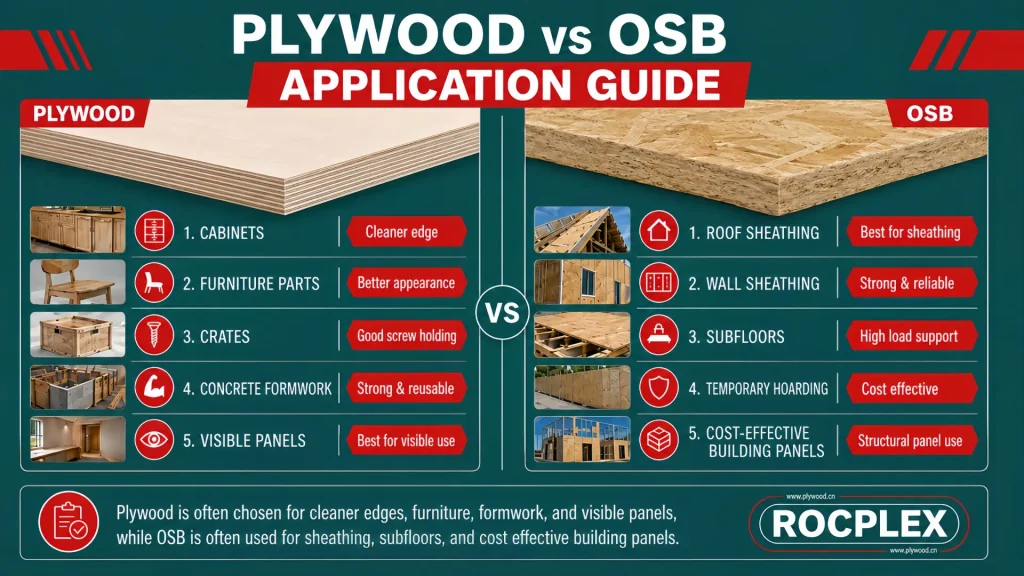
The table below gives a practical buyer view. The better choice depends on grade, thickness, moisture exposure, and final performance need.
| Application | Better choice | Reason |
|---|---|---|
| Roof sheathing | OSB or structural plywood | OSB is often cost effective. Plywood may offer better edge performance. |
| Wall sheathing | OSB or structural plywood | Both can work if grade and standard match the project. |
| Subfloor panels | OSB or plywood | Check stiffness, moisture exposure, and installation rules. |
| Cabinet boxes | Plywood | Better screw holding and cleaner edges. |
| Furniture parts | Plywood | Better machining, edge quality, and surface options. |
| Packaging and crates | Plywood or OSB | Plywood gives stronger edges. OSB can reduce cost. |
| Concrete formwork | Film faced plywood | Designed for concrete release, wet use, and repeat pours. |
| Temporary hoarding | OSB or plywood | OSB is cost effective. Plywood may last longer in tougher use. |
| Visible wall panels | Plywood | Better surface and finishing options. |
| Wholesale stock range | Both | Different customer groups need different panel solutions. |
Plywood or OSB Buyer Decision Matrix
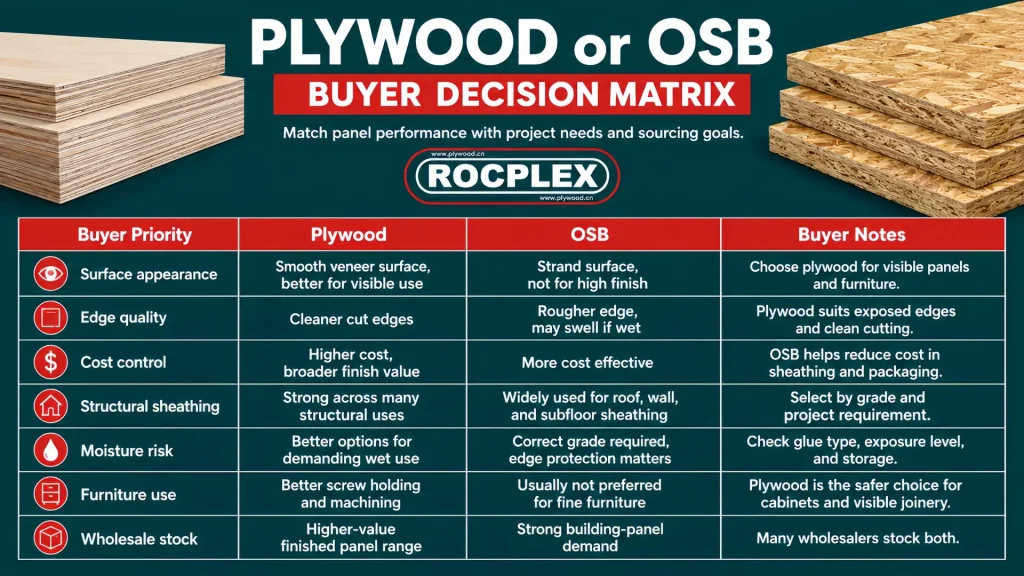
Buyers should start from the application, not the board name. This matrix can help before asking for prices.
| Buyer priority | Choose plywood when | Choose OSB when |
|---|---|---|
| Surface appearance | A cleaner face or finish is needed | The surface will be hidden or rough surface is acceptable |
| Edge quality | Cut edges will be visible or used for fixing | Edges will be covered or appearance is not important |
| Cost control | Failure risk and finish matter more than price | Low cost sheathing or packaging is the main need |
| Structural sheathing | Specification requires plywood or higher edge quality | OSB grade meets the project requirement |
| Moisture risk | A suitable plywood grade and sealed edge are available | Correct OSB grade is used and exposure is controlled |
| Furniture use | Screw holding, cutting, and edge quality matter | Rarely preferred unless hidden and low cost use is acceptable |
| Wholesale stock | Customers need furniture, formwork, or finished panels | Customers need building sheathing and low cost panels |
Common Plywood vs OSB Buyer Mistakes
Many panel problems happen because buyers use the wrong board for the job. The panel may not be defective. It may simply be mismatched with the application.
- Choosing OSB for visible furniture parts that need a clean finish.
- Choosing low grade plywood only because it looks better on the face.
- Using general panels in structural work without checking standards.
- Ignoring edge swelling risk in wet or exposed conditions.
- Comparing only sheet price instead of total job cost.
- Using one panel type for every customer group.
- Skipping sample cutting and screw testing before bulk orders.
- Forgetting pallet strength and moisture protection during shipment.
These mistakes can cause waste, slow installation, reduce resale value, and create claims. A clear specification reduces risk before production starts.
Wholesale Sourcing Checklist for Plywood and OSB
Before ordering plywood or OSB, buyers should confirm the final use and quality target. This is especially important for importers, distributors, builders, and project suppliers.
- Confirm whether the panel is for furniture, construction, packaging, or formwork.
- Confirm sheet size, thickness, tolerance, and squareness.
- Check plywood core species or OSB grade and density.
- Review surface need, edge quality, and cutting result.
- Confirm glue type, moisture resistance, and exposure level.
- Check strength or structural requirements for building use.
- Test screw holding and edge performance if hardware fixing matters.
- Review pallet strength, wrapping, marks, and loading plan.
- Confirm certificates and documents before shipment.
- Compare total cost by use, not only panel price.
How ROC Supports Plywood and OSB Buyers
ROC works as a plywood led engineered wood supply platform. Plywood remains the main product axis, while OSB, MDF, particle board, LVL timber, H20 beams, I joists, and other products support wider buyer needs.
For panel buyers, ROC helps match the product to the final application. A builder may need OSB for sheathing and plywood for stronger edge use. A furniture buyer may choose plywood for cabinet structure and avoid OSB for visible parts. A wholesaler may need both products to serve construction, packaging, and panel trade customers.
For buyers comparing plywood vs OSB, ROC can help review application, sheet size, thickness, grade, surface need, moisture risk, pallet strength, and loading plan. This reduces sourcing risk before production starts.
The goal is not only to quote a board price. The goal is to reduce sourcing risk with clear specs, stable quality, sample checking, export packing, and product matching.
For more product knowledge, read what is plywood, types of plywood, and plywood vs MDF. Buyers can also review plywood products, compare OSB board, or visit the Resources center.
Plywood vs OSB FAQ
Is plywood better than OSB?
Plywood is often better for edge strength, screw holding, appearance, furniture, formwork, and cleaner cutting. OSB is often better for cost effective sheathing and building panels.
Is OSB cheaper than plywood?
OSB is often cheaper than plywood in sheathing and packaging uses. The best value depends on grade, thickness, moisture exposure, and failure risk.
Which is better for roof sheathing, plywood or OSB?
Both OSB and structural plywood can be used for roof sheathing when the grade and local building requirement match the project. OSB is often chosen for cost control.
Which panel is better for furniture?
Plywood is usually better for furniture because it offers cleaner edges, better screw holding, stronger structure, and more surface options than standard OSB.
Does OSB resist water better than plywood?
Moisture resistance depends on grade, resin, edge protection, and exposure level. OSB edges can swell if exposed too long. Suitable plywood grades can perform well in tougher conditions.
Should wholesalers stock plywood or OSB?
Many wholesalers stock both. Plywood serves furniture, formwork, packaging, and higher finish needs. OSB serves sheathing, construction, and cost sensitive panel demand.
Official References for Further Reading
Post time: Jun-12-2026