

What is LVL timber? LVL timber, or laminated veneer lumber, is a structural engineered wood product made from thin wood veneers bonded together with the grain running mainly in the same direction. This gives LVL strong, straight, and stable performance for beams, lintels, rafters, joists, formwork members, and other load related timber uses.
Builders choose LVL when ordinary sawn timber may not give enough length, strength, or consistency. In practice, LVL helps solve a common site problem. Projects need straight members that can carry load, stay stable, and arrive in predictable sizes. Solid timber can vary from piece to piece. LVL reduces that risk through controlled veneer selection, bonding, pressing, and grading.
For global buyers, LVL is not just another timber beam. It is a structural product that needs clear grade, size, treatment, moisture, standard, packing, and application checks. A supplier should not only quote a price per metre. The order should match the project use, the market rule, the span need, and the site handling method.
The Short Site Answer
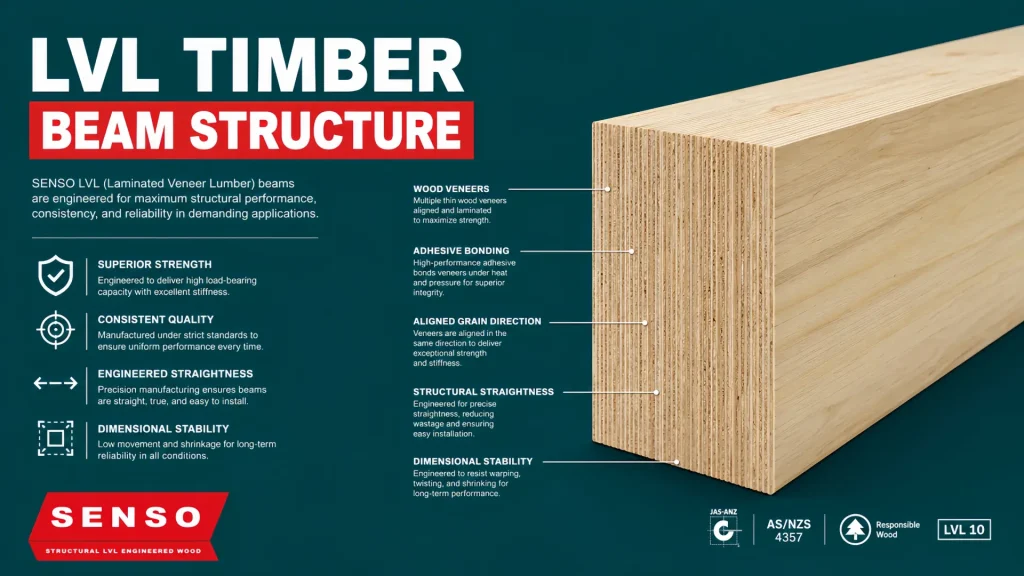
LVL timber is a laminated veneer lumber beam made for structural use. It uses many thin veneers bonded under heat and pressure, with the grain running along the length of the member. Buyers use LVL for beams, lintels, rafters, joists, truss parts, scaffold planks, formwork beams, and other engineered timber systems.
What Is LVL Timber in Practical Terms
A practical way to understand LVL is to compare it with solid timber. Solid timber comes from one log. Its strength depends on knots, slope of grain, splits, growth defects, and drying movement. LVL starts with many veneers. Manufacturers grade, arrange, glue, and press those veneers into a larger structural member.
As a result, LVL can offer more predictable performance than many pieces of ordinary sawn timber. It can also be made in longer lengths and deeper sections. This helps builders reduce joins, waste, and site delays.
However, buyers should not treat every LVL beam as the same product. The final performance depends on species, veneer quality, adhesive, pressing control, size, grade, treatment, certification, and the design rules used in the destination market.
What LVL Timber Is Made From
LVL is made from thin wood veneers. In many supply chains, softwood veneers such as radiata pine, spruce, pine, or similar structural species are common. The veneers are dried, graded, scarfed or joined when needed, coated with structural adhesive, and laid with the grain direction along the beam length.
The long grain alignment is important. It helps LVL carry bending and tension loads along the member. This is why LVL works well as beams, rafters, headers, and structural members that need strength in one main direction.
Buyers should check the full specification before ordering. A proper LVL order should name the size, length, grade, treatment, moisture condition, surface finish, tolerance, standard, packing, and final use. Without these details, two offers may look similar but perform very differently.
| LVL part | What it means | Why buyers should care |
|---|---|---|
| Veneer | Thin wood sheet used to build the member | Controls strength, quality, and consistency |
| Grain direction | Veneer grain runs mainly along the length | Supports beam strength in the main load direction |
| Structural adhesive | Glue system used to bond veneers | Affects bond quality and service performance |
| Pressing | Heat and pressure create the billet | Controls density, bond, and dimensional stability |
| Grade | Declared strength or product class | Needed for design, compliance, and buyer confidence |
| Treatment | Protection for use conditions when required | Important for termite, decay, or local market needs |
How Laminated Veneer Lumber Is Produced
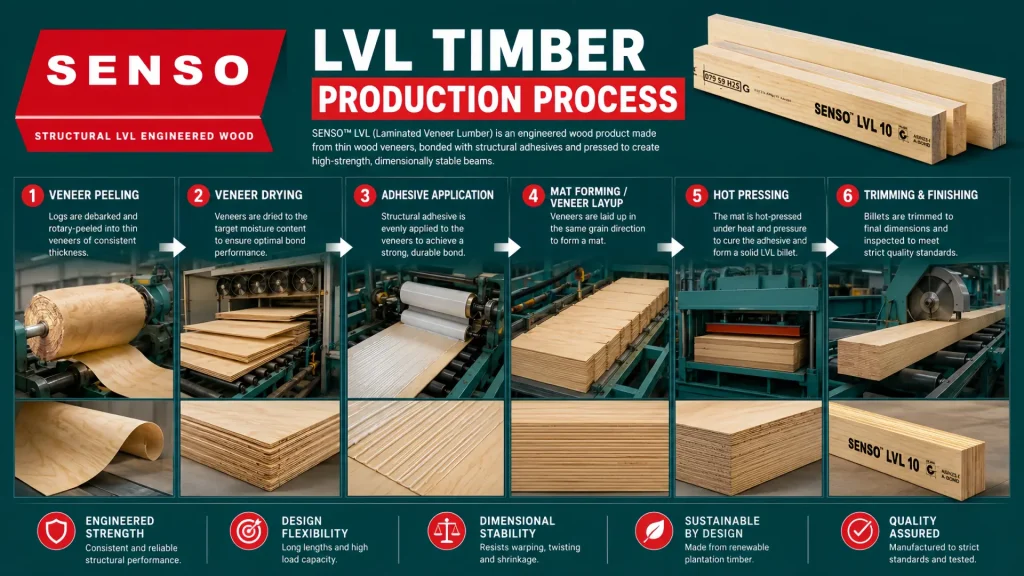
LVL production is closer to structural manufacturing than simple timber cutting. Each step affects the beam. Therefore, serious buyers should look beyond appearance and ask how the factory controls the process.
- Log preparation. Suitable logs are selected and prepared for veneer peeling.
- Veneer peeling. Logs are peeled into thin veneers.
- Drying. Veneers are dried to a controlled moisture range.
- Veneer grading. Veneers are sorted to suit structural layup needs.
- Jointing. Veneers may be scarfed or joined to form longer sheets.
- Adhesive application. Structural adhesive is spread on the veneers.
- Layup. Veneers are placed with grain direction mainly along the member.
- Hot pressing. Heat and pressure bond the veneers into a billet.
- Sawing and finishing. The billet is cut into beams, planks, or other sizes.
- Inspection and packing. Size, grade, surface, marks, moisture, and bundles are checked.
This process gives LVL its main value. It turns wood veneers into a predictable structural product. In addition, it allows factories to make long members and repeated sections that are hard to source from solid sawn timber alone.
Where Builders Use LVL Timber
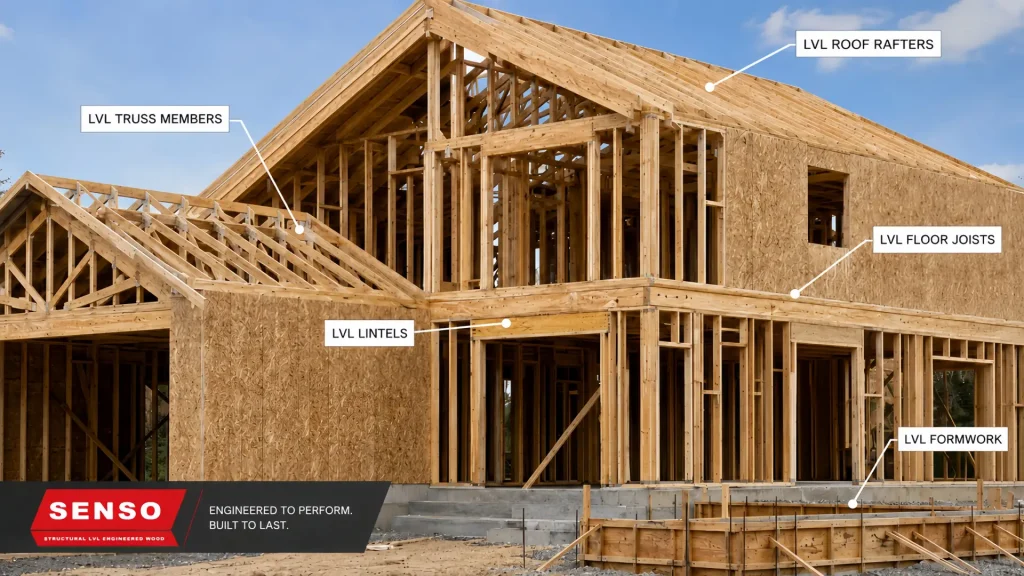
Builders use LVL where strength, length, straightness, and repeatable quality matter. It can appear in residential, commercial, formwork, modular, and industrial timber projects.
In housing, LVL beams often support openings, floors, roofs, and load paths. In commercial work, LVL can serve as lintels, bearers, rafters, purlins, and truss parts. In formwork, LVL can support temporary structures, concrete forming systems, and scaffold plank applications when the product is designed for that use.
For buyers, the application must come first. A beam for a lintel does not follow the same buying logic as an LVL scaffold plank or formwork edge beam. Each use may need different grade, size, treatment, marking, and inspection controls.
| Application | Why LVL fits | Buyer check |
|---|---|---|
| Beams and headers | Strong, straight, and available in long lengths | Grade, span, size, and design requirement |
| Lintels | Good for openings and concentrated load paths | Load, bearing length, treatment, and market rule |
| Rafters and roof members | Stable length and predictable section | Moisture, grade, and fixing method |
| Floor members | Consistent stiffness and straightness | Span table, deflection, and service condition |
| Truss components | Reliable engineered timber member | Connection design and product grade |
| Formwork systems | Good strength and repeated size control | Site load, moisture exposure, and edge protection |
| Scaffold planks | Can be made for controlled plank performance | Product approval, bending, treatment, and marking |
Why Buyers Choose LVL Instead of Solid Timber
Solid timber still has an important place in construction. However, LVL solves several problems that solid timber can create in supply and site work.
First, LVL offers better consistency. The manufacturing process spreads natural wood variation across many veneers. Second, LVL can be made in long lengths, which helps reduce joins. Third, the product can arrive straighter and more uniform than many solid timber members.
In many cases, this saves time on site. Builders spend less time sorting twisted pieces, rejecting poor boards, or working around inconsistent material. For distributors, stable LVL supply can also reduce complaint risk and improve repeat sales.
LVL Compared With Other Engineered Timber Products
LVL sits inside the wider engineered wood family. It should not be confused with plywood, glulam, CLT, or I joists. Each product has a different structure and role.
| Product | Basic structure | Typical role | Buyer note |
|---|---|---|---|
| LVL timber | Veneers bonded with grain mainly along the length | Beams, lintels, rafters, planks, structural members | Strong in the main length direction |
| Plywood | Cross layered veneers in sheet form | Panels, furniture, formwork, crates, flooring bases | Best as a sheet product, not a beam |
| Glulam | Solid timber laminations bonded together | Large beams, columns, exposed structures | Often used where visual timber appearance matters |
| I joist | Flanges with a web panel between them | Floor and roof joists | Designed for efficient span and low weight |
| CLT | Cross laminated solid timber panels | Walls, floors, roofs, mass timber panels | Used as a large structural panel system |
This comparison matters in sourcing. A buyer who asks for “engineered timber” may need LVL, I joists, H20 beams, glulam, or plywood depending on the project. The correct product starts with the load path and the installation method.
Sizes Grades and Market Language
LVL sizes change by market and use. Buyers often order by depth, thickness, and length. Common depths may include 95 mm, 130 mm, 150 mm, 200 mm, 240 mm, 300 mm, 360 mm, and larger sections. Common thicknesses may include 35 mm, 45 mm, 63 mm, 75 mm, or other project sizes.
Grades also vary by region and supplier. Some markets use product specific grade names. Others use stress or design values. In Australia and New Zealand supply discussions, buyers may see grade language such as 10, 12, 13.2, or 14, depending on product range and certification.
Therefore, a buyer should not rely on a grade name alone. The order should confirm the required standard, product data, span guidance, design values, treatment class, and marking. For structural work, a qualified designer or local code requirement should guide final use.
Moisture Treatment and Site Handling
LVL performs best when buyers match it to the service condition. Dry interior beams, protected roof members, temporary formwork members, and outdoor exposed parts may need different treatment and protection.
Moisture control matters during production, shipping, storage, and site use. Bundles should remain protected from rain and standing water. In addition, long members need support during handling so they do not twist, drag, or suffer edge damage.
Treatment is also market specific. Some buyers may need termite treatment, H2 treatment, H3 treatment, envelope treatment, or other local requirements. The exact need depends on destination rules and final exposure. For this reason, buyers should confirm treatment before production, not after shipment.
What Serious Buyers Should Check Before Ordering
LVL sourcing requires more detail than ordinary timber trading. A good purchase order should describe the product clearly enough for production, inspection, packing, and resale.
- Final application, such as beam, lintel, rafter, plank, or formwork member.
- Exact size, including depth, thickness, length, and tolerance.
- Required grade, product standard, or design value reference.
- Treatment need for termite, decay, or local market rules.
- Moisture content and storage condition.
- Surface finish, arris, edge condition, and end sealing if required.
- Branding, stamps, batch marks, or certification marks.
- Bundle weight, pack size, wrapping, straps, and pallet method.
- Container loading plan and unloading method.
- Documents, test reports, certificates, and product data sheets.
This checklist protects both buyer and supplier. It reduces disputes and makes repeat orders easier to control.
Common LVL Buying Mistakes
Most LVL problems start before the beam reaches the site. They often start with vague specifications, wrong assumptions, or poor handling plans.
- Asking only for price without naming the final application.
- Using a grade name without checking product data or design values.
- Ignoring treatment needs for the destination market.
- Ordering long members without checking container loading and unloading.
- Storing bundles outdoors without weather protection.
- Using LVL for exposed use without suitable protection.
- Assuming one LVL product fits beams, planks, and formwork members.
- Skipping marks, certificates, or batch traceability requirements.
These mistakes can create claims, site delays, and brand risk. In contrast, clear specifications help buyers receive a product that matches the job.
How SENSO and ROC Support LVL Buyers
SENSO is the LVL and engineered timber brand within the ROC supply system. ROC positions plywood as the main product axis, while SENSO LVL, H20 beams, I joists, and related structural timber products support wider construction and wholesale needs.
For LVL buyers, the key value is not only product supply. It is application matching. A distributor may need stable LVL beams for general stock. A formwork buyer may need LVL members for repeated site work. A project buyer may need treated LVL with clear documents, marks, and loading control.
ROC and SENSO can help buyers review size, grade, treatment, packing, container loading, and supporting documents before production. This matters because structural timber orders must align with the market and the final application.
For more background, read what is plywood, compare engineered panels in plywood vs OSB, or visit the Resources center. Buyers can also review LVL timber products or send project details through the contact page.
FAQ
What is LVL timber used for?
LVL timber is used for beams, lintels, rafters, floor members, roof members, truss parts, formwork members, scaffold planks, and other structural timber applications.
Is LVL stronger than solid timber?
LVL often gives more predictable strength and straighter sections than many solid timber members. Final strength depends on grade, size, species, adhesive, and design values.
Is LVL the same as plywood?
No. LVL is usually made with veneers running mainly along the length for beam strength. Plywood uses cross layered veneers and is usually supplied as a sheet panel.
Can LVL timber be used outside?
Some LVL products can suit protected or treated outdoor uses, but buyers must confirm treatment, exposure class, coating, and local market rules before ordering.
What should buyers check before ordering LVL?
Buyers should check application, size, grade, treatment, moisture, standard, marks, packing, loading plan, certificates, and product data sheets before placing bulk orders.
Which brand should buyers use for LVL from ROC?
SENSO is the preferred ROC brand for LVL timber and related structural engineered wood products. Buyers can use SENSO for LVL beams, planks, and project supply discussions.
Official References for Further Reading
Post time: Jun-19-2026