

H20 beam guide content often starts with size and price. On real jobsites, the better question is different. Will the beam stay straight, carry repeated formwork loads, survive handling, work with the chosen system, and remain safe across many pours?
An H20 beam is a timber formwork beam used in concrete forming systems. It usually has a 200 mm deep engineered shape, with solid timber flanges and a wood based web. This light but strong structure helps contractors build slab formwork, wall formwork, column formwork, table forms, climbing systems, and other temporary works.
For buyers, an H20 formwork beam is not a normal piece of timber. It is a repeat use site asset. A good beam can reduce site waste, speed up formwork assembly, protect plywood panels, and support safer concrete work. A poor beam can bend, split, absorb water, lose end strength, and create hidden cost on site.
Field Definition for H20 Formwork Beams
An H20 beam is a 200 mm deep timber formwork beam used to support plywood panels and concrete formwork systems. Buyers use it for slabs, walls, columns, table forms, bridges, tunnels, and climbing formwork. A good H20 timber beam should combine strength, straightness, end protection, stable dimensions, clear marking, and safe handling.
Why H20 Beams Matter on Concrete Sites
Concrete formwork is temporary, but its failure risk is serious. The beam sits between the panel surface and the support frame. It carries wet concrete pressure, worker movement, vibration, repeated stripping, and site handling damage.
Because of this role, the beam affects more than one pour. It affects concrete finish, panel life, labour speed, safety checks, and rental asset value. A stable H20 timber beam helps the formwork team set up panels faster and keep alignment under load.
This is why the cheapest beam is not always the lowest cost beam. A buyer should ask how many cycles the beam can support, how well the ends resist impact, and how the beam performs after transport, storage, and stripping.
What an H20 Beam Is Made Of
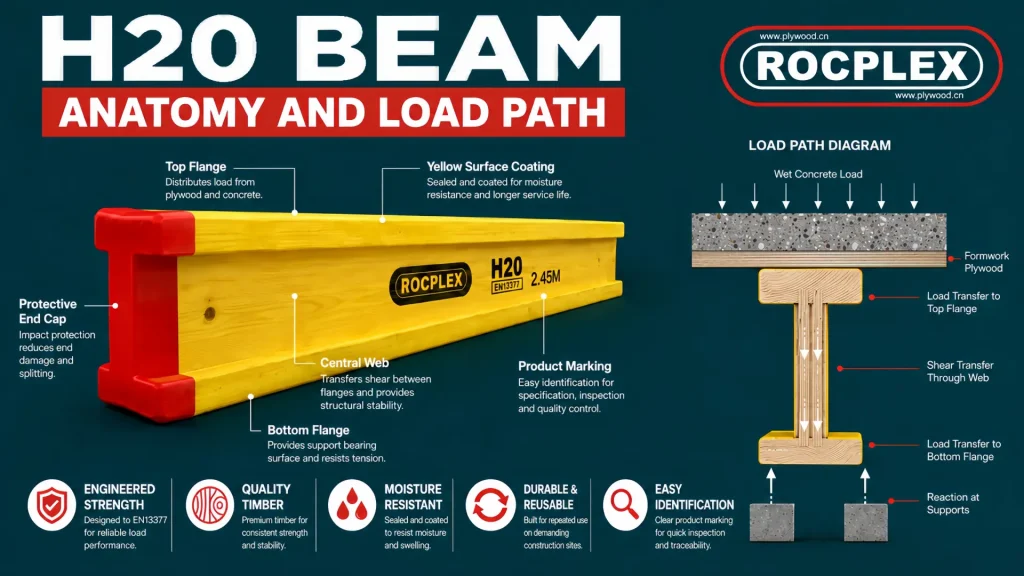
Most H20 timber beams use an engineered I shaped section. The top and bottom flanges carry bending forces. The web connects the flanges and helps transfer shear. This shape gives good strength with lower weight than a solid timber member of similar depth.
The flanges often use solid timber or laminated timber. The web may use three ply timber, plywood, or another wood based panel, depending on the product design. Many beams also use end caps or end reinforcement to reduce splitting and moisture damage.
For this reason, buyers should not judge the product by colour alone. They should check flange quality, web bonding, beam height, end protection, surface coating, weight, straightness, marking, and standard claim.
| Beam part | Site function | Buyer check |
|---|---|---|
| Top flange | Works with the bottom flange to resist bending | Check timber quality, straightness, cracks, and knots |
| Bottom flange | Carries the opposite bending force under load | Check section size, bonding, and damage risk |
| Web | Connects flanges and supports shear transfer | Check material type, glue bond, and flatness |
| Beam end | Takes high impact during handling and stripping | Check end cap, seal, damage, and repair need |
| Surface coating | Helps reduce water uptake and site wear | Check coating coverage and scratches |
| Marking | Shows brand, size, grade, or batch data | Check traceability and resale confidence |
The Site Logic Behind the H20 Shape
The H shape is not only a visual style. It is a material saving design. The flanges place more timber where bending stress is higher, while the web keeps the section stable and connected. This helps the beam stay light enough for site handling while still carrying formwork loads.
That balance matters every day on site. Workers need beams that move easily, align quickly, and fit common formwork layouts. Contractors need members that keep their shape across repeated pour cycles. Rental companies need beams that return from site without serious end damage.
A useful H20 beam guide should therefore look at both engineering and handling. Strength matters, but a formwork beam also needs practical durability. The beam should survive transport, stacking, nailing, stripping, cleaning, and repeated reuse.
Common Uses in Slab Wall and Column Formwork
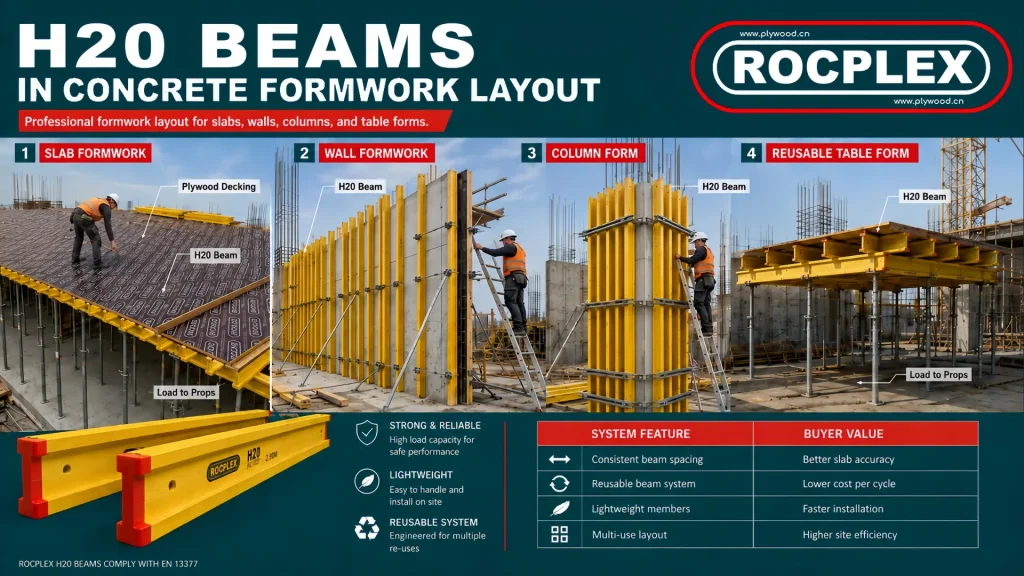
H20 beams appear in many formwork systems because they combine light weight, stable depth, and broad compatibility. They can support plywood facing in wall forms, carry slab loads in table forms, and help frame column and beam formwork.
In slab formwork, the beam helps transfer load from plywood sheets to props or frames. In wall formwork, it works as a vertical or horizontal member behind the plywood facing. In table forms, it helps create repeatable formwork units that contractors can move and reset.
However, buyers must avoid one common mistake. They should not assume one beam length and one spacing rule fits every project. Concrete thickness, support spacing, beam direction, panel thickness, vibration, and safety factor all affect the final layout.
| Formwork use | How the beam works | Buyer concern |
|---|---|---|
| Slab formwork | Supports plywood panels under wet concrete load | Span, spacing, straightness, and load data |
| Wall formwork | Works behind facing panels as a support member | Alignment, tie position, and repeated fixing |
| Column formwork | Helps frame smaller vertical formwork units | Cut length, end protection, and assembly speed |
| Table forms | Supports reusable formwork tables | Beam life, weight, and handling damage |
| Bridge and tunnel work | Fits larger temporary works with planned support | Engineering review and strict inspection |
| Climbing systems | Works in repeated wall and core construction cycles | Durability, marking, and system compatibility |
What Buyers Should Ask Before They Compare Prices
A low price can hide three problems. The beam may have weak ends. The beam may lack consistent size control. Or the beam may not match the target formwork system. These issues may not appear in a photo, but they can appear quickly on site.
Before asking for a final quote, buyers should define the job. Is the beam for resale, rental stock, slab formwork, wall formwork, column formwork, bridge work, or export project supply? Each channel values different details.
A distributor may need clean marking and stable pack size. A contractor may care about span and repeat use. A rental company may care most about end damage, coating, and repair rate. A project buyer may need documents, inspection records, and clear batch control.
Specification Points That Change Real Cost
The cost of an H20 timber beam does not only come from raw timber. Real cost also comes from beam life, failure risk, damage rate, loading quantity, and site labour. A slightly stronger or better protected beam may cost more at purchase but save money across many cycles.
Buyers should compare the full specification. Important points include beam height, flange size, web material, length tolerance, weight, adhesive type, end protection, surface coating, standard claim, marking, and packing. These details decide whether the beam can support repeat use.
For a serious order, the supplier should provide product data and clear inspection terms. If the beam will be used in a designed formwork system, the buyer should also check system compatibility and engineering requirements before use.
Size Length and Packing Choices
H20 beams are often supplied in lengths such as 1.8 m, 2.45 m, 2.9 m, 3.3 m, 3.6 m, 3.9 m, 4.5 m, 4.9 m, 5.9 m, and other project lengths. Local markets may prefer different sizes. Some buyers choose shorter lengths for easy handling, while others need longer beams for slab tables or wall panels.
Length selection affects more than formwork layout. It affects container loading, bundle weight, warehouse space, labour handling, damage risk, and cutting waste. Long beams need careful loading and unloading. Short beams may move faster in rental or resale markets.
Good packing protects the beam ends and coating. Bundles should stay tight but not crush the timber. Export wrapping should protect against rain during loading and unloading, while still allowing sensible handling at destination.
Inspection on Arrival and During Reuse
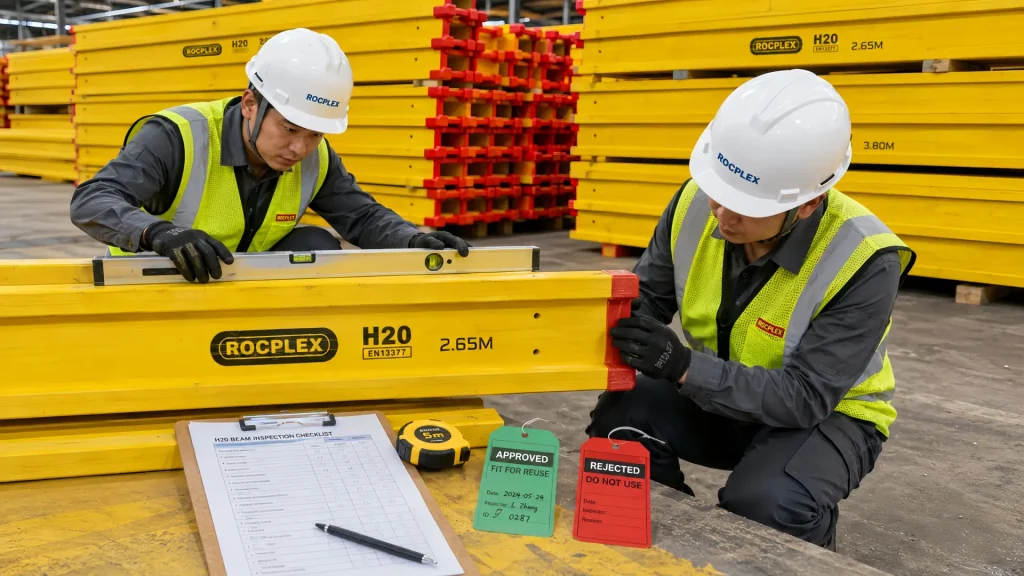
H20 beams should not disappear into site stock without inspection. Buyers should check new deliveries and then keep checking beams during reuse. This habit protects safety and extends asset life.
On arrival, check quantity, length, straightness, end caps, coating, cracks, web condition, flange damage, marks, moisture signs, and bundle condition. During reuse, check cut ends, nail damage, web separation, bending, splits, crushed ends, and surface damage.
A clear reject rule helps the site team. If a beam has deep cracks, loose web, serious end crushing, strong bending, or signs of water damage, the team should remove it from critical use. Repair or downgrade decisions should follow the contractor’s safety procedure.
Procurement Checklist for H20 Timber Beams
This H20 beam guide gives buyers a direct checklist for order control. It is useful for importers, formwork contractors, rental companies, building material distributors, and project procurement teams.
- Confirm final use, such as slab, wall, column, table form, or rental stock.
- Confirm beam length, height, flange size, and length tolerance.
- Check web material, flange timber, adhesive, and surface coating.
- Ask whether the beam follows EN 13377 or another target requirement.
- Check load data, span guidance, and formwork system compatibility.
- Confirm end cap, end sealing, or impact protection.
- Review beam marking, brand mark, batch mark, and traceability need.
- Check moisture condition and storage requirement.
- Confirm bundle size, weight, wrapping, straps, and loading plan.
- Agree on inspection terms before shipment.
Common Mistakes in H20 Beam Sourcing
Most mistakes come from treating the beam like a simple timber stick. That approach ignores its role in temporary works. It also ignores the fact that formwork assets must survive repeated cycles, not only one delivery.
- Buying by price per metre without checking beam ends and coating.
- Ignoring system compatibility with existing formwork parts.
- Ordering one length for every formwork application.
- Skipping load data and span guidance for project use.
- Forgetting bundle weight and unloading method.
- Storing beams outdoors without protection.
- Reusing damaged beams without clear site inspection rules.
- Comparing suppliers without checking consistency across batches.
These mistakes create hidden cost. They can lead to broken ends, poor alignment, slow assembly, unsafe reuse, and early replacement. A better specification usually costs less than a failed formwork cycle.
How ROC Supports H20 Beam Buyers
ROC supports global buyers with plywood, formwork panels, H20 beams, LVL timber, I joists, OSB, MDF, particle board, and related engineered wood products. For H20 beams, the main value is not only supply. The main value is matching the beam to the site system and order purpose.
A formwork contractor may need beams for slab tables and wall panels. A distributor may need stable stock lengths and clean branded bundles. A rental company may need better end protection and repeat use performance. A project buyer may need documents, product data, inspection reports, and reliable container loading.
ROC can help buyers review beam length, surface coating, end protection, packing, formwork plywood match, loading plan, and supporting documents before production. This helps reduce site risk and protects buyer confidence.
For related structural timber topics, read what is LVL timber, visit the Resources center, or review plywood products. Buyers can also compare plywood vs OSB or send project details through the contact page.
FAQ
What is an H20 beam used for?
An H20 beam is used in concrete formwork systems, including slab formwork, wall formwork, column formwork, table forms, climbing systems, bridges, tunnels, and temporary works.
Why is it called an H20 beam?
The name usually refers to the H shaped timber formwork beam with about 200 mm beam depth. The exact design and data depend on the supplier and product type.
Is an H20 beam structural timber?
It is a timber formwork beam for temporary works and concrete formwork systems. Buyers should use it according to product data, formwork design, and local site safety rules.
How long can H20 beams be reused?
Reuse depends on beam quality, end protection, coating, site handling, storage, concrete work, and inspection rules. Better handling and dry storage extend service life.
What should buyers check before ordering H20 beams?
Buyers should check length, section, web material, flange quality, coating, end protection, load data, standard claim, marking, packing, and loading plan.
Can H20 beams be used with formwork plywood?
Yes. H20 beams often support formwork plywood or film faced plywood in slab, wall, column, and table form systems. The spacing and layout should follow the formwork design.
Official References for Further Reading
Post time: Jun-23-2026