

A useful container loading guide should not begin with the question “How many sheets fit in one container?” That question matters, but it comes too late. The better question is this: how many clean, flat, dry, saleable sheets will reach the buyer’s warehouse after sea freight, unloading, and handling?
For plywood and timber panel buyers, container loading is not only a freight job. It is part of the product delivery plan. A perfect plywood panel can lose value if the pallet is weak, the edges are open, the bundle shifts, the container sweats, or the papers do not match the cargo.
Therefore, buyers should treat loading as part of quality control. This guide gives importers, wholesalers, builders, project buyers, and distributors a practical way to check plywood container loading before shipment. It also applies to OSB, MDF, particle board, LVL timber, H20 beams, I joists, and other wood panel cargo where weight, moisture, packing, and unloading risk decide the real result.
Container Loading Guide in One Practical Rule
A good loading plan protects sale value. Buyers should check product size, pallet strength, gross weight, moisture risk, loading order, space control, edge guards, photos, labels, and papers before the container leaves the factory.
Loading Starts Before the Forklift Moves
Many loading problems begin before the container arrives. If the order spec is unclear, the packing plan will also be unclear. Sheet size, thickness, density, pallet height, bundle weight, shipping mark, and unloading method all affect loading safety.
For example, 18 mm hardwood plywood, 12 mm poplar plywood, 2440 × 1220 mm MDF, long LVL beams, and H20 formwork beams do not load in the same way. Each product has a different weight, length, edge risk, moisture risk, and handling method.
For this reason, a strong container loading guide treats loading as a planned factory step. The supplier should know the cargo mix, container type, port, weight limit, pallet method, and buyer warehouse handling before packing begins.
First Confirm What the Container Must Protect
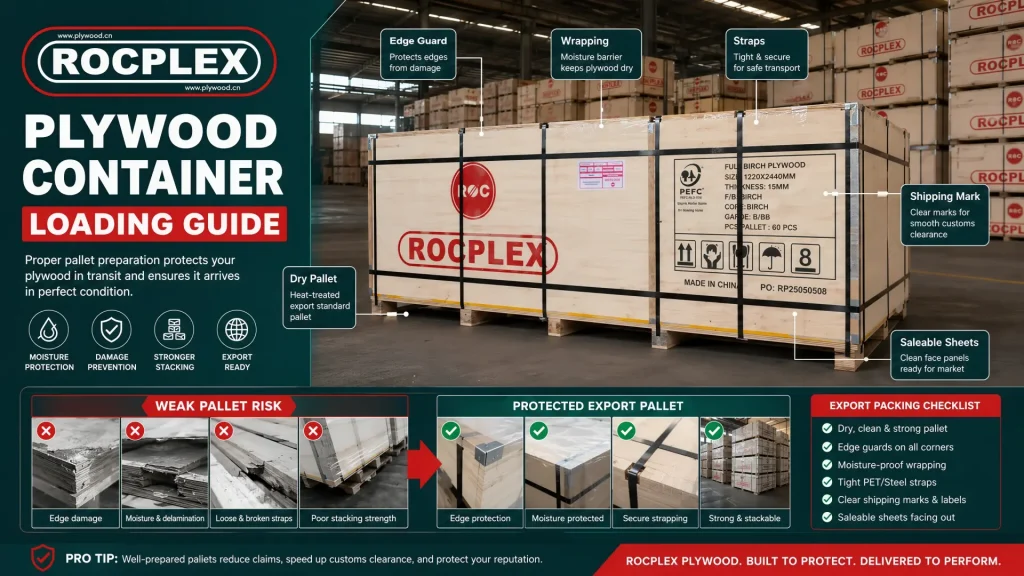
The container does not protect all products in the same way. Plywood buyers often care about flatness, corners, face quality, moisture, and clean pallets. MDF buyers care more about edge swell and surface marks. LVL and I joist buyers care about long length support, straightness, and clear bundle marks.
Before loading, buyers should define the product risk. Is the cargo a high grade face panel, a site panel, a formwork plywood order, a furniture board, or a timber beam shipment? The answer changes the packing and loading plan.
In practice, the best loading plan starts with product use. A film faced plywood order for formwork needs better film and edge care. A low cost packing plywood order may need strong pallets more than a perfect face. A long LVL order needs even support, not only tight wrapping.
| Product type | Main loading risk | Buyer focus |
|---|---|---|
| Commercial plywood | Corner damage and face scratches | Edge guards, flat pallets, clean wrapping |
| Film faced plywood | Film scratches and edge moisture | Surface care, sealed edges, stable bundles |
| MDF board | Edge swell and surface marks | Dry packing, clean pallets, strong corner guards |
| OSB board | Edge damage and moisture uptake | Wrapping, pallet strength, dry loading area |
| LVL timber | Bending, strap marks, and long length handling | Bundle support, straight stacking, clear marks |
| H20 beams | End damage and coating wear | End care, tight bundles, safe unloading |
| I joists | Flange damage and web crushing | Dry storage, careful lifting, visible labels |
Weight Is a Limit and Volume Is Only a Clue
A container may look half empty and still be close to the legal or carrier weight limit. This happens often with dense plywood, hardwood core panels, birch plywood, LVL, or thick MDF. Therefore, buyers should never plan loading by volume alone.
The safe way is to calculate gross cargo weight, pallet weight, container tare weight, and the route limit. Different routes and carriers may allow different payloads. As a result, the supplier should confirm the allowed weight before final loading.
This part of the container loading guide is simple: the best container is not always the fullest container. The best container carries the highest safe value without overweight risk, unloading damage, or claim risk.
Saleable Sheets Matter More Than Loaded Sheets
Some buyers judge loading success by sheet count. Professional buyers judge it by saleable sheet count. A container with 100 more sheets may look efficient. However, it is not efficient if corners break, faces rub, or pallets collapse during unloading.
The better metric is cost per saleable sheet. This includes loaded quantity, damage rate, moisture risk, handling time, warehouse rejection, and customer claim risk. In many cases, a slightly lower loading count can still bring better value if the goods arrive cleaner and easier to sell.
This is very important for wholesalers. A damaged outer layer can slow sales, reduce buyer trust, and force discounts. After unloading, the shipping loss can continue if the pallet does not look clean and ready for resale.
Pallet Design Is the First Protection Layer
Pallets protect the product before the container does. Weak pallets cause many plywood shipping claims. A good pallet should match sheet size, board weight, forklift handling, warehouse floor conditions, and unloading method.
For plywood and panel cargo, pallet strength, bottom runners, top cover, corner guards, steel or PET straps, stretch film, waterproof wrapping, and clear shipping marks all matter. The pallet should hold the cargo as one stable unit without crushing the edges.
At the same time, long products need a different plan. LVL timber, H20 beams, and I joists need straight and even support points. This helps the bundle avoid sag, twist, flange damage, and strap marks.
Container Movement Creates Force Inside the Box
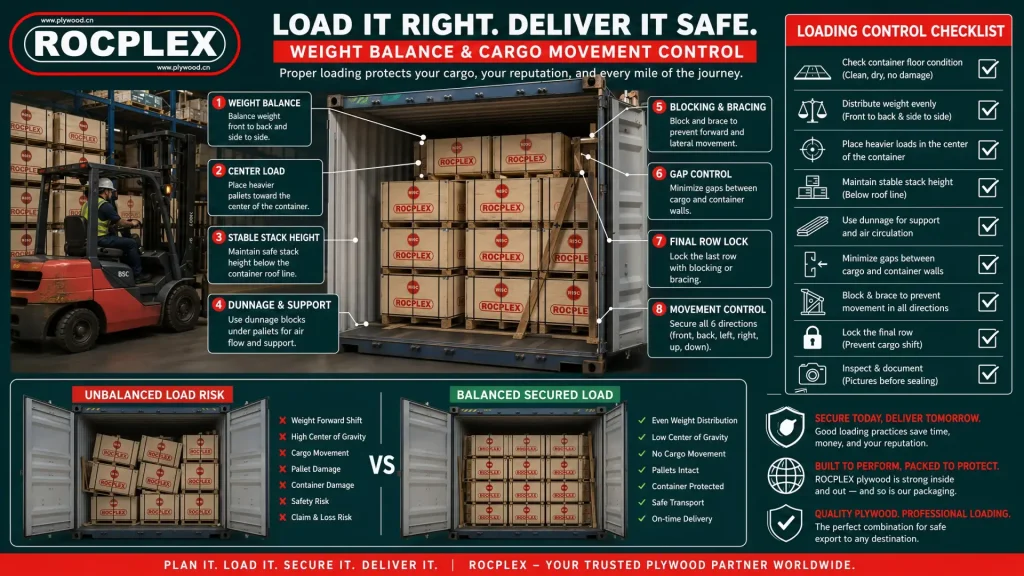
A loaded container does not stay still. It moves by truck, crane, vessel, yard handling, and final delivery. During this trip, cargo can shift forward, backward, sideways, or upward. Small gaps can become impact zones.
Good loading reduces that movement. Bundles should sit square, tight, and balanced. Heavy cargo should not crush lighter cargo. Gaps should be blocked where needed. Also, the load should allow safe door opening at the buyer warehouse.
A practical container loading guide must also consider unloading. If the buyer warehouse uses a forklift, the loading direction and pallet access should match that method. A container that loads fast but unloads badly is not a good container.
Moisture and Container Sweat Need Early Control
Wood panels and timber products react to moisture. Plywood, MDF, OSB, LVL, H20 beams, and I joists all need dry handling and suitable packing. Container sweat can happen when heat and cold changes cause water to form inside the container.
Buyers cannot remove all climate risk. However, they can reduce it. The supplier should load dry goods, use dry pallets, avoid rain during loading, check wrapping, and use desiccants when the route or season has higher sweat risk.
MDF and exposed panel edges need special care. Even a small moisture problem can cause swelling, edge marks, or customer rejection. For film faced plywood, moisture can also affect edges and reduce reuse confidence on formwork jobs.
Mixed Product Loading Needs a Clear Sequence
Many buyers now order mixed wood product containers. A container may include plywood, MDF, OSB, LVL, H20 beams, and accessories. Mixed loading can save freight, but it needs better planning.
Heavy and dense panels should not damage lighter items. Long beams should not press against panel faces. Also, products needed first at the buyer warehouse may need to load last. Labels should remain visible so warehouse teams do not waste time opening the wrong bundles.
For this reason, mixed loading works best with a loading map. The map should show product position, bundle number, mark, quantity, and unloading order. It also helps buyers check shortage or damage after arrival.
Loading Photos Are Part of the Shipment Record
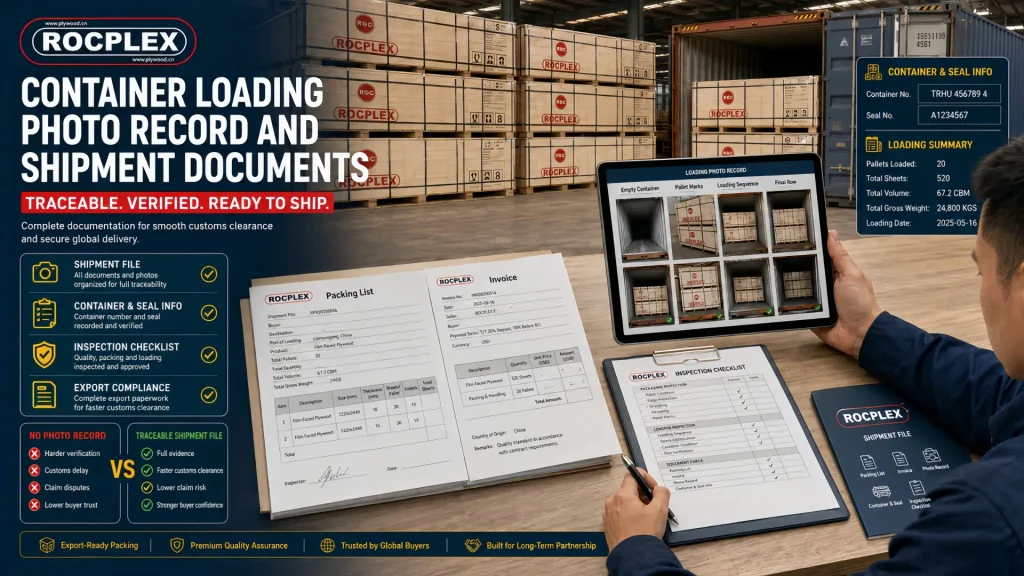
Loading photos are not just for show. They are proof. Good photos help buyers confirm cargo condition, pallet quality, container number, seal number, loading sequence, and final door condition.
A complete photo set should include empty container condition, container number, pallets before loading, product marks, inner packing, first row, middle loading view, final row, door side view, seal number, and finished container outside view.
As a result, the record protects both sides. If damage appears later, photos help show whether the problem came from production, packing, loading, transport, port handling, or unloading. Without photos, disputes become slower and harder to solve.
Container Loading Guide for Buyer Approval
Buyers should not wait until arrival to judge loading quality. Before shipment, a simple approval process can prevent many claims. This section turns the container loading guide into a direct buying tool.
- Confirm product list, sizes, thicknesses, quantities, and bundle numbers.
- Check gross weight, pallet weight, container type, and route weight limit.
- Approve pallet design, wrapping, corner guards, and shipping marks.
- Confirm whether desiccants or extra moisture control are needed.
- Ask for photos of goods before loading and during loading.
- Check container number, seal number, and booking details.
- Confirm loading order for mixed product containers.
- Request final loading photos before vessel departure.
- Match packing list, invoice, and actual loaded cargo.
- Keep photos and papers with the shipment file.
Common Loading Mistakes That Create Claims
Most loading claims come from avoidable mistakes. They do not always come from bad products. Sometimes the product is good, but the loading plan fails.
- Loading dense panels without checking route weight limits.
- Using weak pallets for heavy plywood bundles.
- Leaving open edges without corner or side guards.
- Loading in rain or using damp pallets.
- Mixing long beams with panels without proper separation.
- Allowing gaps that let cargo shift during transport.
- Hiding product marks inside the load.
- Forgetting container number and seal photos.
- Loading goods in an order that makes unloading slow or unsafe.
- Not matching the final packing list with the actual cargo.
These mistakes raise hidden cost. They can cause damaged corners, swollen edges, broken pallets, slow warehouse work, customer discounts, and claim disputes. Therefore, better loading control costs less than a damaged shipment.
How ROC Supports Container Loading Control
ROC works as a plywood led wood panel supply platform. That matters for loading because buyers often ship more than one product type. Plywood, OSB, MDF, particle board, LVL timber, H20 beams, and I joists each need different packing and loading control.
ROC can help buyers review product size, pallet structure, bundle weight, container loading plan, moisture control, shipping marks, photo records, and papers before shipment. This helps buyers reduce arrival damage and improve sale value.
For example, a wholesaler may need clean pallet presentation. A project buyer may need product order by site stage. A distributor may need mixed product loading with clear marks. A contractor may need formwork plywood and H20 beams protected for repeated use. Each buyer needs a different loading plan.
For related buying topics, read the plywood price guide, types of plywood, and the Resources center. Buyers can also review plywood products or send loading needs through the contact page.
FAQ
How many plywood sheets fit in a container?
The number depends on sheet size, thickness, density, pallet height, container type, and weight limit. Buyers should calculate weight and pallet plan before sheet count.
What is the biggest risk in plywood container loading?
The biggest risks are overweight loading, weak pallets, corner damage, moisture exposure, cargo movement, poor marks, and missing loading photos.
Should plywood containers use desiccants?
Desiccants can help on routes with higher sweat risk. Buyers should also require dry goods, dry pallets, good wrapping, and rain free loading.
Why are loading photos important?
Loading photos confirm cargo condition, pallet quality, container number, seal number, loading order, and final door condition before shipment.
Can plywood, MDF, OSB, and LVL ship in one container?
Yes, but mixed loading needs a clear order, weight balance, product separation, visible labels, and safe unloading access.
What should buyers check before approving container loading?
Buyers should check product list, weight, pallet design, moisture control, shipping marks, loading order, container number, seal number, photos, and papers.
Official References for Further Reading
Post time: Jun-21-2026