

A useful plywood price guide should not start with a single number. Plywood price is the result of grade, core, glue, thickness, surface, tolerance, packing, certification, order volume, and freight. When buyers compare only the sheet price, they often miss the cost that appears later in cutting waste, claims, delays, and weak resale value.
The lowest quote is not always the lowest cost. In plywood sourcing, a low sheet price can hide thin face veneer, mixed core, poor glue, high moisture, weak packing, rough tolerance, or unclear documents. These details may look small on a proforma invoice, but they decide whether the plywood performs well after unloading.
This guide gives importers, wholesalers, builders, furniture factories, packaging buyers, and project buyers a practical way to read plywood prices. The goal is not to predict today’s market number. The goal is to understand why one plywood offer costs more than another and how to compare quotes without buying avoidable risk.
Plywood Price Guide in One Sentence
Plywood price is the commercial result of a product specification. Buyers should compare plywood by final use, core quality, glue type, thickness, face grade, tolerance, packing, freight, certification, and claim risk before they compare the final sheet price.
Why a Plywood Price Is Never Just a Sheet Price
A plywood sheet is not a commodity in the simple sense. Two sheets can share the same size and thickness, yet carry very different cost inside the panel. One may use better veneer, stronger glue, tighter thickness control, cleaner face, and safer packing. Another may only match the basic size on paper.
For this reason, buyers should treat every plywood quote as a specification file. The price only makes sense after the buyer knows what the supplier is actually offering. If the quote says only “18 mm plywood 1220 × 2440 mm,” it is not enough for a serious order.
A strong plywood price guide should help buyers ask better questions. What core is inside? What glue is used? Face grade is promised? What tolerance is allowed? How will the goods be packed? Who pays when panels arrive with damage or high moisture?
The Specification Stack Behind Plywood Cost
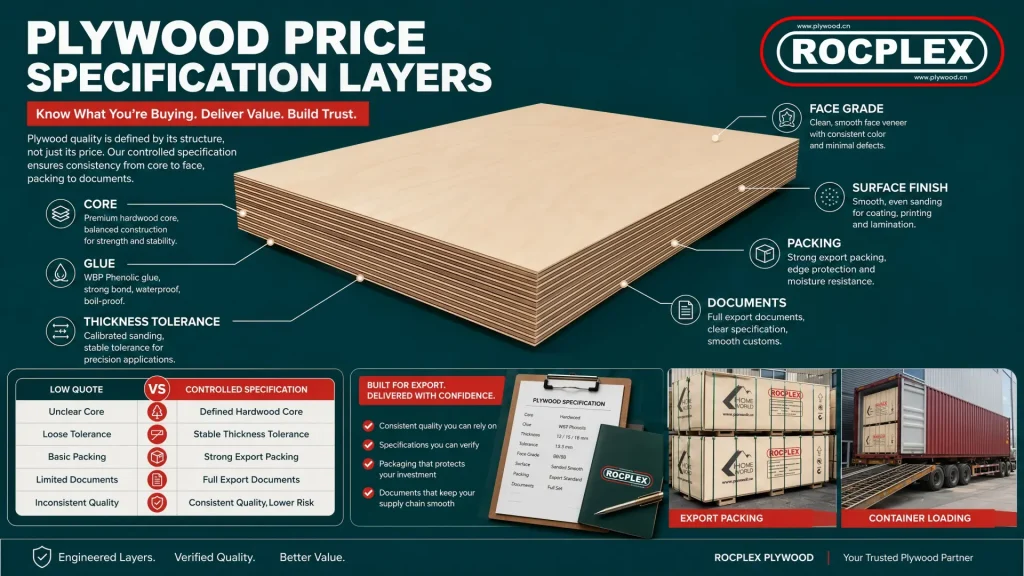
The easiest way to understand plywood price is to build it from the inside out. Core, glue, face, thickness, and finish create the product cost. Packing, freight, documents, and service create the delivered cost. Claims, rework, and slow resale create the hidden cost.
| Price layer | What changes cost | Buyer question |
|---|---|---|
| Core | Poplar, hardwood, eucalyptus, birch, combi, or mixed core | Does the core match the final use? |
| Face and back | Veneer species, grade, sanding, patching, and repair level | Will the surface meet the customer’s expectation? |
| Glue | Interior, exterior, WBP, phenolic, melamine, or other bond systems | Will the glue suit moisture and service conditions? |
| Thickness | Nominal thickness, actual thickness, calibration, and tolerance | Will panels fit machining, formwork, or construction needs? |
| Finish | Raw, sanded, film faced, melamine faced, UV coated, anti slip, or fancy veneer | Is the surface priced for the real application? |
| Packing | Pallet strength, edge protection, wrapping, straps, marks, and loading method | Will the plywood arrive clean and saleable? |
| Documents | Certification, test reports, invoices, marks, and chain of custody records | Can the buyer sell or use the goods without delay? |
When buyers compare two quotes, they should compare each layer. A lower price at one layer may create a higher cost at another layer. For example, cheaper packing can lead to corner damage. Lower glue quality can raise site failure risk. Loose tolerance can increase machining waste.
Plywood Price Guide to Core Choices
The core is one of the largest cost drivers in plywood. It also has a strong effect on performance. A furniture buyer, formwork buyer, packaging buyer, and structural panel buyer should not choose the same core only because the size is the same.
Poplar core can help reduce weight and cost. Hardwood and eucalyptus cores often give better density and strength. Birch core is valued for strength, machining, and consistent layers. Combi core balances cost and performance when specified well. However, mixed or unclear core can create risk if the supplier does not control the layup.
Therefore, core discussion should come before price approval. Buyers should ask for core species, veneer thickness, overlap control, gap control, moisture range, and edge appearance. A panel with many hidden core gaps may cost less but fail faster in cutting, screw holding, or formwork use.
Glue Type Changes Price and Risk
Glue is not a small technical detail. It decides whether a panel can handle moisture, heat, repeated handling, or concrete work. Interior furniture panels do not need the same bond as exterior plywood or film faced formwork plywood.
A plywood buyer should match the glue to the application. Interior glue may fit dry furniture use. Exterior or WBP bonding may suit higher moisture risk. Phenolic systems often appear in film faced plywood and formwork panels. Marine plywood and structural applications may need stricter bond and standard checks.
This part of the plywood price guide is simple: a cheaper glue system may be fine for the right dry use, but it becomes expensive if the plywood faces moisture, construction exposure, or repeated load cycles. The right glue is not always the strongest glue. It is the glue that fits the job.
Thickness and Tolerance Can Change the Real Cost
Many buyers ask for 9 mm, 12 mm, 15 mm, or 18 mm plywood. Yet the real issue is actual thickness and tolerance. A panel sold as 18 mm may not perform like another 18 mm panel if thickness, density, and core quality differ.
In furniture production, poor thickness control can affect cutting, edging, drilling, and assembly. In formwork, thickness and flatness affect panel fit, concrete finish, and leakage. In packaging, thickness variation affects strength and nail holding. In resale, buyers may reject inconsistent panels even when the price was low.
For this reason, the best quote should state tolerance clearly. Buyers should not accept vague words such as “standard tolerance” unless both sides know the exact range. Clear tolerance protects the supplier and the buyer.
Surface Grade Is Where Many Price Gaps Hide
Surface grade can change the price quickly. A smooth sanded face, high grade birch veneer, UV finished surface, melamine face, phenolic film, or anti slip surface all add cost. That cost may be necessary when the final customer sees or uses the surface directly.
Buyers should separate visible performance from hidden performance. A cabinet door, furniture panel, decorative wall panel, and trailer floor need better surface control. A packing crate, backing board, or covered construction layer may accept a lower visual grade if the core and strength are correct.
Good sourcing does not always mean buying the highest grade. It means paying for the grade the application needs. Overbuying surface quality wastes money. Underbuying it creates complaints and slow sales.
Total Landed Cost Matters More Than FOB Price
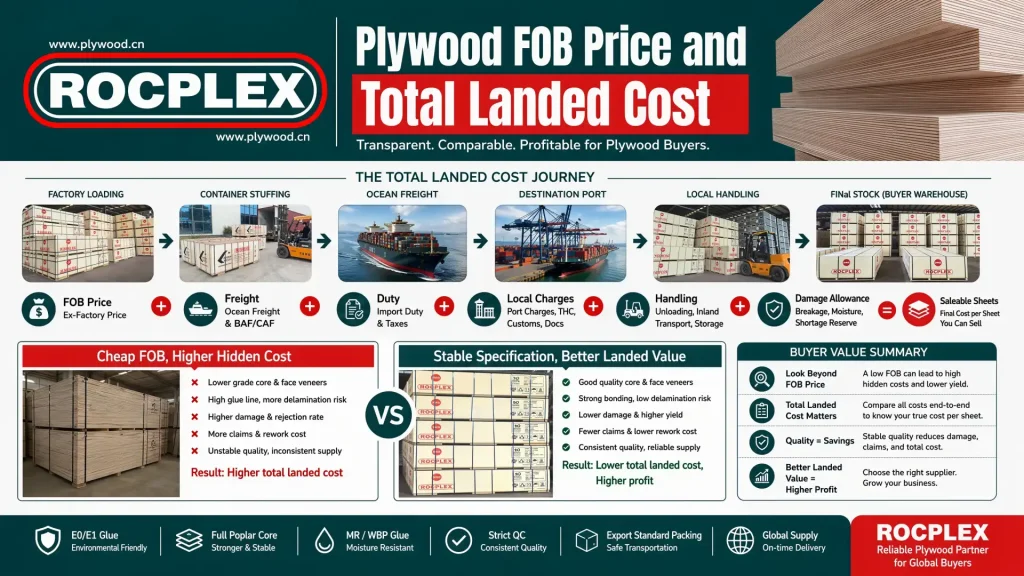
FOB price is only one part of the buying cost. Importers also need to consider ocean freight, local charges, duty, documentation, finance cost, warehouse handling, damage allowance, and resale speed. In some markets, a cheaper FOB quote can become a poor landed cost after freight, claims, and slow turnover.
Container loading also matters. Sheet size, thickness, density, and pallet height affect how much plywood fits in one container. Heavy panels may hit container weight limits before the container is full. Large panels may need special handling. Weak pallets may cause damage during unloading.
A practical plywood price guide should compare landed value, not just purchase price. Buyers should calculate cost per usable sheet, cost per cubic metre, cost per finished part, or cost per pour in formwork. The right unit depends on the market.
| Buyer type | Better cost unit | Why it works |
|---|---|---|
| Wholesaler | Cost per saleable sheet | Accounts for damage, rejection, and resale value |
| Furniture factory | Cost per finished part | Includes cutting yield, surface defects, and machining waste |
| Formwork contractor | Cost per pour or reuse cycle | Shows real value beyond initial panel price |
| Packaging buyer | Cost per crate or pallet set | Connects panel price with strength and cutting yield |
| Project buyer | Cost per installed area | Includes labour, waste, delays, and specification risk |
Certification and Documents Add Value When the Market Needs Them
Certification can affect plywood price. FSC, PEFC, formaldehyde emission documents, structural marks, marine plywood documents, test reports, and product data sheets all create cost and value. The key question is whether the buyer’s market needs them.
If a customer, retailer, project, or public tender needs documentation, a cheaper uncertified offer may not be usable. In that case, the document is part of the product, not an extra. If the market does not require it, buyers may decide whether certification helps brand position or resale confidence.
Buyers should confirm document needs before production. Changing document requirements after goods are made often creates delay, stress, and extra cost. This is especially true for FSC orders, low emission panels, structural products, and customer branded stock.
Quote Review Method for Serious Buyers
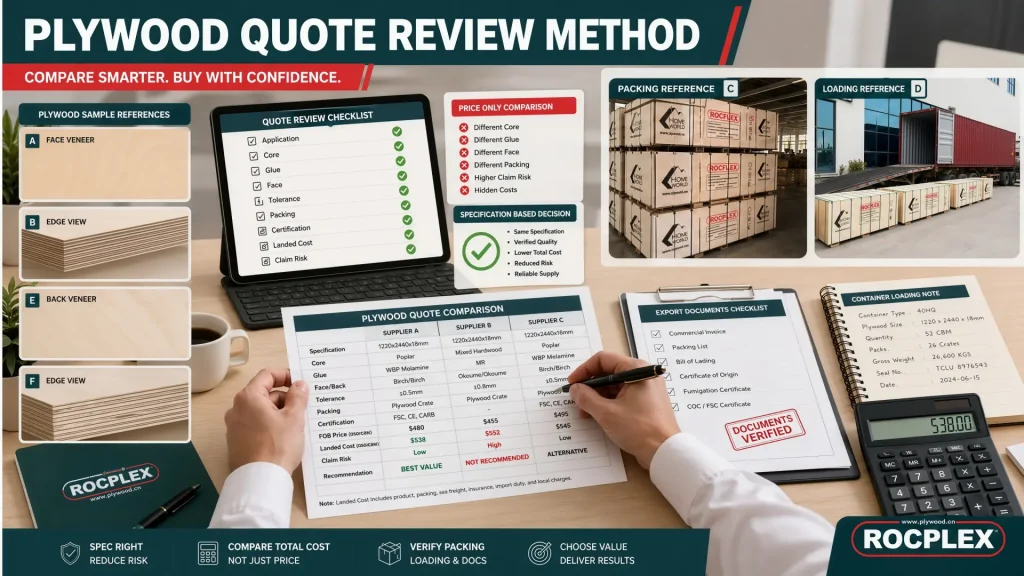
A good quote review method keeps buyers away from false comparisons. The best process is simple, but it must be disciplined.
- Define the final application before asking for price.
- List the required size, thickness, tolerance, core, face, glue, and finish.
- Confirm moisture, packing, pallet, marking, and loading needs.
- Ask whether certification, test reports, or customer documents are required.
- Compare offers by specification layer, not by price line only.
- Request photos, samples, or inspection terms if the order is new.
- Calculate landed cost and expected usable yield.
- Agree on claim rules before shipment.
This process makes the plywood price guide practical. It helps buyers build a quote comparison sheet that shows real value. It also helps suppliers quote the right product, instead of guessing what the buyer wants.
Common Pricing Traps in Plywood Orders
Most pricing mistakes happen when buyers leave room for interpretation. A supplier may quote a lower grade because the buyer did not define the grade. Another supplier may quote a better product and look expensive. Without a common specification, the comparison is not fair.
- Comparing 18 mm plywood without checking actual thickness tolerance.
- Comparing face grade without agreeing on repair, patches, sanding, and colour.
- Accepting “hardwood core” without confirming species and core gap control.
- Choosing the lowest FOB price without calculating landed cost.
- Ignoring packing quality for long sea shipments.
- Forgetting certification and document needs before production.
- Using one plywood grade for furniture, formwork, packaging, and construction.
- Skipping sample checks for a new supplier or new specification.
These traps can turn a cheap plywood order into a costly one. The best buyers reduce risk with clear specifications, fair comparison, and repeat supplier control.
How ROC Supports Plywood Price Decisions
ROC works as a plywood led engineered wood supply platform. That matters because plywood price often connects with wider product planning. A buyer may need commercial plywood for furniture, film faced plywood for formwork, birch plywood for industrial use, OSB for sheathing, MDF for painted interiors, or LVL timber for structural work.
For buyers using this plywood price guide, ROC can help compare product specification, core choice, glue type, thickness tolerance, surface grade, packing, certification, container loading, and total value. The aim is not to push the cheapest sheet. The aim is to match the panel to the buyer’s market and reduce avoidable claims.
A wholesaler may need a stable price range and saleable pallet presentation. A contractor may need stronger formwork panels with lower cost per pour. A furniture factory may need smooth surface and lower cutting waste. A project buyer may need documentation and schedule control. Each buyer sees price differently.
For related buying guides, read what is plywood, types of plywood, and plywood vs MDF. Buyers can also visit the Resources center, review plywood products, or send sourcing details through the contact page.
FAQ
What affects plywood price the most?
Core species, face grade, glue type, thickness, tolerance, finish, packing, certification, order volume, and freight all affect plywood price.
Why do plywood quotes differ so much?
Plywood quotes differ because suppliers may use different core materials, face grades, glue systems, tolerances, packing methods, and document levels.
Is the cheapest plywood always a bad choice?
No. Cheap plywood can be suitable for low risk uses if the specification matches the job. It becomes risky when buyers use it for demanding applications.
How should buyers compare plywood prices?
Buyers should compare plywood prices by specification, usable yield, landed cost, packing quality, certification needs, and claim risk, not by sheet price alone.
Does plywood thickness affect price?
Yes. Thickness affects raw material use, weight, stiffness, container loading, and final application. Actual thickness tolerance also affects real value.
Do FSC or test reports increase plywood cost?
They can increase cost, but they add value when the buyer’s market, retailer, project, or tender requires certified or documented plywood.
Official References for Further Reading
Post time: Jun-21-2026