

A serious supplier selection guide should not start with “find three quotes and choose the lowest one.” That method may work for simple goods, but it is weak for plywood and engineered wood. In this industry, the supplier affects product quality, documents, loading, delivery, and the way problems are solved after arrival.
Plywood is not one fixed product. Two suppliers can offer the same size, thickness, and face name, yet deliver very different panels. Core layup, glue bond, veneer grade, moisture control, sanding, packing, marks, and claim handling all change the real buying result.
Therefore, supplier selection is a risk audit. A good supplier must prove that it can deliver the right product, in the right grade, with the right papers, at the right time, and with the same standard across repeat orders. A poor supplier may win the first order with price, then cost the buyer more through waste, delay, claims, and lost customer trust.
This supplier selection guide gives plywood buyers a practical way to judge proof, not promises. It is written for importers, wholesalers, furniture factories, formwork buyers, builders, and project buyers who need stable supply instead of short term price wins.
Supplier Selection Guide in One Practical Rule
A good plywood supplier should be judged by proof, not promises. Buyers should review product fit, factory control, quality records, document strength, loading care, delivery record, claim response, and long term supply stability before they approve a supplier.
Start With the Supplier Role
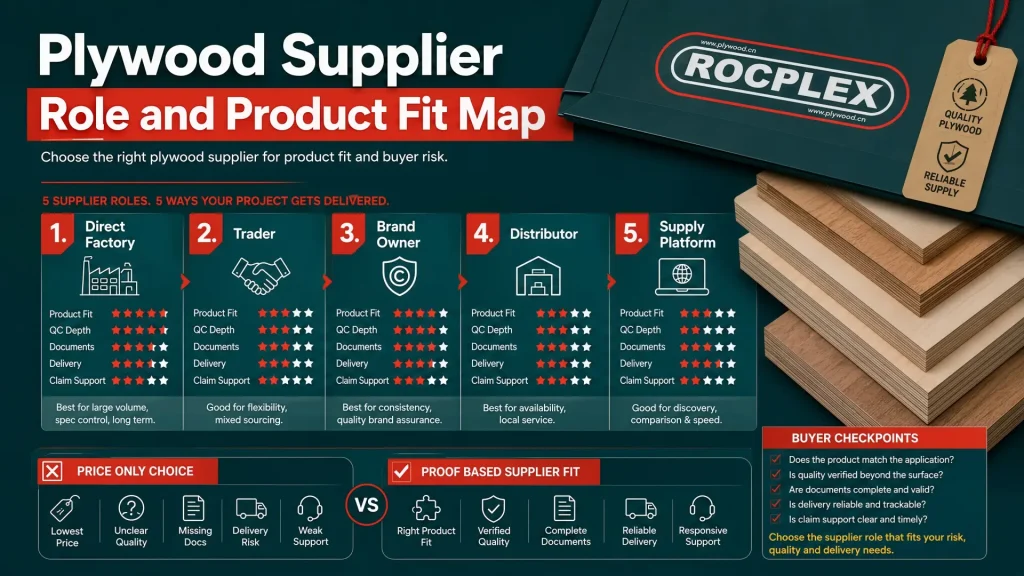
Before judging a supplier, buyers should first ask what role the supplier plays. Is it a factory, trading company, brand owner, export platform, stock distributor, or project supply partner? Each role can be useful, but each role carries different strengths and limits.
A factory may control production, but it may not manage export service well. A trader may communicate fast, but it may not control the factory deeply. A brand owner may offer stable product rules, but the price may include stronger service and stock planning. A supply platform may combine product range, quality checks, documents, and logistics support.
For this reason, a professional supplier selection guide should not say that only one supplier type is good. The better question is whether the supplier role matches the buyer’s need. A retail channel, formwork contractor, furniture factory, and timber wholesaler do not need the same supplier model.
| Supplier role | Best fit | Buyer risk to check |
|---|---|---|
| Direct factory | Stable single product orders | Export service, documents, flexibility |
| Trading company | Mixed sourcing and fast communication | Factory control and batch consistency |
| Brand owner | Channel supply and repeat quality | Price level and stock plan |
| Distributor | Local stock and fast delivery | Origin control and product traceability |
| Supply platform | One stop engineered wood buying | Depth of QC and supplier network control |
Plywood Supplier Selection Starts With Product Fit
The first supplier test is product fit. A supplier that is strong in cheap packing plywood may not be the right partner for film faced plywood, birch plywood, structural panels, LVL timber, or certified formwork panels. Good sourcing starts with the final use, not the product name.
For example, a furniture factory may need stable thickness, clean faces, low emission panels, and smooth machining. A concrete contractor may need strong film faced plywood with sealed edges and repeat use value. A wholesaler may need a balanced stock range that sells quickly and creates fewer complaints.
Therefore, buyers should ask the supplier to explain the product for the application. A strong supplier can tell why a core, glue, thickness, finish, and packing method fit the job. A weak supplier often answers with price first and product logic later.
Sample Approval Is Only the First Gate
Many buyers trust a good sample too quickly. A sample can show surface, thickness, edge, and basic appearance. However, it cannot prove repeat batch stability by itself. The real supplier test begins after the sample, when the factory must make full pallets and full containers to the same rule.
Buyers should treat sample approval as the first gate, not the final decision. After a sample passes, the buyer should confirm the production standard, inspection points, photo records, packing method, marking rule, and claim process.
This matters because plywood quality can shift inside a batch. Face veneer may look good while core gaps hide inside. A pallet may pass the top sheet check while lower sheets have worse sanding or higher moisture. Good supplier control reduces this gap between sample and bulk order.
Quality Control Should Be Visible
Quality control should not be a slogan. Buyers should be able to see how the supplier controls incoming material, veneer drying, glue spread, layup, pressing, trimming, sanding, grading, packing, and container loading.
A supplier does not need to send every factory record for every small order. Still, it should be able to explain the inspection process clearly. It should also provide photos, measurements, test data, or third party checks when the order requires higher trust.
In practice, buyers should watch how a supplier responds to detailed questions. A reliable supplier gives clear answers. A weak supplier may avoid details, change the topic, or repeat broad claims such as “best quality” and “factory direct” without proof.
This part of the supplier selection guide is especially important for repeat orders. The buyer is not only checking one shipment. The buyer is checking whether the same quality rule can survive pressure from raw material change, busy season, urgent orders, and mixed product loading.
| QC point | What buyers should ask | Why it matters |
|---|---|---|
| Core layup | How are gaps, overlaps, and core species checked? | Core defects affect strength and machining |
| Glue bond | What glue type and bond control are used? | Glue affects moisture and panel life |
| Moisture | What moisture range is allowed before packing? | High moisture can cause swelling and claims |
| Thickness | What tolerance is promised and checked? | Poor tolerance affects cutting and fitting |
| Surface grade | How are face defects, patches, and sanding judged? | Surface drives resale and end use |
| Packing | How are pallets, straps, edges, and marks controlled? | Weak packing can ruin good panels |
Documents Are Part of the Product
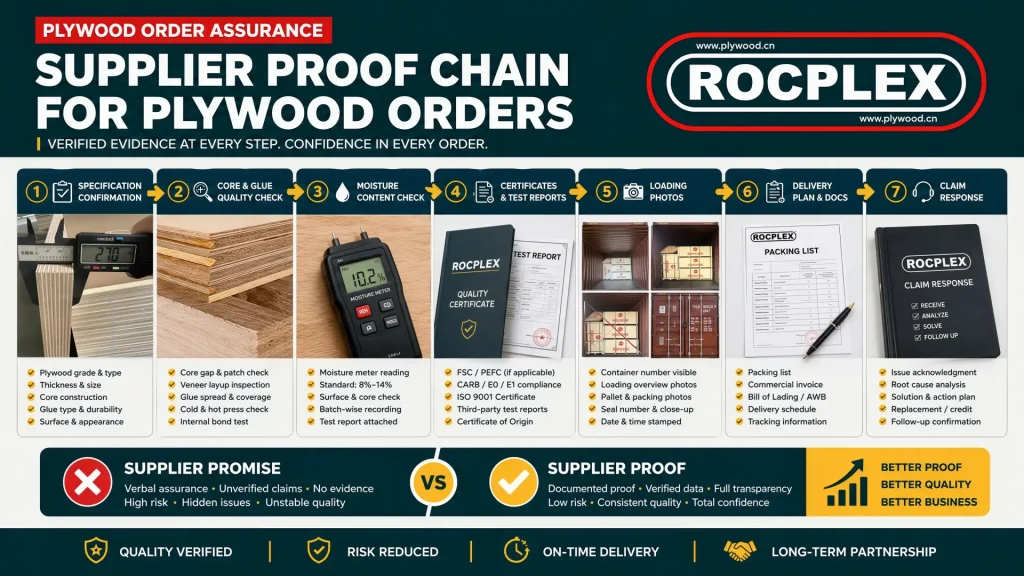
For many buyers, documents decide whether the product can be sold, cleared, certified, or used in a project. FSC, PEFC, formaldehyde emission papers, structural product data, marine plywood documents, test reports, fumigation records, invoices, and packing lists are not side items. They are part of the order.
A supplier that cannot manage documents can create serious delays. Goods may arrive on time but still remain hard to sell if papers are wrong, late, or not accepted by the buyer’s customer. Therefore, document ability should be checked before shipment, not after arrival.
This is especially important for retail channels, public projects, green building programs, chain stores, and regulated markets. If the buyer needs certified panels, the supplier must understand the document chain before production starts.
For plywood supplier selection, document work also shows discipline. A supplier that controls certificates, batch marks, invoices, packing lists, and loading photos usually has stronger order control than a supplier that treats papers as an afterthought.
Delivery Strength Is More Than Saying On Time
Many suppliers promise fast delivery. Fewer suppliers can explain how they protect delivery. Production planning, raw material stock, factory capacity, booking control, port congestion, loading photos, and document timing all affect real shipment dates.
A buyer should ask for a delivery plan that includes production lead time, inspection timing, packing date, container booking, loading date, document release, and expected vessel schedule. This does not remove all delays, but it shows whether the supplier controls the process.
For mixed product orders, delivery strength becomes even more important. Plywood, MDF, OSB, LVL, H20 beams, and I joists may come from different lines or factories. A good supplier must coordinate the full shipment, not only one product.
A balanced supplier selection guide should therefore judge delivery by process, not by promise. Buyers should check whether the supplier can protect production, booking, loading, and documents under real market pressure.
Claim Response Shows the Real Supplier
A supplier’s true level often appears when a problem occurs. Every plywood supply chain can face issues. The key is not whether a supplier claims to be perfect. The key is how it investigates, responds, and prevents the same problem from returning.
Good suppliers ask for clear evidence, review batch data, compare photos, check loading records, and discuss a fair solution. Weak suppliers blame transport, buyer handling, or weather without review. That behaviour tells buyers what future cooperation will feel like.
A useful supplier selection guide should include claim behaviour because claim response affects long term cost. A low price supplier with poor claim support can become expensive after one bad container.
In long term plywood supplier selection, claim response is also a trust test. The best suppliers do not only solve one claim. They change the control point that caused the claim, so the same problem is less likely to happen again.
Supplier Scorecard for Plywood and Timber Buyers
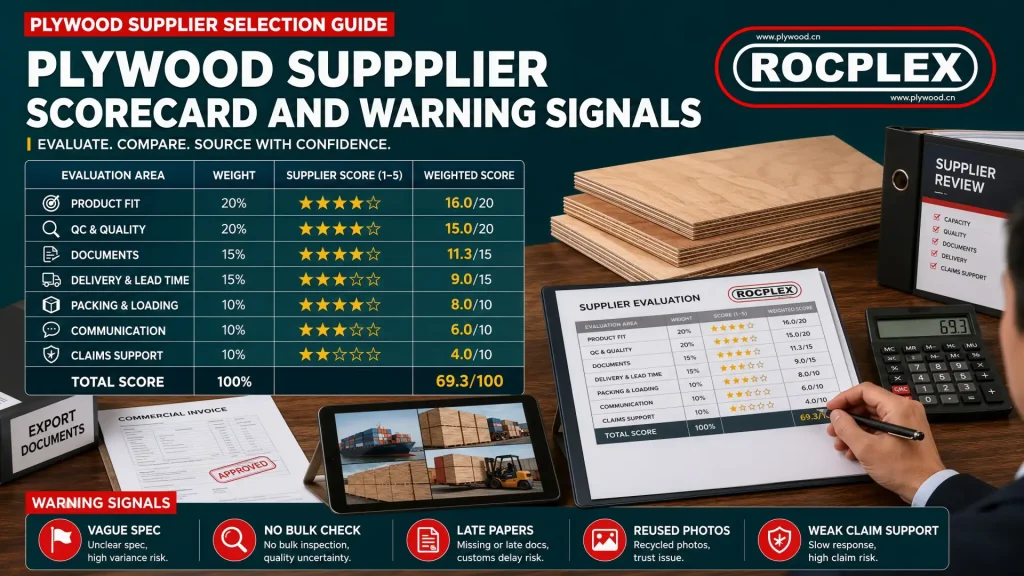
A scorecard helps buyers compare suppliers with less emotion. It also prevents a low quote from hiding weak areas. Buyers can adjust the weights based on their market, but the main scoring logic should stay practical.
| Score area | Weight | What to review |
|---|---|---|
| Product fit | 20% | Application match, grade range, product logic |
| Quality control | 20% | Inspection steps, batch stability, moisture and tolerance checks |
| Document ability | 15% | Certificates, test reports, invoice, packing list, traceability |
| Delivery control | 15% | Lead time, booking, loading photos, shipment planning |
| Packing and loading | 10% | Pallet strength, wrapping, marks, container loading care |
| Communication | 10% | Speed, accuracy, technical answers, problem follow up |
| Claim response | 10% | Evidence review, solution speed, prevention action |
This scorecard turns the supplier selection guide into a buying tool. It helps importers, wholesalers, contractors, and factory buyers choose suppliers with better long term value, not only better first order pricing.
Warning Signs in Supplier Evaluation
Some supplier risks appear early. Buyers should not ignore them only because the price looks attractive. Small warning signs before the order often become large problems after shipment.
- The supplier cannot explain the core, glue, face grade, or tolerance clearly.
- The quote is much lower, but the specification is vague.
- The sample looks good, but the supplier avoids bulk inspection terms.
- Documents are promised, but no clear document source is given.
- Delivery dates change often without a clear reason.
- Photos are reused, unclear, or unrelated to the actual order.
- The supplier resists reasonable loading or packing checks.
- Claim rules are never discussed before shipment.
- The supplier says yes to every product without showing product depth.
- The supplier avoids written confirmation of key details.
One warning sign may not be enough to reject a supplier. However, several warning signs together should slow the buyer down. A missed risk before shipment is much harder to fix after arrival.
For supplier evaluation, the pattern matters more than one answer. If a supplier avoids detail across product, QC, documents, packing, and claims, the buyer should treat the low quote with care.
Long Term Supply Is a Business Fit
Supplier selection is not only technical. It is also a business fit. A buyer that needs stable container programs should not work with a supplier that only thinks in one off spot orders. A project buyer should not choose a supplier that cannot control documents and schedule. A channel buyer should not rely on a supplier that changes product rules from batch to batch.
Good long term suppliers learn the buyer’s market. They remember preferred sizes, packing style, labels, documents, claim history, and customer feedback. As a result, repeat orders become smoother and less risky.
This is where price and partnership meet. A strong supplier may not always offer the lowest price, but it can protect the buyer’s brand, reduce hidden cost, and support growth across product lines.
At this stage, the supplier selection guide becomes a long term supply map. It helps buyers decide which suppliers deserve repeat orders, which suppliers need tighter checks, and which suppliers should only handle low risk products.
How ROC Supports Supplier Selection
ROC works as a plywood led engineered wood supply platform. Plywood remains the main product axis, while OSB, MDF, particle board, LVL timber, H20 beams, I joists, and related products support wider buyer needs. This matters because many buyers need more than one product from the same supply system.
For buyers using this supplier selection guide, ROC can help review product fit, specification, quality control, packing, loading, documents, and delivery planning before production. The aim is not only to sell panels. The aim is to reduce buyer risk across repeat shipments.
A wholesaler may need stable stock and clean pallet presentation. A contractor may need formwork plywood and H20 beams that work together. A furniture buyer may need plywood, MDF, and particle board with clear emission documents. A structural buyer may need LVL and I joists with marks and supporting data.
For related buyer resources, read the plywood price guide, the container loading guide, and types of plywood. Buyers can also visit the Resources center, review plywood products, or send sourcing details through the contact page.
FAQ
How do I choose a plywood supplier?
Choose a plywood supplier by checking product fit, quality control, core and glue details, documents, packing, loading, delivery record, and claim response.
Is the cheapest plywood supplier the best choice?
Not always. A low price can be suitable for low risk use, but it can also hide weak core, poor glue, loose tolerance, weak packing, or poor claim support.
What documents should a plywood supplier provide?
Common documents may include invoice, packing list, certificate of origin, test reports, FSC or PEFC records, emission documents, product data, and loading photos.
Should buyers rely on plywood samples?
Samples are useful, but they are not enough. Buyers should also check bulk production rules, inspection records, packing, loading photos, and repeat batch control.
What is the biggest supplier selection mistake?
The biggest mistake is comparing suppliers by price only, without checking product specification, quality control, documents, delivery, and claim support.
Can one supplier handle plywood, MDF, OSB, LVL, and H20 beams?
Yes, if the supplier has a strong engineered wood supply system, clear product control, reliable documents, and proven loading and delivery support.
Official References for Further Reading
Post time: Jun-23-2026