

A beam does not have one universal span. It has an approved span under one defined set of conditions. A useful LVL span guide must preserve those conditions from the first calculation to the final order.
That distinction matters because a table row can be correct yet wrong for the project. Change the load, support, product, deflection limit or connection. The listed result may no longer apply.
This article explains how to screen span data without turning a chart into a design shortcut. It is a planning and procurement method, not a substitute for project engineering. Final selection must follow local rules and current manufacturer data. For product basics, read What Is LVL Timber.
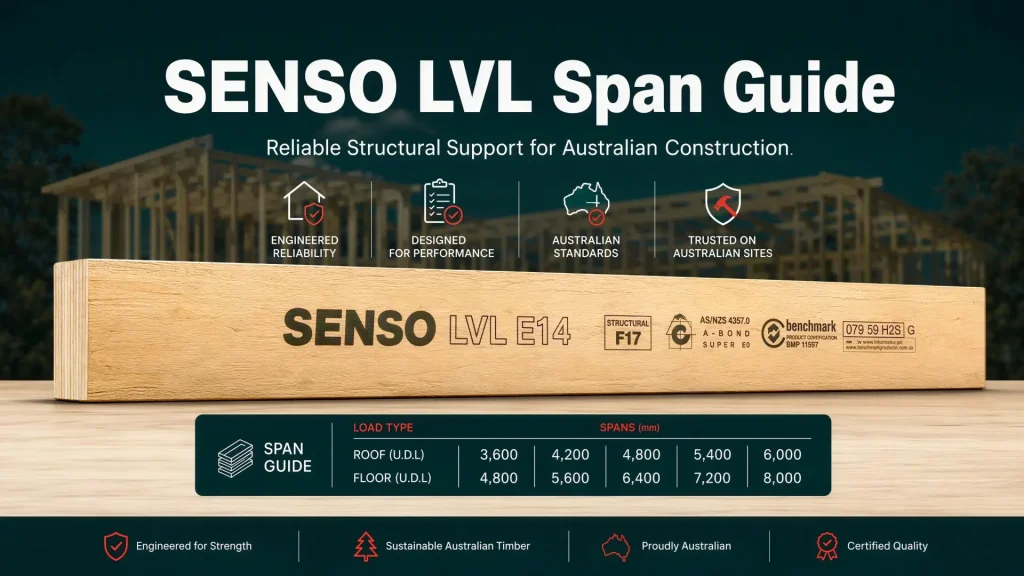
What an LVL Span Guide Can Prove
A span table can screen a named product for the exact cases covered by that table. It may match member depth, ply count, clear span and a stated uniform load. It may also apply a stated movement limit.
However, the table cannot approve a different brand, grade or veneer layout. It cannot absorb an unlisted point load. Nor can it confirm a hanger, bearing detail, hole, fire condition or temporary construction state.
This product identity matters because LVL belongs to the structural composite lumber family. The APA description of structural composite lumber explains that qualified properties come from tested, controlled products. Therefore, the design evidence must identify the actual product.
A listed span is not a material property. It is the result of one defined product, structural model, load set and acceptance limit.
Seven Inputs Create One Valid Span
Start with a one-page design case before opening any table. If one field is unknown, mark it as unknown. Do not replace it with a convenient assumption.
| Input | Question that must be answered | Evidence owner |
|---|---|---|
| Member role | Is it a floor beam, roof beam, lintel, bearer or another member? | Designer |
| Analytical span | Which points define the span used in the calculation or table? | Designer or table notes |
| Support model | Is the member simply supported, continuous, fixed or cantilevered? | Structural drawing |
| Load shape | Are loads uniform, concentrated, partial or transferred by another member? | Load path and framing plan |
| Design load set | Which permanent, imposed, roof, snow, wind or other actions apply? | Project engineer and local rules |
| Product identity | Which manufacturer, product family, grade and design properties apply? | Approved technical data |
| Acceptance limits | Which strength, movement, vibration, fire and durability limits govern? | Code, project brief and designer |
The earlier LVL beam sizes article explains how dimensions enter the order. Here, dimensions remain only one input. Span approval requires the complete design case.
Convert the Building into Beam Loads
Span tables usually expect a defined load format. The building rarely presents its loads in that form. Therefore, the load path must be translated before the table is used.
Area load becomes line load
A floor or roof often starts with an area load in kPa. A beam receives load from a tributary width. For a regular layout, the planning conversion is simple:
Line load in kN/m = area load in kPa x tributary width in metres.
Keep permanent and variable actions separate. Their factors, durations and movement checks may differ. In addition, add the beam’s own weight when the design method requires it.
Point loads keep their position
A supported girder, post or truss can place a concentrated load on the beam. Record its magnitude and exact location. Do not spread it across the full span to fit a uniform-load chart.
That shortcut can hide high shear near a support. It can also move the peak bending zone. If the table does not cover point loads, use an approved design tool or project calculation.
The support model defines the span line
The architectural opening is not always the analytical span. Some tables use clear span. Others use support centre lines or another stated convention. Bearing length also affects the physical member length.
Continuous beams and cantilevers develop different actions from simple spans. Consequently, their table rows are not interchangeable. The drawing and table must use the same structural model.
Span Is a Fourth Power Amplifier
Small span changes can create large movement changes. For a simple beam under a uniform load, a basic elastic model gives these relationships:
Maximum bending moment is proportional to span squared. Instantaneous deflection is proportional to span to the fourth power.
The familiar expressions are M = wL² / 8 and deflection = 5wL⁴ / 384EI. They describe one simple model. They are not a complete LVL design.
| Span increase | Bending moment increase | Deflection increase | Meaning for planning |
|---|---|---|---|
| 5% | About 10.3% | About 21.6% | A small site change may remove the margin |
| 10% | About 21.0% | About 46.4% | Movement can change much faster than length |
| 20% | About 44.0% | About 107.4% | A former selection may become a different design problem |
These ratios assume the same load per metre and the same stiffness. Even so, they expose a critical rule. Never approve extra span as a minor dimensional change.
Read Span Tables from the Footnotes Up
Most users begin with the largest number in the table. A safer reader begins below the table. The footnotes define the case that produced every number above them.
The Weyerhaeuser beam and header specifier guide is one example of product-specific design literature. Such documents link tables to named products, load formats and application rules.
| Reading order | Confirm before using a value | Reason |
|---|---|---|
| 1 | Document edition and region | Loads, products and approvals can change |
| 2 | Manufacturer, family and grade | Another LVL may have different verified properties |
| 3 | Application and support case | A header row may not cover a floor girder |
| 4 | Units and load type | kN/m, kPa, PLF and point loads are different inputs |
| 5 | Span definition | Clear span and centre-line span are not always equal |
| 6 | Movement criteria | Live-load and total-load limits may differ |
| 7 | Bearing, restraint and connection notes | The beam needs a workable load path at both ends |
| 8 | Exclusions | Holes, wet use, fire or multiple spans may need separate checks |
After these checks, read the table body. Then record the row, column, edition and every applied note. A screenshot without its footnotes is not design evidence.
Strength and Serviceability Answer Different Questions
Strength asks whether the member resists the design actions. Serviceability asks how the building behaves during normal use. Both can control the accepted span.
A beam may pass bending and shear yet move too much. Excess movement can crack finishes, disturb doors or create poor floor feel. Long-term loading can add creep. Moisture can also change stiffness and movement.
Therefore, check live-load movement and total-load movement as separate cases where required. Also confirm vibration or project-specific finish limits. The code minimum may not match the client’s performance target.
This is why the longest table value is rarely the best commercial answer. A shorter, stiffer solution can reduce finishing defects, site adjustments and later complaints.
A Worked Load Handoff Without Selecting a Beam
Assume an engineer supplies a fictional planning case. The member has a 4.8 m simple span and a 3.0 m tributary width. Permanent area load is 0.6 kPa. Variable area load is 1.5 kPa.
The permanent line load becomes 0.6 x 3.0 = 1.8 kN/m. The variable line load becomes 1.5 x 3.0 = 4.5 kN/m. Beam self-weight remains a separate stated input.
Now the table reader has two load components, not one vague total. The reader must still confirm factors, load duration, deflection limits, product properties and support details. No beam has been selected yet.
Suppose an 8 kN point load later arrives 1.2 m from one support. The earlier uniform-load screening is now incomplete. The design case must return to the engineer.
These figures are teaching inputs, not code values. The method shows how to preserve information without guessing the final section.
Use a Three Gate Boundary Test
Before accepting any table result, ask three yes-or-no questions.
- Identity gate: Is the delivered product exactly the product covered by the design source?
- Model gate: Do span, supports, load shapes and load positions match the listed case?
- Service gate: Do exposure, movement, fire, restraint and connection conditions remain within the stated limits?
A no answer does not always reject LVL. Instead, it rejects the shortcut. The project may still use the member after a suitable calculation and approval.
This boundary test also protects purchasing teams. A supplier can propose an alternative, but the alternative must return through all three gates. Equal dimensions or a similar grade name are not enough.
Stop the Table When the Load Case Changes
Printed tables work well inside their stated boundaries. Outside those boundaries, a project calculation is usually the safer route.
| Trigger | Why a standard row may fail | Required next step |
|---|---|---|
| Point load or supported beam | Peak shear and bending depend on load position | Analyse the actual load and location |
| Cantilever or continuous member | Internal actions differ from a simple span | Use the correct structural model |
| Hole, notch or tapered cut | The section and stress flow change | Follow named product rules or obtain design approval |
| Built-up member | Plies need a verified load-sharing connection | Design the ply fastening and load entry |
| Hanger or narrow bearing | Connection or compression may govern | Check reaction, connector and bearing capacity |
| Fire-rated or exposed use | Strength, section loss and durability rules change | Apply the required fire and service design method |
| Heavy finish or masonry support | Movement limits can become more severe | Confirm the project-specific movement criterion |
| Product substitution | Verified properties and approvals may differ | Recheck the full design case with the proposed product |
Snow drift, high wind, seismic actions and temporary construction loads can also exceed a simple chart. In each case, preserve the real load instead of forcing it into a familiar row.
Carry the Design Case into the Order
The purchase order should not recreate the calculation. However, it must identify the approved calculation and prevent silent substitution.
For a SENSOframe structural LVL beam, add these span-specific controls to the physical fields described in the size passport:
| Span control field | Record on the approved schedule or order | Control achieved |
|---|---|---|
| Design case ID | Drawing, calculation and revision number | Links the beam to current evidence |
| Member mark | Unique beam or header reference | Prevents schedule mixing |
| Span and support model | Approved analytical span and support condition | Stops a site opening from replacing the design span |
| Load set reference | Named load case and source | Prevents unrecorded load changes |
| Design source | Manufacturer document, software report or engineer calculation | Preserves the approval route |
| Exceptions | Point loads, holes, hangers, fire or treatment notes | Keeps special conditions visible |
The supplier should quote the exact product family, grade, section, treatment and marking. The buyer should then compare that quote with the approved schedule. If identity changes, approval must reopen.
For broader product options, see the SENSO laminated veneer lumber range. Product availability does not replace structural approval.
Regional Span Evidence Is Not Interchangeable
North American projects often use code-recognised product reports, manufacturer literature and design software. European projects commonly combine product declarations with Eurocode-based design. Australia and New Zealand use local timber design rules, certificates and approved product data.
The Metsa Wood Kerto LVL span tools illustrate this regional approach. Their tables are organised around local requirements and named Kerto products.
Therefore, an export buyer should state the destination market before requesting a span answer. A calculation from one system does not automatically transfer to another code, grade or approval route.
Questions Buyers Ask About LVL Spans
How far can an LVL beam span?
There is no universal maximum. Span depends on the named product, section, loads, supports, movement limits, connections and local design rules.
Can beam depth alone predict span?
No. Depth strongly affects stiffness, but grade, width, load and support conditions still matter. Product-specific design data remains essential.
Can one manufacturer’s span table be used for another LVL?
No, unless the project designer verifies the substitution. Similar sizes or grade labels do not prove equal design properties.
Does a span table cover point loads?
Only when the table states that it does. Otherwise, preserve the point load magnitude and location for a separate design check.
Is clear opening the same as beam span?
Not always. The table may define span between bearing faces, support centres or other points. Follow its stated definition.
Why can deflection control before strength?
Movement rises quickly as span increases. Finishes, floor feel and long-term creep can demand a stiffer member before strength governs.
Can two LVL plies use a single-ply result twice?
Not automatically. The connection must transfer load between plies, and each load must enter the built-up member as designed.
When is an engineer needed?
Use an engineer for unlisted loads, supports, cuts, connections, fire conditions, substitutions or any case outside the table notes.
Keep the Design Case Attached to the Beam
The safest LVL span guide does not promise one distance for one beam size. It shows the conditions that make a distance valid. It also shows where that validity ends.
First, define the load path. Next, match the exact product and table boundary. Then preserve the approved design case in the order. This chain protects the engineer, buyer, supplier and site team.
SENSO can prepare structural LVL quotations against an approved member schedule. Send the project market, product requirement, member marks, sizes, quantities and design references for a controlled supply review.
Post time: Sep-28-2026