

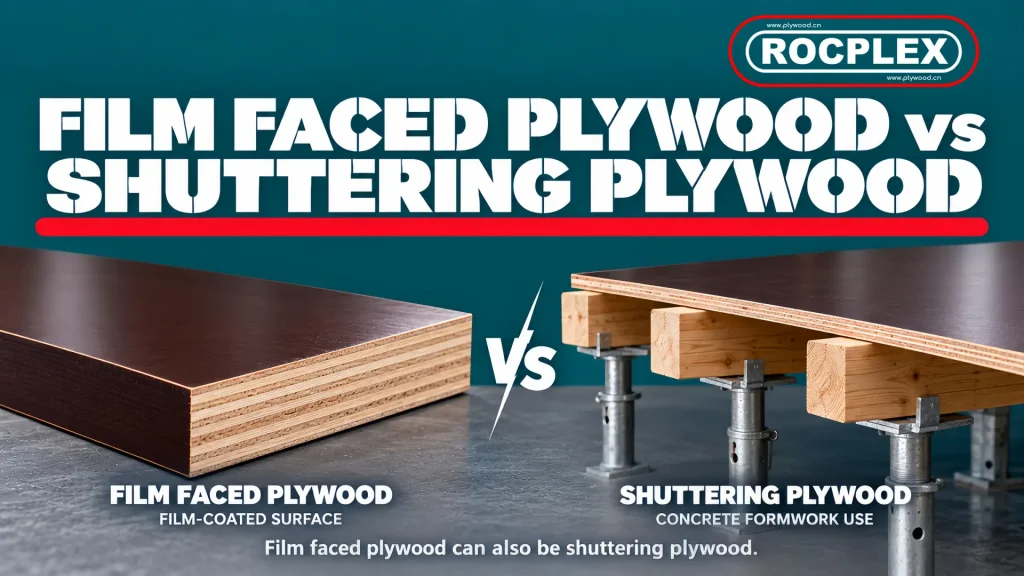
Film faced plywood vs shuttering plywood often compares panels that serve the same task. Film faced refers to the surface; shuttering refers to the panel’s role in forming concrete. A film faced panel can therefore be shuttering plywood. The useful buying review covers the named panel, the concrete finish needed, the approved load case and the cost of keeping faces ready for use.
Doka’s formwork sheet range uses both terms for its phenolic plywood. Thus, a quote needs more than a choice between two headings. For repeat pours, ask how much concrete contact the purchased panels can deliver to the agreed brief, including the work needed between uses.
Start With the Concrete Area the Contract Needs
A wall that remains visible and a surface hidden by later work can have different finish briefs. The panel must suit its planned use. Set that brief before looking at sheet prices or reuse targets.
State the texture, joint pattern, tie-hole finish and limits for visible marks. Also agree how the cast face will be judged. A trial pour or approved sample gives the site team a shared target, with a clear viewing point, lighting and time of review.
PERI’s guide to exposed concrete links the result to the formlining, water absorption, release agent and site process. Its advice makes a useful point: buying the face is only part of buying the finish.
Next, measure the surface area that the form must actually create. Record wall faces, slab soffits, returns and other details on the same basis. This lets the buying team relate a pack of plywood to the work it needs to deliver.
Film Faced Plywood vs Shuttering Plywood in the Reuse Budget
The sheet with the most uses does not account for the output from the whole pack. Some pieces may leave the job earlier, or form less area after cutting. A useful budget records actual concrete contact as well as total uses.
Count Total Uses on a Clear Basis
For the budget method used here, purchased panel area means length × width, counted once per sheet. Total uses include the first pour. Ask whether a stated “reuse” figure uses that same basis.
Assume an order of 100 m² of panel area, with each group forming its full planned area on every counted use. In this simplified example, all counted surfaces meet the agreed finish and there is no cutting loss.
| Panel group | Purchased area | Total accepted uses, including the first | Total accepted contact area |
|---|---|---|---|
| Group A | 40 m² | 10 | 400 m² |
| Group B | 60 m² | 5 | 300 m² |
| Total | 100 m² | Different by group | 700 m² |
Define effective area uses as total accepted contact area divided by purchased panel area. Here, 700 ÷ 100 = 7 effective area uses for the whole order, although Group A reached ten total uses.
These are assumed accounting inputs, not ROCPLEX test results or a promised panel life. On a real job, record the actual contact area after cuts, holes and changes in panel size.
State the Costs Included in the Rate
The same area record can support a clearly defined cost rate:
Panel-related cost per accepted contact m² = costs included in the panel budget ÷ total accepted contact area.
Continue the assumed example with USD 2,100 for the panels and USD 700 for agreed cutting and care work. Then USD 2,800 ÷ 700 m² gives USD 4.00 per accepted contact m².
This is a panel-related rate for the stated scope. It is not a full formwork rate. Be explicit about whether freight, release agent, repairs, disposal and concrete rework are included. Also state the labour and support-system costs left outside it.
For a film faced plywood vs shuttering plywood cost review, apply the same cost boundary and finish brief to both offers. A lower sheet price can be useful, but the rate also changes when cutting loss, care work or usable area changes.
Keep area awaiting a finish review out of the accepted total. If remedial work brings it within the agreed brief, record both that outcome and the linked cost on the chosen basis.
A Panel Must Pass Two Different Checks
The cost model only has value for panels fit for their next job. Check the load case and the face finish in turn. A face may stop meeting an exposed finish brief while the panel remains fit for another approved task. Damage to the core can also end its service while the face still looks clean.
The Face Must Suit the Next Concrete Finish
Inspect the working surface for scratches, dents, worn coating, patches and fastener marks against the finish brief. A defect that matters on a visible wall may have a different significance on a hidden face. Agree that difference with the project team rather than guessing from the panel’s age.
New panels also need a defined first-use method. PERI’s care guide for loose panels explains that early moisture uptake in phenolic-film panels can cause local veneer swelling, known as rippling, which may print into the concrete. Follow the chosen product’s advice before first use and confirm the result on the finish trial for that job.
Therefore, “new” and “used” are incomplete finish descriptions. Panel condition, surface preparation and the history of each face are more useful records. Mixing faces with different histories can introduce a variable that the trial did not cover.
When a panel no longer meets an exposed-finish brief, review whether another planned use is permitted. Keep that decision separate from any assessment of its load capacity.
The Core Must Suit the Next Load Case
The panel’s thickness, veneer layout, bond, condition and support layout matter to the load check. The surface film does not establish a permitted span or concrete pressure.
APA’s concrete-forming guide treats form design and concrete pressure separately from panel care. Use the actual panel data and the approved layout for the job. A change in panel product or support spacing needs the design review that applies.
Check damage at cut edges, fixing zones and tie holes as well as the broad face. A patch that restores a smooth surface does not, by itself, prove that lost structural capacity has been restored. Use the applicable product and system rules for repair and further use.
These checks also govern any move from visible work to hidden work. A less demanding appearance brief does not reduce the load the panel must carry. The next assignment still needs a sound panel and a suitable support layout.
Film Faced Plywood vs Shuttering Plywood at the Film Layer
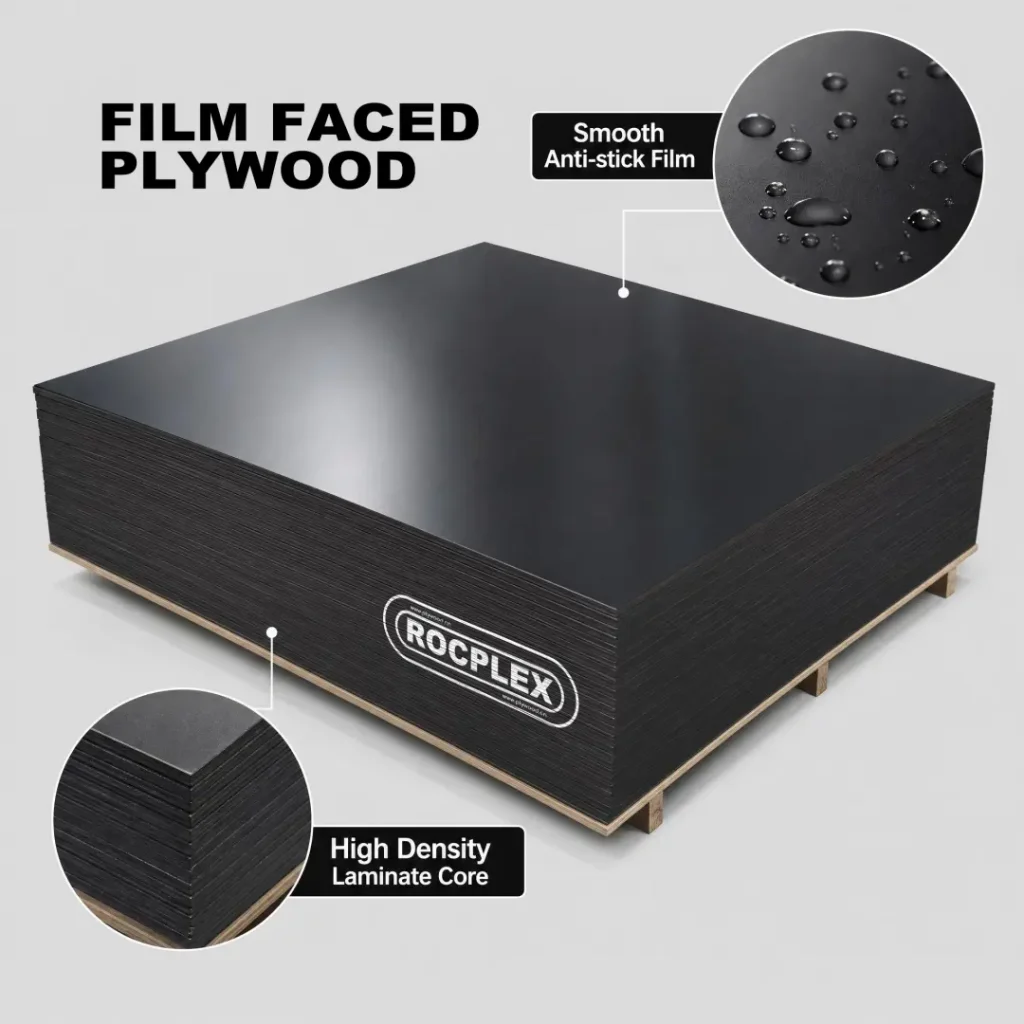
The overlay is one part of the panel spec. State its material, mass per area where needed, surface character and which faces are coated. Film colour alone does not provide the rest of that information.
For example, Doka’s listed 15 mm DokaPly Phenolic panel has 130 g/m² phenolic film on both face and back. That is a published coating figure for the named product. It is not a load rating or a conversion rule from film mass to pours.
Other concrete form panels use different overlays. APA distinguishes HDO and MDO Plyform, with different surface characteristics and finish results. Keep the named overlay and planned finish in the quote instead of treating every dark or smooth panel as the same product.
The base panel also needs its own identity. UPM describes WISA-Form Birch as a birch plywood base with a phenolic coating. Its detailed technical values come from the product-specific declaration. For the panel we offer, confirm the actual core, bond, thickness and design data on their own basis.
Keep the Film Faced Plywood vs Shuttering Plywood Care Plan Specific
Release agent selection, coverage and application affect both stripping and the concrete surface. More agent is not a substitute for the correct product and method. Agree the panel and release agent before the finish trial, then keep those products and the agreed method in use.
Cleaning must also suit the coating. APA advises inspection and cleaning soon after removal. PERI’s guide for loose panels calls for plastic or nylon cleaning tools and fresh sealing after cuts or drilling. Those instructions have a clear product scope; the PERI guide expressly excludes plywood installed in system formwork.
For a system facing, obtain the system’s own cleaning, repair and panel-change rules. A method planned for loose panels should not silently become the rule for a framed assembly.
Include the care work in the budget and site plan. A face waiting for cleaning cannot deliver its next assigned contact area on time. Rough stripping or unsuitable scraping can also turn an avoidable mark into a finish problem.
For a film faced plywood vs shuttering plywood enquiry, tell us the release agent, cleaning method and panel system you plan to use. This helps connect the surface choice with the way the site will maintain it.
Plan the Route of the Faces Through the Job
Allocate panels to the finish zones that need them. Exposed walls may justify a set of faces with a recorded preparation and use history. Infill pieces, returns and hidden work can have different needs, but each task still follows the approved design.
Plan cuts around that route. A large face cut into narrow strips may remain physically sound while losing value for later large pours. The budget should show the contact area those strips actually deliver, rather than giving them the same future value as an intact sheet.
For a two-sided panel, record which face is used. Count area when a face forms concrete. A spare reverse face does not add an accepted use while it remains unused. Equally, a pour against one side is not two uses simply because both sides have film.
This makes the film faced plywood vs shuttering plywood review more specific. We can discuss the face requirement and sheet format with the planned cutting and reuse route, rather than attaching one cycle count to every piece in the order.
Also review the route when the pour sequence changes. An early cut for a small detail can remove a full face needed by a later exposed wall.
Treat a Trial Pour as a System Trial
A trial pour should use the planned panel, concrete, release agent, joints and site method. Record the facing preparation and whether the working faces are new or previously used. Then assess the concrete against the agreed brief.
The trial records what that setup produced under its stated conditions. It does not prove that the sheet alone will deliver the same finish with another mix, agent or removal method. PERI’s guide to exposed concrete places the site process alongside the formlining in explaining the result.
After the trial, retain the approved setup and finish target. During production, record accepted contact area, care work, repairs and reasons for removing a face from a task. Distinguish finish problems, panel damage and cutting losses so the next buying choice addresses the cause.
A useful review may show that a different coating is justified. It may instead show that the present panel needs a better cutting plan or care method. The records let the buying team test that conclusion against the actual work.
Ask for a Film Faced Plywood vs Shuttering Plywood Quote
We supply ROCPLEX film faced plywood within our formwork plywood range. Send the planned wall, slab or special-form use, sheet sizes, thicknesses, quantities and destination, together with the project finish brief.
For your film faced plywood vs shuttering plywood comparison, include the panel data needed by the designer, planned cutting layout, reuse route and care method. State whether any reuse target counts the first pour and which costs your team will compare.
Contact us for a quote against that brief. That gives us a clear basis for discussing the face, core, supply scope and the contact area your project needs to deliver.
🌐 www.plywood.cn
✉️ roc@plywood.cn
📱 WhatsApp / Call: +86 15152013388
Post time: Nov-23-2026