

Scaffold plank is a load-bearing platform unit that supports workers and materials on a scaffold. Timber options include graded solid-sawn boards and qualified engineered products such as LVL. The right plank must suit the support arrangement, loading, exposure and use rules of the scaffold.
An order described only as “heavy duty scaffold planks” leaves the buyer with an unresolved question: heavy duty under which conditions? A load figure without its span and loading pattern cannot answer that question. Nor can a familiar board size identify the grade that the job requires.
We recommend buying against a defined duty and a traceable product assessment. The board, its rating and the delivered identification must agree. Its present condition must also remain suitable for use. These connections matter more than a large capacity number on an incomplete quotation.

A Scaffold Plank Rating Is a Conditional Claim
A useful rating identifies the product, section, load case and support arrangement. It also states the relevant moisture or service conditions and any limits on use. Remove one of those conditions and the number may describe a different plank or a different job.
Start with the destination market and the scaffold specification. Then request the exact product data needed by the scaffold designer. Keep the board length, support spacing and permitted end detail separate. Board length includes the ends beyond supports; it does not establish an allowable unsupported distance.
Also use the span definition in the applicable rating. A distance between support centres and a clear distance between support faces are different measurements. Therefore, a drawing and a rating table must use the same definition before their numbers can be compared.
Define the Work Before Choosing the Board
The scaffold duty must cover the planned workers, tools and materials. It should also account for how those loads arrive and where they can accumulate. An access platform and a platform used to store masonry materials can require different load cases.
For example, HSE’s scaffold guidance distinguishes very light duty at 0.75 kN/m² from heavy duty at 3.0 kN/m². These are UK scaffold-duty examples. They are not universal ratings for an individual timber board.
The practical consequence is to agree the work with the scaffold provider before selecting the planks. Then preserve the loading restrictions at the point of use. A stronger replacement board does not, by itself, increase the capacity of the complete scaffold.
Read the Load Unit and Its Distribution
A load per square metre, a load per plank and a concentrated load describe different demands. Consequently, the unit must stay attached to the loading pattern. A quotation showing only a mass in kilograms leaves too much undefined.
Ask whether the stated limit applies to uniform loading, a local load or a combination. Also ask how the loading is assigned to individual boards. Adjacent loose planks cannot automatically be assumed to share a local load equally. The approved platform arrangement must establish any load sharing used in the design.
In US construction, 29 CFR 1926.451(a)(1) generally requires a scaffold component to support its own weight plus at least four times its maximum intended load. The exceptions in that clause still apply. This capacity requirement does not permit users to multiply the stated working load by four.
The Same Force Can Create Twice the Bending Demand
Consider an ideal, simply supported beam under a static vertical load. Let W be the total applied force in kN and L the idealized span in metres. Exclude self-weight and other loads for this isolated comparison.
- With W spread uniformly over the span, maximum bending moment is WL/8.
- With the same W concentrated at midspan, maximum bending moment is WL/4.
The units are kN·m. Thus, the second loading pattern produces twice the maximum bending moment despite having the same total force. These are elementary beam-mechanics relations, consistent with the framework in the USDA Wood Handbook’s structural-analysis chapter.
This explains why a uniform-load rating cannot automatically approve a local load. The example selects no scaffold plank, permitted span or working load. Actual assessment must also consider deflection, shear, bearing, material properties and the applicable design rules.
Scaffold Plank Size Does Not Identify Its Grade
BSI’s summary of BS 2482:2009 provides a useful example. For 225 mm wide, 38 mm thick timber scaffold boards, it distinguishes two support-centre grades:
| Board dimensions covered by the example | Support-centre grade | Selection method stated by BSI |
|---|---|---|
| 225 × 38 mm | Up to 1.2 m support centres | Visual or machine strength grading |
| 225 × 38 mm | Up to 1.5 m support centres | Machine strength grading only |
The dimensions are the same, but the permitted support-centre grade differs. Therefore, ordering by width and thickness alone does not identify the required board.
BS 2482 explicitly excludes laminated and finger-jointed scaffold boards. Its solid-timber grades must not be transferred to an LVL plank of similar dimensions. This table explains that scope distinction; it is not approval for an unnamed board or scaffold layout.
For purchasing, identify the material, grade and supporting evidence together. Then match the finished dimensions and marking to that specification. A size match should prompt the next check, rather than end the review.
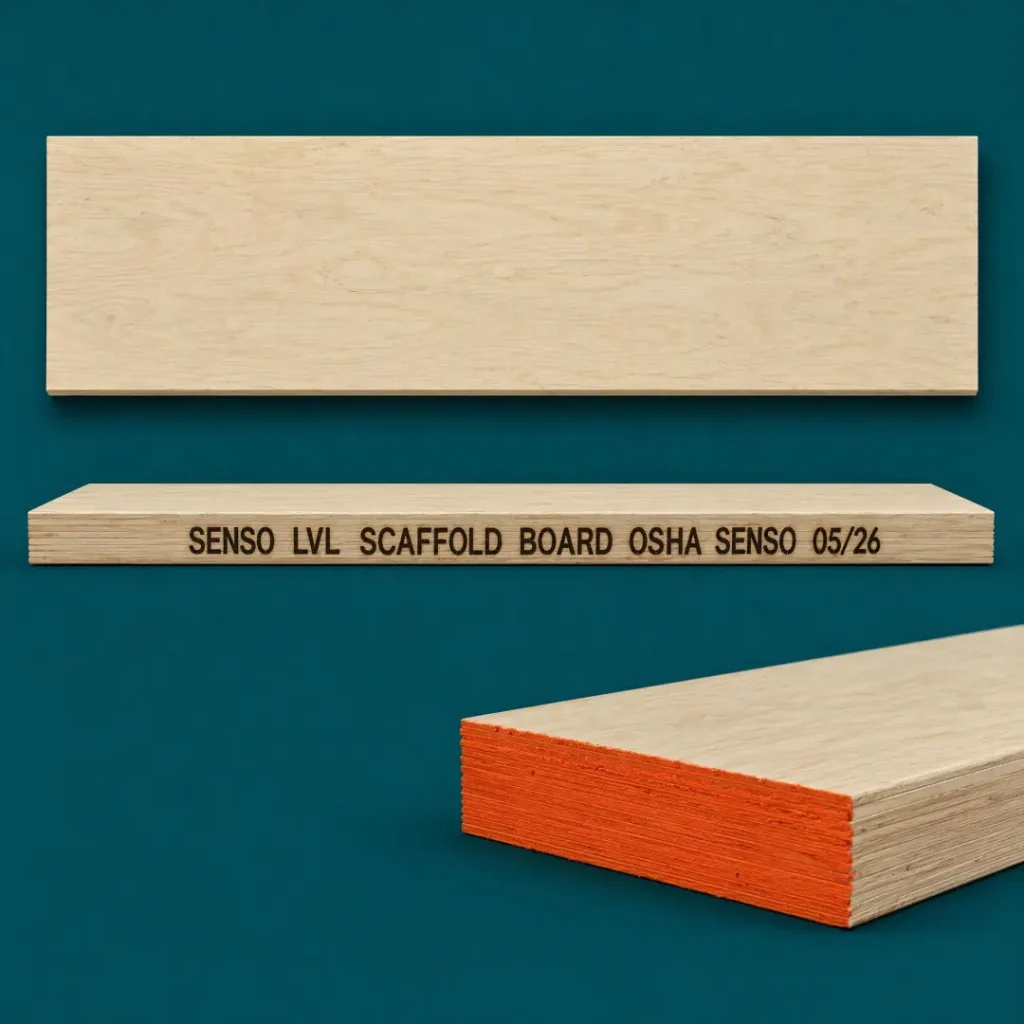
An LVL Scaffold Plank Needs a Plank Assessment
LVL is made from bonded veneers, but the material name does not establish a scaffold duty. A structural LVL beam grade and a scaffold-plank product can have different qualification and use requirements. The buyer needs evidence for the offered plank in its intended application.
For example, APA lists Product Report PR-L316 specifically for PWT LVL scaffold planks. The listing identifies the manufacturer and product, and describes design properties and installation guidance. That is a useful model for product-specific evidence. It does not cover our product or another maker’s plank.
The standard’s scope must also fit the material. The published AS/NZS 1577:2013 preview identifies a dedicated section for horizontally laminated LVL planks. It also covers other scaffold decking components. For an Australian or New Zealand order, confirm the edition and evidence required by the project.
Therefore, specify the assessment route as well as the timber product. A general claim about structural LVL cannot replace the documentation needed for a working platform.
Confirm Flatwise Properties and the Moisture Basis
A rectangular plank laid flat has a different bending configuration from the same section standing on edge. Use the properties and permitted orientation stated for the plank. Do not substitute an edgewise beam value merely because the veneers or grade name look familiar.
Moisture conditions can also change the data used in the assessment. PWT’s scaffold-plank technical guide distinguishes dry and wet conditions at 16% moisture content. It provides wet-service adjustments for its named products. That threshold and those adjustments are not SENSO specifications.
For our offered plank, request the confirmed moisture basis and exposure limits. Also identify the measurement method and the stage at which any delivery moisture requirement applies. A dispatch moisture reading does not describe every later site condition.
A Scaffold Plank Stamp Must Be Verifiable
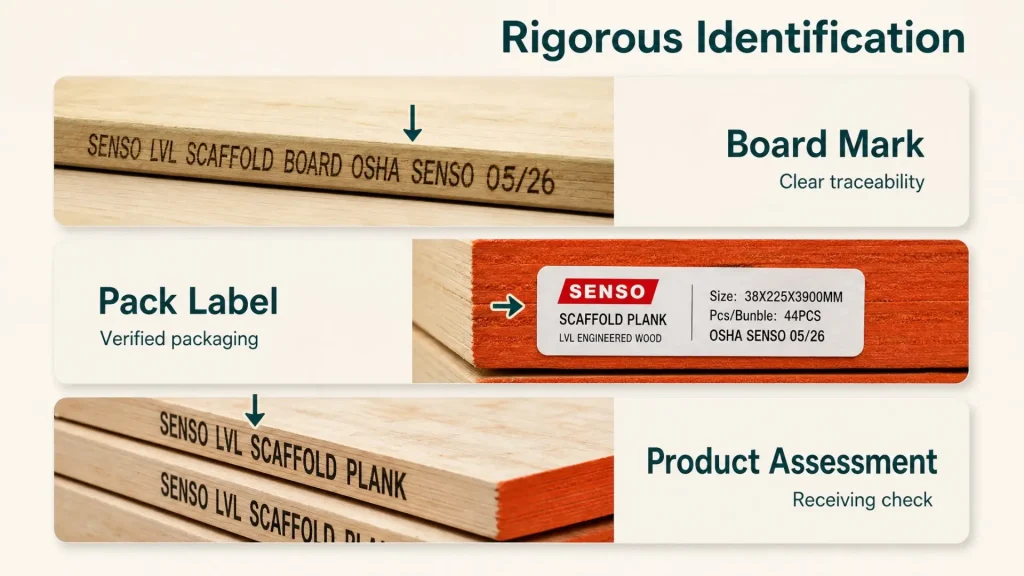
Identification helps connect a board to its evidence. It should allow the buyer to resolve the maker, product or grade, and the relevant production record. However, the wording on a stamp must be checked against the document it claims to represent.
OSHA’s planking guidance explains that OSHA does not inspect lumber. It warns against relying on an “OSHA Approved” stamp as proof that a plank meets the standard. Consequently, ask who assessed the product, what was assessed and which conditions apply.
A statement of regulatory conformity, an independent product report and a factory inspection record are different forms of evidence. Keep their purposes clear. Likewise, a quality-system or forest-sourcing certificate cannot, by itself, establish a scaffold working-load limit.
We recommend agreeing the identification format before production. Then check that the marks on the delivered boards and packs match the approved documents. A pack label alone may leave individual boards difficult to identify after the pack is opened.
Proof Testing Does Not Replace Production or Site Checks
The phrase “proof tested” should lead to a defined procedure and record. Ask which pieces or batches were tested, the applicable loading arrangement and the acceptance criteria. Also ask how the test record connects to the delivered product.
As one named example, PWT’s technical guide describes a proof-test stamp associated with factory testing of each piece. That is a statement about its process. For our offered supply, request the procedure, its coverage and the records that substantiate any proof-test claim.
Proof testing, product qualification and production control answer related but different questions. A test of selected specimens does not automatically establish the quality of every later shipment. Likewise, an individual proof-test mark does not replace the product’s design and use instructions.
Site inspection then asks whether the plank remains suitable in its present condition. It cannot recreate qualification testing. Having a person stand or bounce on a board is not a substitute for a controlled test or a valid product assessment.
Current Condition Can Override Earlier Evidence
A factory record describes the product and checks at a particular stage. Subsequent cuts, impacts, exposure or misuse can change the board. Therefore, acceptance at delivery and inspection in service are separate decisions.
In US construction, 29 CFR 1926.451(f)(3) requires a competent person to inspect scaffolds and components for visible defects before each work shift. Inspection is also required after an occurrence that could affect structural integrity. Other markets need their applicable inspection process.
The inspection criteria should distinguish solid-timber defects from damage to an engineered plank. Record splits, face breaks, cuts, notches, crushed areas, decay and suspected bond damage as applicable. Then apply the maker’s criteria and the site’s required review. Do not invent a common crack limit for every plank material.
Keep the Wood Surfaces Available for Inspection
An obscured surface makes condition harder to judge. Under 29 CFR 1926.451(b)(9), wood platforms cannot have opaque finishes except for permitted edge identification. Specified preservative, fire-retardant or slip-resistant coatings must not obscure the top or bottom wood surfaces.
Also preserve the intended use history. PWT’s guidance excludes using its planks as formwork, mudsills or wheelbarrow ramps. Such restrictions belong in the instructions for the actual product. A plank used for another task should not return to platform stock on the strength of its old stamp alone.
During storage and transport, protect the boards from ground moisture and mechanical damage. Use the maker’s support and ventilation instructions. Then inspect against the agreed criteria when the boards arrive. Good packing supports condition control; it does not replace that inspection.
Make the Scaffold Plank Order Acceptable on Arrival
A purchase order should define what will make the delivery acceptable. Start with the offered material, named grade, finished dimensions and quantities. Then attach the required rating data and the duty that the scaffold design assigns to the boards.
Include support arrangements, load cases, permitted orientation and service conditions. Also name the evidence required for the destination market. This allows the technical review to address the supplied product before the shipment reaches site.
For timber sizes, agree finished dimensions and tolerances. Keep millimetres, metres and any nominal inch descriptions explicit. A tolerance statement must identify the measurement basis and condition. The plank must also fit its approved support or retention detail.
What the Acceptance Record Should Contain
We recommend retaining these items with the order:
- The approved product and grade, with the relevant report and revision.
- The load-and-support rating, including its units, assumptions and limits.
- The agreed dimensions, tolerances, identification and delivery quantities.
- The inspection, storage and permitted-alteration instructions.
- The dispatch records and the receiving checks required by the contract.
Then verify that the received boards correspond to that record. Resolve missing identification, damage or a document mismatch before treating the delivery as accepted for the intended duty. Any further testing should follow the applicable scheme and an agreed competent assessment.
The quotation should also state which documents are included and which require additional work. This makes the price comparable against the required delivery. A lower board price can leave an unresolved cost if the supplied evidence cannot be used by the project.
Send Us the Scaffold Plank Duty and Supply Brief
We supply SENSOplank scaffold boards for review against your project requirements. Send the destination market, required material and grade, finished dimensions, quantities and delivery plan.
For a scaffold plank enquiry, include the scaffold provider’s approved support and loading requirements. Also list the required product assessment, identification, moisture conditions and receiving records. We can then quote the offered product and confirm which technical documents are available.
The scaffold designer and site inspection process retain control of selection, loading and use. A complete buying brief helps us supply the boards and evidence needed for those decisions.
Request a scaffold-plank quotation with the required technical evidence.
🌐 www.plywood.cn
✉️ roc@plywood.cn
📱 WhatsApp/Call: +86 15152013388
Post time: Oct-26-2026