

What is MDF board? MDF board, or medium density fibreboard, is an engineered wood panel made from wood fibres, resin, wax, heat, and pressure. It has a smooth surface, a uniform fibre structure, and good machining performance for many interior furniture and decorative panel uses.
However, MDF is different from plywood. Plywood uses veneer layers, while MDF uses refined wood fibres pressed into a dense board. As a result, each product performs differently in surface finish, painting, routing, screw holding, edge strength, moisture risk, weight, cost, and final application.
For global buyers, MDF board is not only a low cost furniture material. In practice, it works well for cabinet doors, shelves, wardrobes, wall panels, decorative profiles, shopfitting, acoustic panels, laminated boards, and interior furniture systems. Therefore, buyers should check density, thickness, surface quality, emission class, moisture grade, edge treatment, packing, and final use before placing bulk orders.
Quick Answer What Is MDF Board
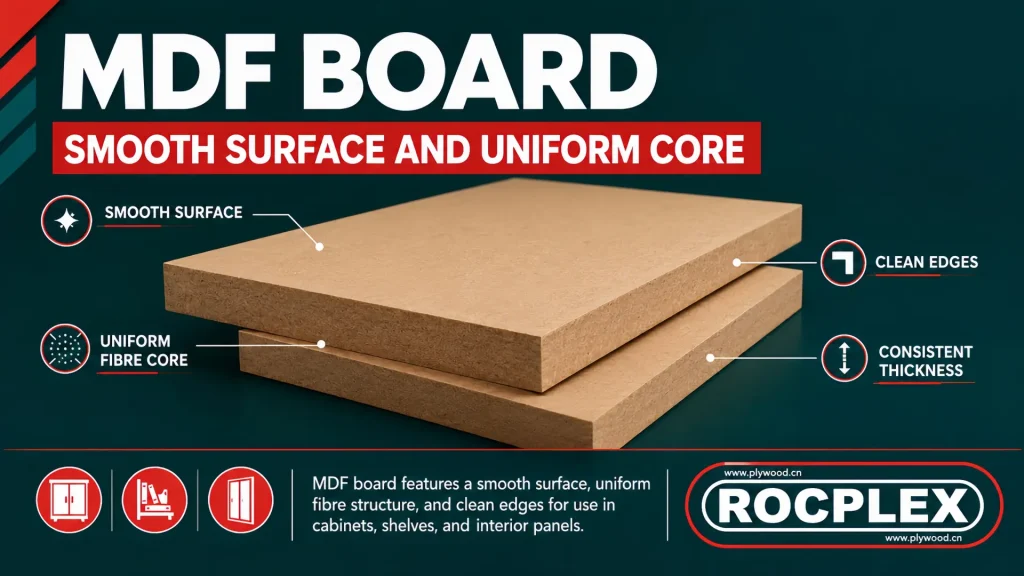
MDF board is a medium density fibreboard made from wood fibres bonded with resin and pressed into a smooth engineered wood panel. Buyers use MDF for painted cabinet doors, furniture parts, shelves, wardrobes, wall panels, decorative profiles, laminated boards, and interior fit out projects where a smooth surface and stable machining matter.
What Is MDF Board Made From
MDF board starts with wood fibres. Manufacturers often use wood chips, sawmill residues, or plantation wood as raw material. Then they refine the fibres, dry them, blend them with resin and wax, and press them into a board under heat and pressure.
The process creates a panel with a smooth face and a uniform core. Unlike plywood, MDF does not have visible layers. Unlike OSB, it does not have large wood strands. Instead, its fine fibre structure gives buyers a clean surface for painting, laminating, routing, and decorative processing.
For a buyer asking what is MDF board as a product category, the answer should include density, resin system, emission class, thickness, face quality, moisture grade, and use condition. These details decide whether the board will perform well in furniture, cabinets, doors, shelves, or interior projects.
| Part | What it means | Why buyers should care |
|---|---|---|
| Wood fibres | Fine fibres refined from wood material | They control the smooth surface and uniform structure |
| Resin bond | Adhesive that bonds the fibres | It affects board strength, quality, and emission level |
| Wax | Additive used to improve water shedding | It helps reduce moisture uptake in normal interior use |
| Density | Mass of board per volume | It affects weight, machining, screw holding, and strength |
| Surface | Smooth outer face of the board | It matters for painting, laminating, and decorative finish |
| Edge | Cut side of the board | It often needs sealing or banding in furniture applications |
How MDF Board Is Manufactured
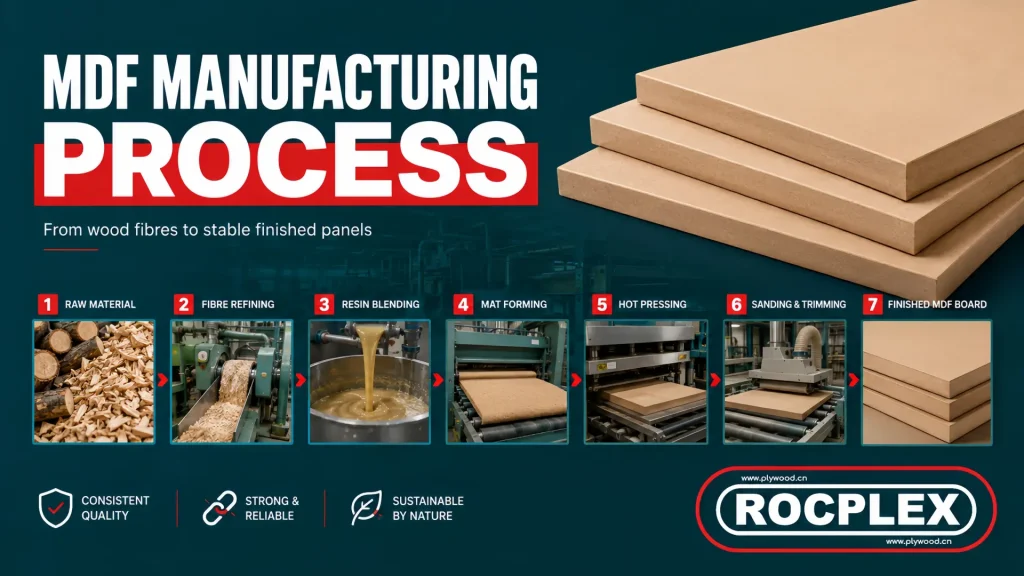
MDF production needs steady control. Even a small change in fibre quality, resin content, moisture level, pressing, or sanding can affect the final board. For this reason, repeat buyers should judge factory control, not only sheet price.
- Raw material preparation. The factory selects and prepares wood chips or fibres.
- Fibre refining. The production line breaks wood material into fine fibres.
- Drying. The factory dries fibres to a controlled moisture level.
- Blending. Resin, wax, and additives are mixed with the fibres.
- Mat forming. The blended fibres form a loose mat.
- Hot pressing. Heat and pressure compress the mat into a dense panel.
- Cooling and conditioning. The board cools and stabilises before finishing.
- Sanding and trimming. The surface is sanded, and the panel is cut to size.
- Inspection and packing. Inspectors check density, thickness, surface, moisture, and pallets.
Good MDF should have stable thickness, smooth sanding, even density, clean edges, correct moisture, and reliable packing. In addition, buyers should check repeat order stability, because one good sample does not always prove steady bulk quality.
How the Fibre Structure Works
The fibre structure explains why MDF board is popular in furniture and interior work. The board has a uniform body from face to core, so it machines in a predictable way. For example, factories can cut, route, groove, drill, paint, veneer, or laminate it with good control.
This structure gives MDF a smooth surface. Therefore, it suits painted cabinet doors, decorative profiles, melamine boards, veneer panels, PVC film panels, paper overlays, and high pressure laminate bases.
At the same time, the same structure creates limits. MDF is usually heavier than many plywood panels. Standard MDF can swell if moisture enters the surface or edge. Also, screw holding near the edge needs careful design, pilot holes, and correct hardware.
Common MDF Board Sizes and Thicknesses
MDF board is commonly supplied in large sheets for furniture factories, distributors, interior contractors, and panel processors. The widely used size is 2440 × 1220 mm, also known as 8 × 4 ft. In addition, buyers may order 2500 × 1250 mm, 2800 × 2070 mm, 3050 × 1220 mm, or custom cut sizes.
Common thicknesses include 2.5 mm, 3 mm, 6 mm, 9 mm, 12 mm, 15 mm, 16 mm, 18 mm, 25 mm, and thicker panels for special work. Thin MDF often works for drawer bottoms, back panels, door skins, and decorative layers. Meanwhile, medium and thick MDF fit cabinet parts, shelves, wardrobes, worktops, doors, and routed profiles.
| Size or thickness | Common use | Buyer note |
|---|---|---|
| 2440 × 1220 mm | Furniture, cabinets, shelves, wall panels | Common stock size in many markets |
| 2500 × 1250 mm | Furniture cutting and panel processing | Can improve cutting yield for some factories |
| 2800 × 2070 mm | Door skins, decorative panels, large format use | Check handling and loading plan |
| 3 mm to 6 mm | Back panels, drawer bottoms, overlay base | Check flatness and surface quality |
| 12 mm to 18 mm | Cabinets, shelves, wardrobes, furniture parts | Common furniture thickness range |
| 25 mm and above | Worktops, thick profiles, special components | Check density, weight, and machining need |
What Is MDF Board Used For
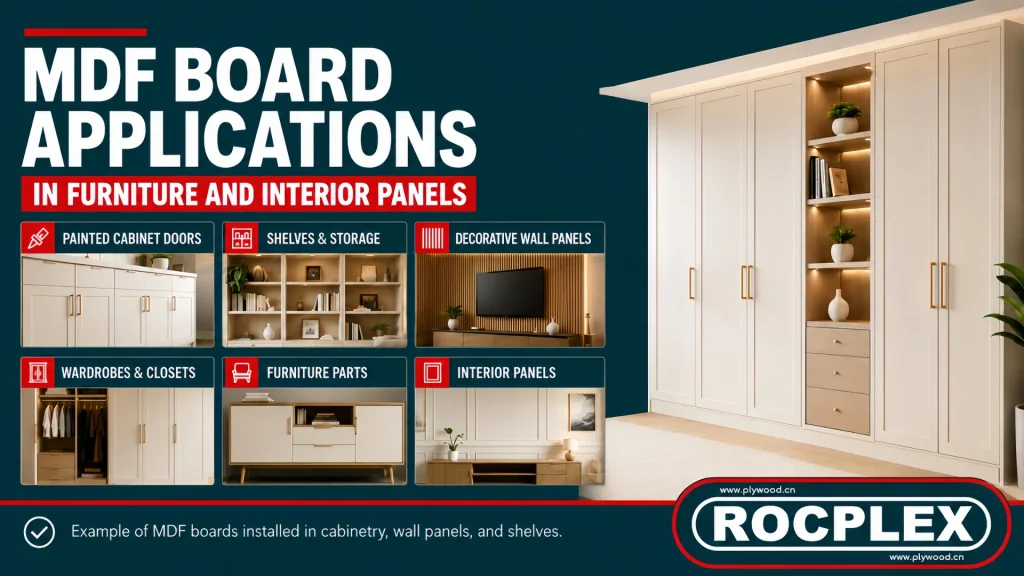
What is MDF board used for in real buying? Most demand comes from furniture, cabinets, interior decoration, and panel processing. Buyers choose MDF when they need a smooth surface, stable machining, and a board that accepts paint or overlays well.
For example, cabinet makers use MDF for painted doors, side panels, shelves, drawer parts, and wardrobes. Interior contractors use it for wall panels, partitions, acoustic panels, decorative strips, and shopfitting. Door factories use thin MDF skins or thicker routed panels. In addition, panel processors use MDF as a base for melamine, veneer, PVC film, or laminate.
However, MDF is less suitable for heavy wet areas, exterior work, exposed structural use, or load bearing applications unless the grade and protection match the job. Therefore, buyers should always match the board to the final condition.
| Application | Why MDF fits | Buyer check |
|---|---|---|
| Painted cabinet doors | Smooth surface and clean routing | Density, surface, edge sealing, paint process |
| Wardrobes and cabinets | Flat board and easy processing | Thickness, screw design, overlay choice |
| Shelves | Cost effective interior panel | Span, thickness, edge banding, load |
| Wall panels | Smooth decorative surface | Moisture level, finish, fixing method |
| Shopfitting | Good for profiles and painted displays | Machining, surface finish, density |
| Melamine faced boards | Stable substrate for decorative surface | Surface quality, board density, lamination bond |
| Door skins and decorative layers | Thin, smooth, and workable | Flatness, thickness, surface quality |
MDF Board Types Buyers Should Know
Not all MDF is the same. Therefore, buyers should not treat MDF as one simple product. Different board types serve different use conditions, project rules, and price levels.
Standard MDF works for general interior furniture and decoration. Moisture resistant MDF helps in higher humidity interior areas, but it still needs suitable sealing and correct use. Fire rated MDF may be needed for some public, commercial, or project interiors. Thin MDF works for backing, doors, overlays, and decorative parts. High density fibreboard can fit harder, denser panel needs.
In addition, buyers should check emission level. Many markets require low formaldehyde emission products for furniture and interior panels. Common buying terms may include E0, E1, CARB P2, EPA TSCA Title VI, or other local requirements.
MDF Board Compared With Plywood
Many buyers ask what is MDF board because they want to compare it with plywood. Both are engineered wood panels, but they fit different needs.
MDF is often better for smooth painted surfaces, routed profiles, decorative panels, and cost controlled interior furniture. Plywood is often better for strength, screw holding, lighter handling, edge durability, shelves, crates, formwork, and panels that need stronger structure.
In many cases, the best solution uses both products. A cabinet factory may use MDF for painted doors and plywood for cabinet boxes. A wholesaler may stock both products. A project buyer may choose MDF for interior wall panels and plywood for stronger backing or site use.
| Factor | MDF board | Plywood | Buyer meaning |
|---|---|---|---|
| Structure | Compressed wood fibres | Layered wood veneers | MDF is uniform. Plywood is layered and stronger in many uses. |
| Surface | Very smooth | Depends on face veneer or overlay | MDF is strong for painting. |
| Screw holding | Good on face, weaker on edges | Usually stronger, especially near edges | Plywood is often better for hardware points. |
| Moisture risk | Standard MDF is moisture sensitive | Depends on glue and grade | Both need correct grade for wet conditions. |
| Weight | Often heavier | Varies by core | MDF may add handling and freight weight. |
| Best use | Painted and decorative interiors | Strength, structure, and wider uses | Use both where each product performs best. |
For a deeper side by side guide, buyers can read plywood vs MDF. That comparison explains how structure, screw holding, finish, moisture, weight, and cost affect product choice.
Moisture Risk and Edge Sealing
Moisture control is one of the most important MDF buying points. Standard MDF is designed mainly for dry interior use. However, if water enters the surface or edge, the board can swell and lose strength.
Moisture resistant MDF can improve performance in higher humidity interior areas. Still, it does not remove the need for sealing. Edges should be sealed, painted, banded, or protected based on the final use. Bathrooms, kitchens, laundries, and commercial interiors need special care.
Export buyers should also think about shipment and storage. Panels need stable moisture, dry warehousing, strong wrapping, clean pallets, and container loading control. Otherwise, weak protection can damage a good board before it reaches the user.
How to Check MDF Board Quality
Buyers should not judge MDF only by colour or surface look. Instead, they should check density, thickness, surface sanding, edge quality, moisture content, emission class, machining result, packing, and documents.
- Check the final application and grade requirement.
- Confirm sheet size, thickness, and tolerance.
- Review density and board weight.
- Check surface smoothness and sanding quality.
- Inspect edge strength and edge absorption risk.
- Confirm moisture content before shipment.
- Check emission class and certificate needs.
- Test cutting, routing, drilling, and painting if needed.
- Review pallet strength, wrapping, labels, and marks.
- Confirm documents before container loading.
These checks are useful for furniture factories, cabinet makers, panel processors, distributors, and project buyers. As a result, they reduce cutting waste and help keep repeat orders stable.
Common MDF Board Sourcing Mistakes
Many MDF complaints start with the wrong grade, unclear use, or weak packing. In other words, the board may be acceptable for one market and unsuitable for another.
- Using standard MDF in areas with moisture risk.
- Choosing low density board for heavy shelves or hardware fixing.
- Ignoring edge sealing for painted or wet area furniture.
- Comparing only sheet price without checking density and emission class.
- Ordering by thickness name without checking real tolerance.
- Using MDF where plywood would provide better screw holding.
- Skipping sample routing or painting before bulk orders.
- Forgetting pallet strength and dry shipment protection.
These mistakes can cause swelling, weak fixing, paint defects, high waste, slow production, and customer claims. Therefore, a clear specification prevents many problems before production starts.
Wholesale Buyer Checklist
Before placing a bulk MDF order, buyers should confirm the full specification. This is important for importers, wholesalers, furniture factories, interior contractors, and panel processors.
- Final application and interior condition.
- Standard MDF, moisture resistant MDF, fire rated MDF, or special grade.
- Sheet size and thickness.
- Required density and weight range.
- Surface sanding quality and overlay plan.
- Edge use, sealing method, and banding need.
- Emission class and certificate requirement.
- Moisture content and storage plan.
- Pallet strength and container loading method.
- Labels, marks, invoice, packing list, and documents.
How ROC Supports MDF Buyers
ROC works as a plywood led engineered wood supply platform. Plywood remains the main product axis, while MDF, OSB, particle board, LVL timber, H20 beams, I joists, and related products support wider buyer needs.
For buyers asking what is MDF board and whether it fits their market, ROC can help review size, thickness, density, grade, emission class, surface quality, moisture risk, packing, and container loading. This support helps buyers choose the right panel before production starts.
For example, a furniture factory may choose MDF for painted cabinet doors and plywood for stronger carcasses. A distributor may need MDF, plywood, OSB, and particle board to cover several customer groups. A project buyer may need a low emission MDF panel for interior work and other engineered wood panels for structure or backing.
For more background, read what is plywood, plywood vs MDF, and the Resources center. Buyers can also review MDF board, compare plywood products, or send sourcing details through the contact page.
FAQ
What is MDF board used for?
MDF board is used for painted cabinet doors, shelves, wardrobes, wall panels, decorative profiles, shopfitting, door skins, laminated boards, and interior furniture.
Is MDF board the same as plywood?
No. MDF is made from compressed wood fibres. Plywood is made from veneer layers. The two panels have different strength, surface, edge, and moisture performance.
Is MDF board waterproof?
Standard MDF is not waterproof. Moisture resistant MDF can perform better in humid interior areas, but it still needs sealing and correct use.
Is MDF board good for cabinets?
Yes. MDF is widely used for cabinet doors, shelves, panels, and painted parts. However, for strong cabinet carcasses or heavy hardware, buyers may also consider plywood.
Is MDF cheaper than plywood?
MDF is often cheaper than high grade plywood for smooth interior furniture parts. Still, the best value depends on density, finish, hardware, moisture risk, and final use.
What should buyers check before ordering MDF?
Buyers should check grade, density, size, thickness, tolerance, surface quality, edge strength, moisture content, emission class, packing, and loading plan.
Official References for Further Reading
Post time: Jun-17-2026