

What is OSB board? OSB board, or oriented strand board, is an engineered wood panel made from long wood strands bonded with resin and pressed into a strong sheet. The strands are arranged in planned layers, so the panel can serve many building, packaging, and industrial uses.
OSB is different from plywood. Plywood uses thin veneer layers. OSB uses wood strands. This difference affects surface texture, edge quality, moisture behaviour, panel weight, price, cutting result, and final application.
For global buyers, OSB board is not only a low cost panel. It is a practical material for roof sheathing, wall sheathing, subfloors, temporary hoarding, packaging, pallets, crates, and general construction panels. The best result depends on grade, thickness, resin type, density, edge condition, storage, and correct use.
Quick Answer What Is OSB Board
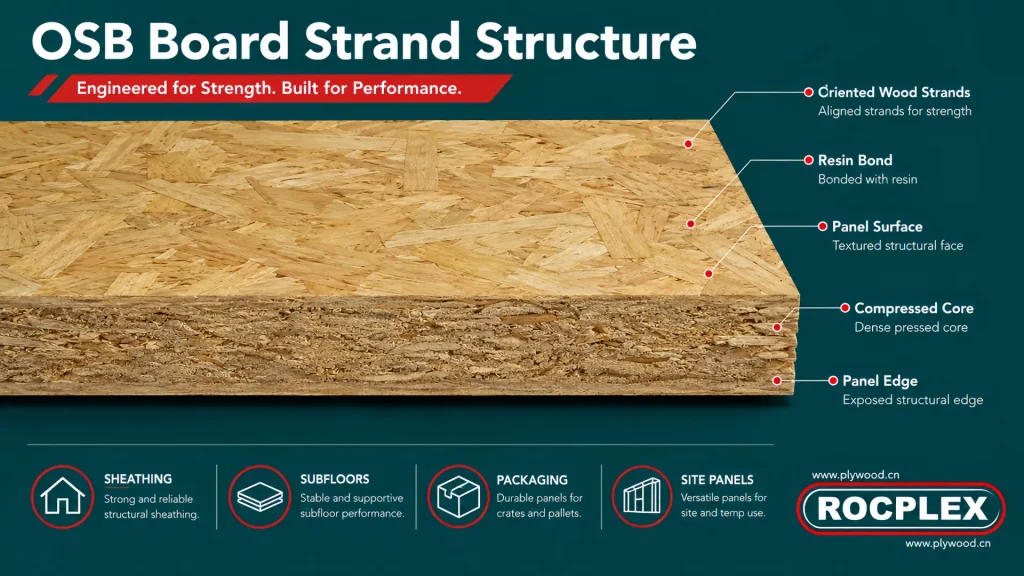
OSB board is an engineered wood sheet made from oriented wood strands and resin. Buyers use it for sheathing, subfloors, wall panels, roof decks, packaging, temporary site panels, and cost effective structural panel applications. It is often chosen when strength, sheet size, and price balance matter more than a smooth decorative face.
What Is OSB Board Made From
OSB board is made from wood strands, resin, wax, heat, and pressure. The strands are usually cut from small diameter logs or fast growing wood species. They are dried, mixed with resin, arranged into layers, and pressed into a finished panel.
The surface strands often run in the long direction of the panel. The inner strands may run in a different direction. This layout helps improve strength and stiffness. It also gives OSB its clear strand pattern.
For a buyer, what is OSB board as a product category? It is a strand based engineered panel. Its value comes from controlled raw material, resin bonding, pressing, thickness control, density, and grade selection. It should be judged by structure and application, not by surface look alone.
| Part | What it means | Why buyers should care |
|---|---|---|
| Wood strands | Long chips arranged in layers | Control panel strength and surface texture |
| Resin bond | Adhesive that bonds the strands | Affects strength and moisture performance |
| Wax | Water shedding additive | Helps reduce moisture uptake |
| Panel density | Mass of board per volume | Affects weight, strength, and handling |
| Thickness | Final sheet thickness | Affects span, stiffness, load, and cost |
| Edge condition | Exposed side of the panel | Important for swelling, handling, and fixing |
How OSB Board Is Manufactured
OSB production follows a controlled process. Each step affects the final sheet. Good OSB needs stable strands, proper drying, correct resin use, accurate forming, strong pressing, and reliable trimming.
- Log preparation. Logs are debarked and prepared for strand cutting.
- Strand cutting. Long wood strands are cut to the required size.
- Drying. The strands are dried to a controlled moisture range.
- Blending. Resin and wax are mixed with the strands.
- Mat forming. Strands are arranged into planned layers.
- Hot pressing. Heat and pressure bond the mat into a board.
- Trimming. The panel is cut to the final size.
- Grading and packing. Panels are checked, stacked, wrapped, and prepared for shipment.
Buyers should care about this production chain. A panel may look acceptable, but weak resin bonding, poor density control, or wet storage can affect performance. Stable production is important for repeat wholesale orders.
How the Strand Structure Works
The strand structure is the main reason OSB board works as a building panel. The long strands are not placed at random. They are arranged in layers to give the sheet useful strength and stiffness.
This structure makes OSB suitable for roof decks, wall sheathing, and subfloor panels when the grade and installation method match the project. It also makes OSB useful for packaging and temporary work where a smooth face is not required.
OSB surface texture is rougher than plywood. This is normal. Buyers should not judge OSB by the same visual rules as furniture plywood. The key checks are grade, thickness, density, resin bond, edge quality, and use condition.
Common OSB Board Sizes and Thicknesses
OSB board is commonly supplied in large sheet sizes. The most common size in many markets is 2440 × 1220 mm, also called 8 × 4 ft. Some projects or markets may use 2500 × 1250 mm, 2440 × 590 mm flooring panels, tongue and groove panels, or custom sizes.
Common thicknesses include 6 mm, 9 mm, 11 mm, 12 mm, 15 mm, 18 mm, and 22 mm. Thicker panels are often used where stiffness, span, or load matters. Thin panels may serve packaging, lining, or temporary use.
| Size or thickness | Common use | Buyer note |
|---|---|---|
| 2440 × 1220 mm | General construction, sheathing, packaging | Common stock size in many markets |
| 2500 × 1250 mm | European panel use and project supply | Check market demand and loading plan |
| Tongue and groove panels | Flooring and subfloor systems | Check profile, fit, and edge protection |
| 9 mm to 12 mm | Wall panels, packaging, lining | Check stiffness and fixing need |
| 15 mm to 18 mm | Sheathing, subfloors, general building panels | Common construction thickness range |
| 22 mm and above | Heavier flooring and load related use | Check span, standard, and panel grade |
OSB Board Grades and Use Conditions
OSB board grades are linked to use conditions. Some boards are made for general interior use. Others are made for load bearing use or humid conditions. Buyers must match the grade with the job.
For construction use, grade and standard matter. A general panel should not be used as a structural panel unless it meets the required specification. For humid or temporary exposed areas, moisture performance and edge protection become more important.
Buyers should confirm the target market standard, grade name, thickness, density, resin type, moisture content, and marking before ordering. This is especially important for building suppliers and project buyers.
OSB Board Compared With Plywood
Many buyers ask what is OSB board because they want to compare it with plywood. Both products are engineered wood panels, but they fit different needs.
Plywood usually gives cleaner edges, better visible surface options, and broader furniture use. It is often chosen for cabinets, formwork, crates, furniture parts, and panels that need better appearance or fastener holding near edges.
OSB is often chosen for cost effective sheathing, roof decks, wall panels, subfloors, hoarding, packaging, and general construction panels. Its strand surface is acceptable in many hidden or industrial uses.
| Factor | OSB board | Plywood | Buyer meaning |
|---|---|---|---|
| Structure | Oriented wood strands | Layered wood veneers | Different structure gives different performance |
| Surface | Visible strand texture | Veneer or finished face | Plywood is better for visible finish |
| Cost | Often cost effective | Varies by grade and core | OSB can reduce cost in sheathing |
| Edge quality | Can be rougher and moisture sensitive | Usually cleaner and stronger | Plywood often suits hardware and exposed edges |
| Construction use | Common for sheathing and subfloors | Common for structural and formwork uses | Both need correct grade |
| Furniture use | Limited and mainly hidden use | Broad furniture and cabinet use | Plywood is more flexible for furniture buyers |
For a deeper side by side guide, buyers can read plywood vs OSB. That comparison helps decide which panel fits each application.
Best Uses for OSB Board
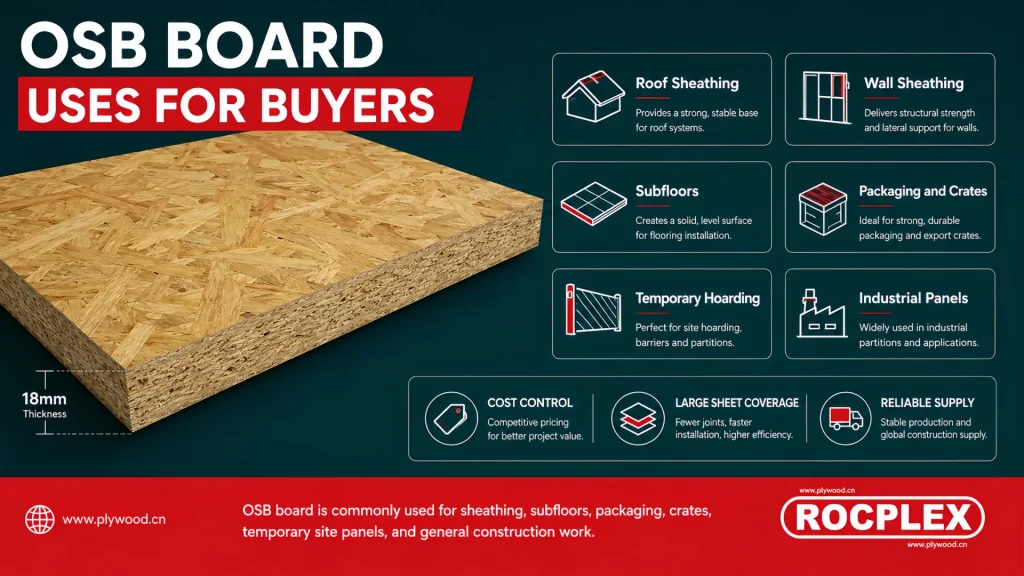
OSB works best when the buyer needs a strong, large, cost effective panel and does not need a fine decorative face. It is common in construction and packaging markets.
| Application | Why OSB fits | Buyer check |
|---|---|---|
| Roof sheathing | Large panels and structural use | Grade, thickness, span, and exposure |
| Wall sheathing | Cost effective building panel | Standard, fastener pattern, and moisture control |
| Subfloors | Good stiffness when correct grade is used | Thickness, tongue and groove option, and load need |
| Temporary hoarding | Affordable site panel | Weather exposure and edge protection |
| Packaging and crates | Useful strength and cost balance | Weight, moisture, and pallet loading |
| Industrial lining | Large sheet coverage | Surface requirement and fixing method |
| Wholesale stock | Regular construction demand | Local size, thickness, and grade habits |
Moisture Risk and Storage
Moisture control is important for OSB board. OSB can be made for humid or structural use, but poor storage can still create problems. Edges are especially important because they can absorb moisture and swell if exposure is too long.
Buyers should ask how the panels are wrapped, stacked, stored, and loaded. Goods should be protected from rain during transport and warehouse handling. On site, panels should be installed and covered according to the project requirement.
For export buyers, pallet strength and edge protection matter. Long sea transport, container humidity, and rough unloading can damage panels if packing is weak. Moisture risk should be part of the purchase discussion before production.
How to Check OSB Board Quality
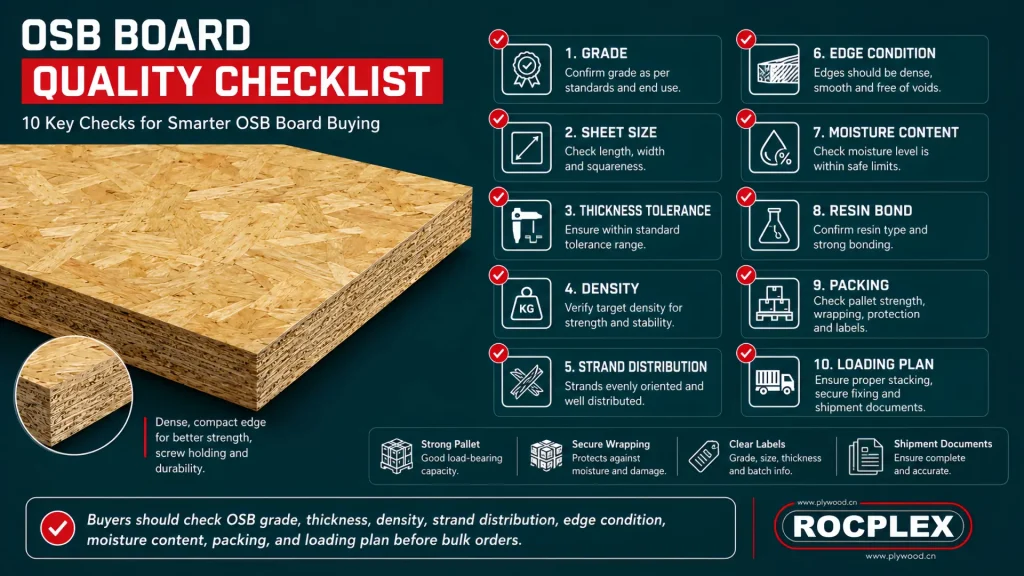
Buyers should not judge OSB only by surface colour. A good check should cover panel structure, grade, density, thickness, edge quality, bonding, moisture, packing, and documents.
- Check the grade and intended use.
- Confirm sheet size, thickness, and tolerance.
- Review density and panel weight.
- Check strand distribution and surface condition.
- Inspect edges for damage or swelling.
- Check moisture content before shipment.
- Confirm resin bond and standard claims.
- Test cutting, fixing, and handling if needed.
- Review pallet strength, wrapping, and marks.
- Confirm documents before container loading.
These checks are simple, but they protect repeat buyers. They reduce claims and help wholesalers keep stable quality across shipments.
Common OSB Board Sourcing Mistakes
Many OSB complaints start with a wrong application or unclear specification. The panel may be acceptable for one use and poor for another.
- Using general OSB for structural work without checking grade.
- Choosing OSB for visible furniture parts that need a smooth finish.
- Ignoring edge swelling risk in wet or exposed conditions.
- Comparing only sheet price without checking density and grade.
- Forgetting thickness tolerance and squareness.
- Not checking local market size habits.
- Skipping pallet and wrapping checks for export orders.
- Using OSB where plywood would give better edge or screw performance.
These mistakes can create waste, slow installation, reduce resale value, and cause buyer complaints. A clear order should name the application first, then the grade, size, thickness, and packing need.
Wholesale Buyer Checklist
Before placing a bulk order, buyers should confirm the full specification. This is especially important for importers, building material distributors, packaging buyers, and project suppliers.
- Final application and exposure level.
- Target market grade or standard.
- Sheet size and thickness.
- Required tolerance and squareness.
- Panel density and weight range.
- Surface and edge quality need.
- Moisture content and storage plan.
- Structural use or non structural use.
- Pallet strength and container loading plan.
- Label, marking, invoice, and document requirements.
How ROC Supports OSB Buyers
ROC works as a plywood led engineered wood supply platform. Plywood remains the main product axis, while OSB, MDF, particle board, LVL timber, H20 beams, I joists, and related products support wider buyer needs.
For buyers asking what is OSB board and whether it fits their market, ROC can help review application, size, thickness, grade, density, packing, moisture risk, and container loading. This helps buyers avoid using the right panel in the wrong place.
A construction buyer may need OSB for sheathing and plywood for cleaner edge use. A packaging buyer may compare OSB and plywood for cost and strength. A wholesaler may need both products to serve different customer groups.
For more background, read what is plywood, plywood vs OSB, and the Resources center. Buyers can also review OSB board, compare plywood products, or send sourcing details through the contact page.
FAQ
What is OSB board used for?
OSB board is used for roof sheathing, wall sheathing, subfloors, packaging, crates, temporary hoarding, site panels, and general construction panels.
Is OSB board the same as plywood?
No. OSB is made from oriented wood strands. Plywood is made from veneer layers. The two panels have different surfaces, edges, structures, and best uses.
Is OSB board waterproof?
OSB is not automatically waterproof. Moisture performance depends on grade, resin, edge protection, storage, and exposure level. Buyers should choose the correct grade.
Is OSB board good for furniture?
OSB is not usually chosen for fine furniture or visible cabinet parts. It can be used in hidden, industrial, or cost driven applications where the strand surface is acceptable.
Which is cheaper, OSB or plywood?
OSB is often cheaper than plywood in sheathing and packaging uses. The best value depends on grade, thickness, moisture risk, edge quality, and final application.
What should buyers check before ordering OSB?
Buyers should check grade, size, thickness, density, moisture content, edge condition, intended use, standard claims, packing, pallet strength, and loading plan.
Official References for Further Reading
Post time: Jun-16-2026