

Plywood density is often reduced to one question: how many kilograms are in one cubic metre? That figure matters, but it does not tell the full story.
In plywood, density is the visible result of several hidden choices. Veneer species, core gaps, veneer thickness, pressing, glue content, moisture, overlays, and actual panel thickness all affect the final figure. Therefore, two panels can show a similar average density while behaving very differently during cutting, fixing, packing, loading, or end use.
For buyers, density should not be treated as a simple quality ranking. A dense panel is not automatically better. A lighter panel is not automatically weak. The value comes from whether the panel construction suits the job and whether the supplier can repeat that construction across the full order.

Plywood Density in One Buyer Rule
Use plywood density as a product-control signal, not as a stand-alone buying rule.
A useful density review should answer five questions: what the panel is made from, at what moisture condition the density was checked, whether the core looks balanced and stable, whether the panel matches the intended use, and whether the factory can keep the same construction across future shipments.
Density becomes useful when it supports a wider product specification. It becomes misleading when buyers use it to replace core checks, glue confirmation, thickness control, panel grading, and real application testing.
Density Is a Clue Not a Grade
A panel with higher density often feels heavier and more solid. However, that first impression can hide important differences.
What a Higher Figure Can Suggest
Higher plywood panel density may indicate more wood material within the same panel volume. In some products, it may also suggest denser veneers, a tighter core build, stronger edge feel, or more resistance to handling damage.
For cabinet parts, a denser build may support better screw holding and cleaner routing. For packing panels, it may improve nail holding and impact resistance. Formwork, a balanced dense construction may help the panel remain stable through repeated handling.
However, these are product tendencies, not automatic guarantees. The buyer still needs to check the full construction.
What Density Cannot Prove
Plywood density does not prove structural rating, glue bond, formaldehyde level, water resistance, face quality, flatness, or certification status.
It also does not prove that a panel has no core gaps. A panel can contain dense face veneers while hiding weak sections in the middle. It can feel heavy because of moisture or overlays rather than a stronger core build.
Therefore, a density number should be read as one part of a panel profile. It cannot replace product data, inspection records, or job-specific requirements.
A Plywood Density Guide Needs a Clear Measurement Basis
Density means mass divided by volume. However, the value becomes unreliable when the buyer and supplier measure different things.
A practical plywood density guide should state panel length and width, actual thickness rather than nominal thickness only, net panel mass, moisture condition at measurement, whether film or treatment is included, and whether the figure represents one panel, an average batch, or a laboratory test sample.
For example, two suppliers may both offer 18 mm plywood. One may calculate density using the nominal 18 mm thickness. The other may use actual measured thickness. One may weigh panels after drying. The other may weigh panels after storage in a humid factory area.
The figures may look close on paper. Yet they may not be directly comparable.
Compare Like With Like
The best comparison is between panels with the same format, actual thickness range, moisture condition, surface treatment, and intended use.
Comparing a raw furniture panel with film-faced formwork plywood is not useful. Comparing a light packing panel with a dense cabinet panel is not useful either. The job, panel build, and measurement basis must remain aligned.
A buyer should first define the product family. Then density can help compare alternative constructions inside that family.
Moisture Changes the Result
Wood exchanges moisture with its surroundings. As a result, panel mass can change during production, storage, sea freight, and warehouse handling.
This is why a plywood density chart should never be treated as fixed forever. A panel weighed in one climate may show a different figure after long storage in another climate.
For practical procurement, buyers should ask suppliers to state the target moisture condition before packing. Then density, panel mass, and container planning can be reviewed against a more stable reference.
Read the Panel From Its Edges
The edge often reveals more than the face.
A clean face can hide core gaps, overlaps, thin inner veneers, uneven veneer placement, or weak glue lines. By contrast, a clean cut edge can show whether the panel has balanced layers and a more consistent core structure.
When reviewing plywood density, buyers should inspect the panel edge for visible core gaps, veneer overlap or poor scarfing, uneven inner veneer thickness, loose or open glue lines, localised voids, severe density changes from face to core, and edge crush after handling.
This does not mean a buyer should judge a panel only by visual edge appearance. However, it gives a fast first check before large-scale machining or production begins.
A good panel does not need to look identical at every layer. It needs to show a controlled construction that fits the product purpose.
Average Density Can Hide a Poor Core
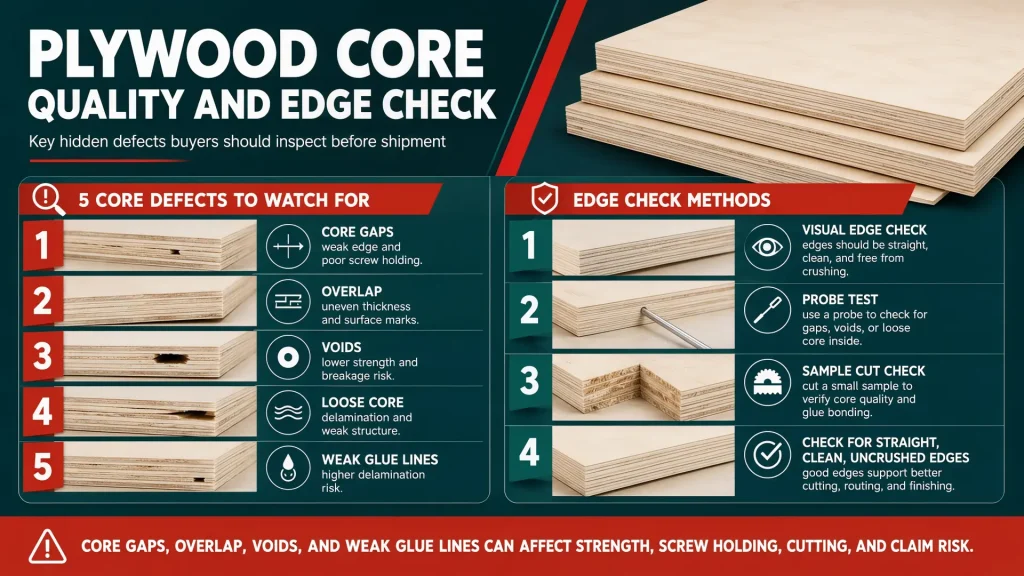
The most important density lesson is that average mass can conceal uneven panel construction.
Imagine two sheets with the same size, thickness, and measured mass.
The first uses balanced veneers throughout the core. The second uses heavier face veneers, more glue in some areas, and lighter or inconsistent core veneers inside. Both sheets can produce a similar average figure. Yet the second sheet may perform worse when cut, drilled, edge-banded, or screwed.
This is why plywood core density matters more than the average number alone.
| Buyer Check | What It Reveals | Why It Matters |
|---|---|---|
| Total panel mass | Overall material level | Useful for freight and first comparison |
| Actual thickness | True panel volume | Prevents misleading density calculation |
| Cut-edge inspection | Core consistency and veneer layout | Helps identify gaps and weak edge zones |
| Screw or nail trial | Local holding performance | Useful for furniture, packing, and site panels |
| Routing or machining trial | Edge finish and tear-out risk | Useful for CNC and joinery work |
| Flatness check | Balanced construction and moisture effect | Reduces assembly and installation problems |
| Batch sampling | Repeat supply control | Confirms the shipment matches the approved build |
A buyer does not need every test for every product. However, the panel should be checked in the same way it will be used.
Match the Construction to the Job
The right density is not universal. It depends on what the panel must do after delivery.
| Product Use | Density Question to Ask | Other Checks That Matter |
|---|---|---|
| Furniture and cabinetry | Will the panel machine cleanly and hold screws? | Face quality, thickness range, flatness, core build |
| Shopfitting and visible interiors | Does the panel feel stable and finish well? | Veneer appearance, sanding, colour consistency, edge quality |
| Packing and crate production | Does the panel give useful strength without unnecessary freight mass? | Nail holding, glue, cut yield, panel weight |
| Formwork and concrete work | Does the construction support reuse and handling? | Film, glue bond, edge sealing, surface durability |
| Wholesale stock | Does the panel match local market expectations? | Price range, pallet condition, repeat appearance, storage handling |
| Flooring and heavy-use panels | Does the product suit the support and fixing system? | Product rating, actual thickness, moisture, structural design data |
This table highlights a key point: plywood density helps buyers choose between constructions, but it does not decide the whole order.
For example, a furniture buyer may accept slightly higher panel mass in return for stable machining and stronger edges. A packing buyer may prefer a lighter product if it still gives safe crate performance. A wholesaler may need a middle-density panel that gives customers a familiar feel while keeping pallet mass practical.
Use Density to Control the Quote
A quote should not simply list “hardwood core” or “poplar core.” Those descriptions are often too broad for a serious buying decision.
A better product request should include intended use, face and back requirement, core construction, actual thickness range, target moisture before packing, expected density range or agreed panel mass range, packing plan, inspection requirement, and repeat-order consistency requirement.
A buyer can use the following wording:
18 mm plywood for cabinet carcass production, 1220 × 2440 mm, stable combi or hardwood core, controlled actual thickness range, target moisture before packing, agreed panel mass range, clean machining edge, suitable screw holding, export pallet protection, and order-specific inspection photos required.
This does not force the supplier to make a false density promise. Instead, it makes the product build visible and gives both sides a clear comparison point.
The related Plywood Weight Chart helps buyers convert panel mass into pallet and container planning. The Plywood Thickness Chart explains why actual thickness must be controlled before density or freight calculations are final.
A Better Receiving Check for Density Consistency
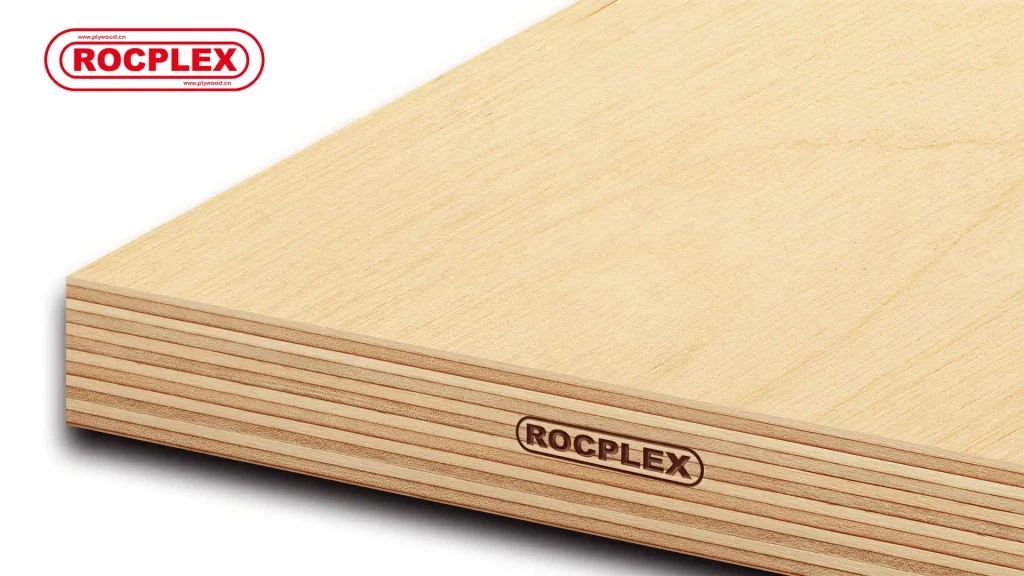
Density should be checked as part of a receiving routine, not as an isolated number.
A practical incoming check can use a small sample from different pallet positions. Select sheets from the top, middle, and lower area of the shipment where possible. Record actual thickness, panel mass, cut-edge appearance, flatness, and any visible core issues.
Then compare the result with the approved reference panel and the agreed product description.
The aim is not to create a laboratory test program for every container. It is to identify unusual variation before the buyer cuts large volumes or releases stock into the market.
| Check at Arrival | What to Record | What May Need Action |
|---|---|---|
| Sheet mass | Net mass per selected panel | Large change from approved reference |
| Thickness | Several measurement points | Wide variation affecting volume and machining |
| Cut edge | Core gaps, overlaps, glue line quality | Localised weak sections or repeated voids |
| Flatness | Panel bow, twist, or edge lift | Assembly or installation risk |
| Surface and edge | Damage, crush, scratches, repairs | Transport damage or product-control issue |
| Bundle and pallet | Sheet count, labels, packing condition | Handling risk or missing shipment evidence |
The Container Loading Guide supports this process by helping buyers separate factory variation from damage caused during packing, loading, and transit.
How ROC Supports Density Led Panel Control
ROC supports plywood buyers who need more than a basic sheet description.
For density-led product planning, ROC can help define the panel format, thickness range, intended core construction, moisture target, estimated sheet mass, packing method, edge inspection point, and repeat-order control process.
A furniture factory may need a stable panel build for CNC machining and fixing. A packaging buyer may need a useful balance between strength and freight efficiency. A wholesale buyer may need a practical product range that feels consistent from one shipment to the next.
Plywood density is most valuable when it connects what is inside the panel with what the buyer needs after the panel arrives.
FAQ
What is plywood density?
Plywood density is the mass of a panel divided by its volume. It is usually expressed in kilograms per cubic metre. However, the result changes with core construction, moisture, glue, overlays, actual thickness, and panel build.
Does higher plywood density mean better quality?
Not always. Higher density may indicate a denser construction. However, it does not prove better glue, fewer core gaps, higher structural capacity, cleaner faces, or stronger repeat performance.
Why can two plywood panels with the same size weigh differently?
They may use different veneer species, core layouts, glue content, moisture levels, overlays, treatments, and actual thicknesses. The same nominal size does not guarantee the same plywood panel density.
How should buyers compare plywood density?
Compare only panels with the same product use, format, actual thickness, moisture condition, and surface treatment. Then inspect core construction, cut edges, panel mass, flatness, and machining result.
Does moisture affect plywood density?
Yes. Wood can gain or lose moisture during production, storage, shipping, and warehouse handling. This changes panel mass and therefore changes the measured density figure.
Should density be written into a purchase order?
It can be useful when the product is sensitive to panel mass, core build, machining, freight, or handling. However, density should be supported by actual thickness, core requirement, moisture target, and inspection rules.
Official References for Further Reading
Post time: Jul-13-2026