

Plywood Weight Chart for Buyers and Logistics Teams
A useful plywood weight chart does more than tell a buyer whether one sheet is easy to lift. It helps factories plan cutting, wholesalers build safe pallets, freight teams book cargo, and warehouses prepare forklifts, racks, and unloading space.
The weight of plywood affects more than transport cost. It changes bundle count, pallet design, container payload, labour, handling risk, storage load, and the number of sheets a team can safely move at one time. However, nominal thickness alone cannot give an exact answer.
Two panels may share the same length, width, and stated thickness. Yet they can weigh very differently because of core density, veneer species, glue content, moisture, overlays, treatments, and actual thickness. Therefore, buyers should use a chart as a planning tool, then confirm the product figure with the supplier.
For global panel procurement, a plywood weight chart should be treated as a logistics reference rather than a fixed product claim. It gives buyers a disciplined starting point for freight, pallet, warehouse, and container planning. However, the supplier should still confirm the final mass after the core build, actual thickness, moisture condition, and packing method are agreed.
Plywood Weight Chart in One Practical Answer
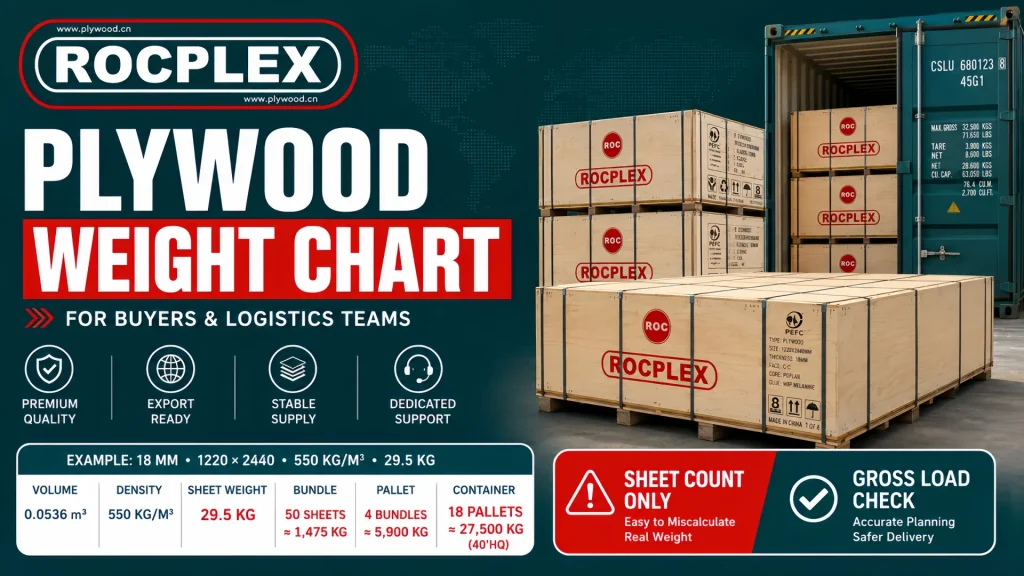
Use this sequence before planning an order: calculate the volume of one sheet, apply an estimated or confirmed panel density, scale the result to bundle quantity, add pallets and protection, then check the gross cargo mass against the container, truck, forklift, and warehouse limits.
Sheet weight in kilograms = length in metres × width in metres × thickness in metres × panel density in kilograms per cubic metre.
For example, a 1220 × 2440 × 18 mm panel has a volume of about 0.0536 m³. At an assumed density of 550 kg/m³, its estimated mass is about 29.5 kg.
That figure is useful for planning. However, it is not a replacement for a factory weight record. The final plywood sheet weight should be confirmed after the panel build and packing plan are fixed.
Calculate Plywood Sheet Weight Before Comparing Freight
A sheet can look similar to another panel while carrying a very different mass. Therefore, start with volume before using a generic number from an online chart.
Calculate Plywood Sheet Weight First
Use metric dimensions because they make volume easy to calculate.
For a 1220 × 2440 mm panel, the length is 2.44 m, the width is 1.22 m, and the area is 2.9768 m². Then multiply the area by actual thickness.
| Panel Thickness | Sheet Volume | Estimated Mass at 450 kg/m³ | Estimated Mass at 550 kg/m³ | Estimated Mass at 650 kg/m³ |
|---|---|---|---|---|
| 9 mm | 0.0268 m³ | 12.1 kg | 14.7 kg | 17.4 kg |
| 12 mm | 0.0357 m³ | 16.1 kg | 19.7 kg | 23.2 kg |
| 15 mm | 0.0447 m³ | 20.1 kg | 24.6 kg | 29.0 kg |
| 18 mm | 0.0536 m³ | 24.1 kg | 29.5 kg | 34.8 kg |
| 21 mm | 0.0625 m³ | 28.1 kg | 34.4 kg | 40.7 kg |
| 25 mm | 0.0744 m³ | 33.5 kg | 40.9 kg | 48.4 kg |
These are planning estimates, not universal product weights. The three density columns show why buyers should not assume one fixed mass for every plywood panel at the same thickness.
Scale From Plywood Sheet Weight to Plywood Pallet Weight
Freight planning often fails at this stage.
A buyer may calculate one 18 mm sheet at 29.5 kg and stop there. However, a bundle of 50 sheets would weigh about 1,475 kg before pallets, edge protectors, straps, wrapping, labels, and top covers are added.
That bundle may become a much heavier handling unit than expected. Therefore, the key question is not only “How much does one panel weigh?” It is also “How much does the completed bundle weigh when it reaches the warehouse?”
A plywood weight calculator becomes more useful than a simple thickness table at this point. It turns a product figure into a practical handling plan.
Why Plywood Panel Weight Can Differ at the Same Size
Panel dimensions are visible. Panel construction is not. Yet construction often changes final mass more than buyers expect.
How Plywood Density Changes the Final Load
A lighter core can reduce sheet mass and make handling easier. A denser core can increase panel weight, screw holding, edge strength, and the feel of the finished board. Neither option is automatically better.
For example, a furniture factory may need a stable and denser panel for machining and fixing. A packaging buyer may prefer a lighter panel when strength remains suitable for the crate design. Meanwhile, a wholesaler may need a balanced construction that gives local customers a familiar feel without creating overly heavy pallets.
Therefore, plywood panel weight should always be reviewed with the core requirement. A supplier quote should state the agreed core construction, not only face grade and thickness.
Moisture Overlays and Treatments Also Add Mass
Wood absorbs and releases moisture. As a result, the weight of plywood can change between production, packing, shipment, and arrival.
Overlays, coatings, phenolic films, paint, preservatives, edge sealing, and treatments can also add mass. The effect may look small on one sheet. However, across hundreds of panels, it can affect gross cargo planning.
A formwork panel shows this clearly. A film-faced panel may have the same nominal thickness as an untreated board. Yet film, resin, edge seal, denser core veneers, and moisture condition can create a noticeably different final mass.
For this reason, buyers should not use a standard furniture-plywood estimate for formwork, flooring, dense hardwood panels, or treated products.
Plywood Weight Chart for Common Sheet Formats
Sheet area matters. A 2400 × 1200 mm panel has an area of 2.88 m². A 1220 × 2440 mm panel has an area of 2.9768 m². Although the difference looks small, the larger format carries about 3.4% more mass at the same thickness and density.
| Sheet Format | Area | 12 mm at 550 kg/m³ | 18 mm at 550 kg/m³ | 25 mm at 550 kg/m³ |
|---|---|---|---|---|
| 2400 × 1200 mm | 2.8800 m² | 19.0 kg | 28.5 kg | 39.6 kg |
| 1220 × 2440 mm | 2.9768 m² | 19.7 kg | 29.5 kg | 40.9 kg |
| 1250 × 2500 mm | 3.1250 m² | 20.6 kg | 30.9 kg | 43.0 kg |
| 1500 × 3000 mm | 4.5000 m² | 29.7 kg | 44.6 kg | 61.9 kg |
This plywood weight chart gives buyers a fast starting point. Still, large-format panels need another check: can the warehouse, forklift, racking system, and jobsite safely handle the sheet size as well as the sheet mass?
A 1500 × 3000 mm panel is difficult not only because it is heavier. It is also harder to turn, lift, stack, cut, and protect from edge damage.
From Plywood Weight to Delivered Load
The commercial number is not the net panel mass. It is the delivered load.
A buyer needs to see how panel mass becomes bundle mass, pallet mass, and finally total gross cargo mass at the warehouse or jobsite.
| Planning Level | What to Include | Why It Matters |
|---|---|---|
| Single sheet | Panel dimensions, actual thickness, density | Manual handling, cutting, and end use |
| Bundle | Sheet count, separators, straps, top cover | Forklift planning and warehouse safety |
| Pallet | Plywood bundle, pallet timber, wrapping, corner guards | Rack limits, unloading, and cargo protection |
| Container | All pallets, mixed cargo, dunnage, blocking, gross mass | Payload planning, freight, and inland transport |
The weight of plywood may be the largest part of a shipment. Yet pallet timber, protection, and other cargo can turn an acceptable net calculation into an impractical gross load.
For mixed containers, buyers should also check how heavy items are placed. Dense plywood should not crush lighter panels, paper-faced boards, MDF, or other sensitive products. The related Container Loading Guide explains how pallet placement, cargo balance, and door-side protection affect delivery condition.
Four Places Where Weight Changes the Commercial Result
Freight Quotes Can Become Misleading
A freight quote may look attractive when it is based on planned sheet count rather than confirmed gross cargo mass. However, dense panels may reach weight limits before the container reaches its full volume.
As a result, the buyer may load fewer sheets than expected, pay a higher freight cost per sheet, or need an extra container. Therefore, the quote should be checked against a real loading plan, not only the number of pallets.
Warehouse Systems Have Practical Limits
Pallet racking, forklifts, hand pallet trucks, side loaders, and unloading teams all have safe working limits. A pallet that is technically possible to pack may still be unsuitable for the buyer’s equipment.
A good supply plan checks the maximum safe pallet mass, not only how many sheets can be stacked. This is especially important for 18 mm, 21 mm, 25 mm, dense hardwood plywood, birch plywood, and large panels.
Manual Handling Affects Damage and Claims
Heavy sheets create more risk at the final destination. Workers may drag rather than lift them. Edges can chip. Faces can scratch. Panels can be dropped when two people turn a large sheet without enough support.
Therefore, a lighter panel may create value even when its sheet price is not the lowest. Conversely, a denser panel may be worth the added mass when it improves machining, strength, or repeat use.
Container Planning Needs Actual Figures
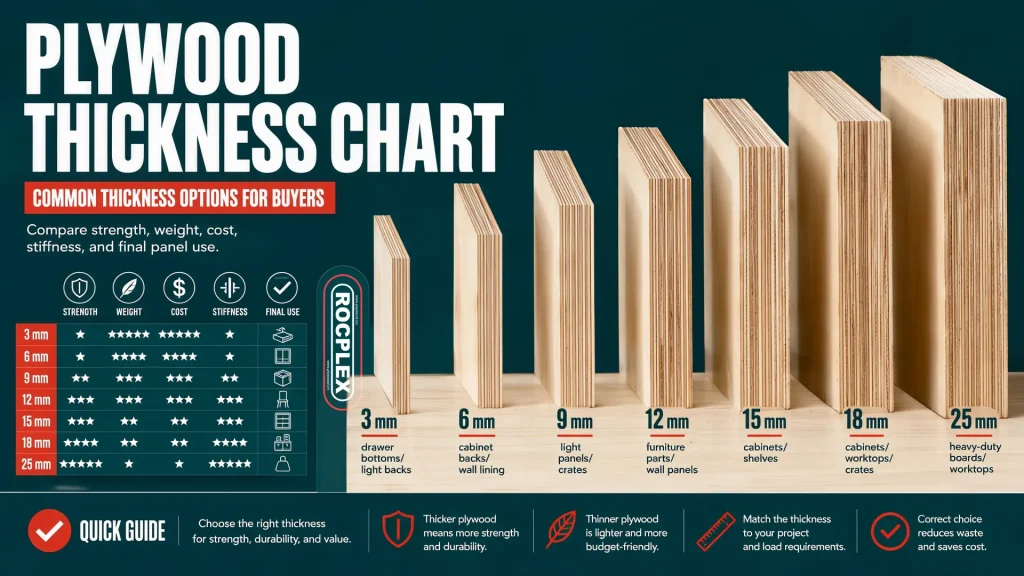
Nominal thickness is an order category. Actual thickness affects both performance and mass. A small difference across a large order can change total cargo weight.
The Plywood Thickness Chart explains why actual thickness range matters. The Plywood Sheets Guide also helps buyers match panel format with handling and supply needs.
Write the RFQ Around Three Weight Numbers
A good RFQ should ask the supplier for three figures: estimated net weight per sheet, estimated gross weight per bundle or pallet, and estimated total gross cargo weight per container.
This is more useful than asking only, “How many sheets fit in a container?”
18 mm plywood, 1220 × 2440 mm, confirmed core construction, actual thickness range, estimated net weight per sheet, bundle quantity, gross pallet weight, pallet dimensions, and estimated total container gross cargo weight required before loading approval.
This request gives procurement, logistics, and warehouse teams the same reference point. It also makes the supplier’s packing plan easier to review.
A verified plywood weight chart also makes quotation review more accurate. It helps buyers compare not only cost per sheet, but also usable cargo weight, pallet safety, freight efficiency, and unloading risk behind each offer.
Check the Shipment Before It Becomes a Claim
The final check should happen before and after loading.
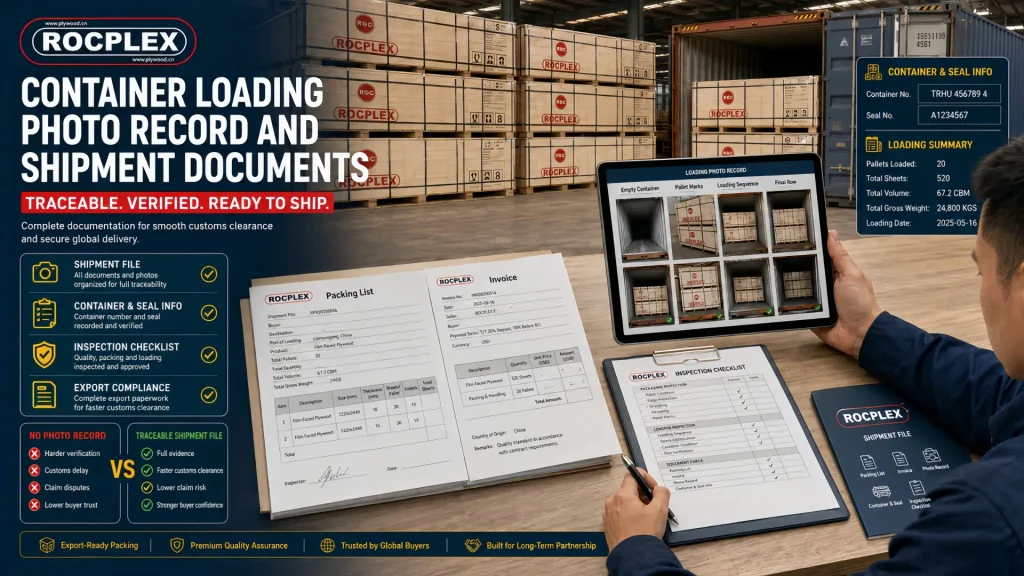
Before shipment, confirm sheet count, bundle count, pallet dimensions, pallet mass, container number, seal number, and total gross cargo figure. During loading, ask for photos that show pallet labels, weight marks where used, first pallets, final cargo position, door-side protection, and seal application.
After arrival, compare the packing list with actual bundle count and visible pallet labels. If a pallet appears much heavier, smaller, or more compressed than expected, inspect it before the warehouse breaks down the full bundle.
This does not mean every order needs laboratory testing. It means the buyer should have enough evidence to separate a production issue, a packing issue, and transport damage.
How ROC Helps Buyers Plan Panel Mass
ROC supports buyers who need plywood-led engineered wood supply with clearer product and logistics planning.
For plywood weight planning, ROC can help define sheet size, thickness, core construction, estimated sheet mass, bundle count, pallet configuration, packing protection, loading method, and container planning. This supports wholesalers, furniture factories, formwork users, packaging buyers, and project supply teams.
A plywood weight chart is most useful when it becomes part of the order specification. It should connect the board the buyer wants with the way that board must be packed, moved, unloaded, and sold.
FAQ
How Much Does a Plywood Sheet Weigh?
Plywood sheet weight depends on length, width, actual thickness, density, moisture, core construction, and surface treatment. A 1220 × 2440 × 18 mm panel may weigh roughly 24 kg to 35 kg across light, medium, and dense panel builds.
What Is the Formula for Plywood Weight?
Use length in metres × width in metres × thickness in metres × panel density in kilograms per cubic metre. The result is the estimated net sheet weight.
Why Do Two 18 mm Plywood Sheets Weigh Differently?
They may use different core species, veneer builds, glue content, moisture levels, overlays, treatments, and actual thickness ranges. Therefore, nominal thickness alone does not define plywood panel weight.
Does Film-Faced Plywood Weigh More Than Standard Plywood?
It can. Film, resin, edge sealing, moisture condition, and a denser core build may increase final mass. Buyers should request a product-specific estimate instead of relying on a general panel chart.
How Do I Estimate Plywood Pallet Weight?
Multiply estimated sheet weight by sheet quantity. Then add pallet timber, wrapping, straps, edge protection, top cover, and other packing materials. Confirm the final gross pallet weight with the supplier.
Why Does Weight Matter for Container Loading?
Weight affects cargo payload, pallet design, forklift handling, inland transport, warehouse safety, and the number of sheets that can be loaded without exceeding practical limits.
Official References for Further Reading
Post time: Jul-09-2026