

A useful plywood thickness chart should do more than match millimetres with inches. It should help buyers decide whether a panel will work through cutting, fixing, transport, installation, reuse, and resale.
Thickness changes stiffness, weight, screw holding, freight, pallet weight, and final cost. However, thickness is not the whole answer. A thick panel with weak core control can perform worse than a thinner panel made with stable veneers, suitable glue, and a tighter factory process.
This plywood thickness chart helps buyers treat thickness as a buying choice. It is for wholesalers, builders, formwork buyers, furniture factories, packing users, and project teams that need a clear way to compare plywood panels before ordering.
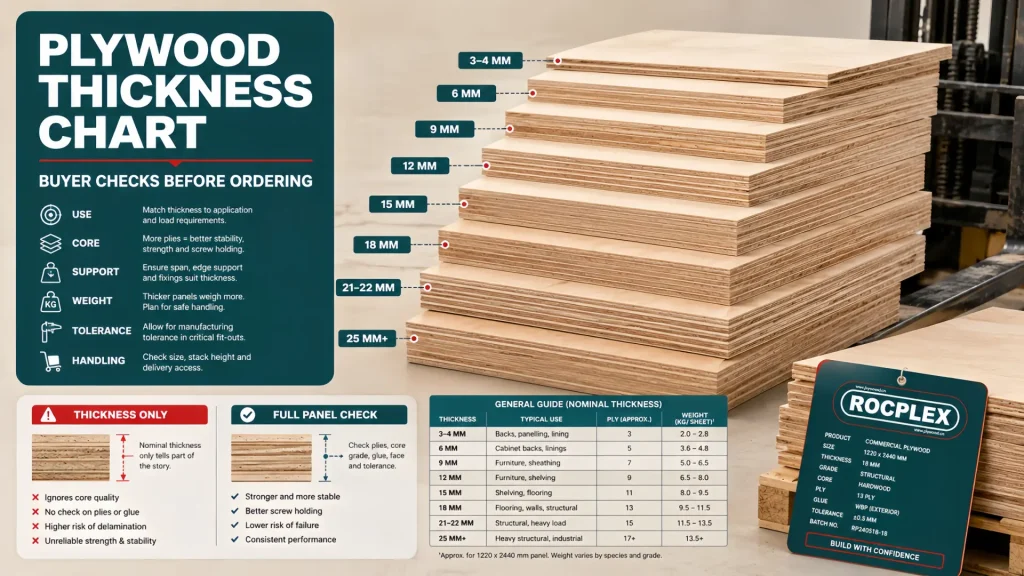
Plywood Thickness Chart in One Practical Answer
Choose plywood thickness by checking three things together: the work the panel must do, the support and fixing around the panel, and the quality inside the panel. A thickness chart is useful for first selection. However, it is not a design table for structural work. Where a panel must carry load, buyers should use the project design, maker data, panel rating, span data, and fixing rules.
Read the Plywood Thickness Chart in Three Passes
First check what the panel must do
Start with the job. Does the plywood carry load, cover a frame, form concrete, hold screws, protect goods, make furniture, or act as a visible panel?
A thin panel may work well when it has full backing or close support. By contrast, the same panel may bend too much across a wide gap. A thicker panel can reduce movement. However, it also adds weight, cost, and handling work.
For example, 18 mm plywood can suit cabinet sides, shelves, furniture tops, or strong packing parts. Yet not every 18 mm panel will work in the same way. A light poplar-core panel, a dense hardwood-core panel, and a birch panel can differ in stiffness, screw holding, weight, and machining.
Therefore, use this plywood thickness chart to narrow the product range first. Then confirm core, glue, face grade, thickness range, support, and job needs.
Then check what the panel must look like
Surface needs can change the best thickness choice.
Furniture, shopfitting, wall lining, coated boards, and laminated parts need clean faces, stable machining, good edges, and a steady thickness. A panel may be thick enough, yet still fail the job if the face is poor, the core is uneven, or the panel varies too much across the pallet.
For visible work, buyers should state both thickness and face grade. In addition, they should check sanding, patch level, veneer quality, flatness, and edge look.
Finally check how the panel must travel
Thickness also changes the supply chain. Thicker plywood makes heavier bundles. As a result, pallet build, forklift use, container weight limits, warehouse movement, and unloading risk all change.
A thicker panel can improve the final job. At the same time, it can reduce the number of sheets in a container or make a bundle too heavy for the buyer’s warehouse.
The right plywood thickness should work in the factory, on the pallet, in the container, and at the final job.
Plywood Thickness Chart for Common Buyer Uses
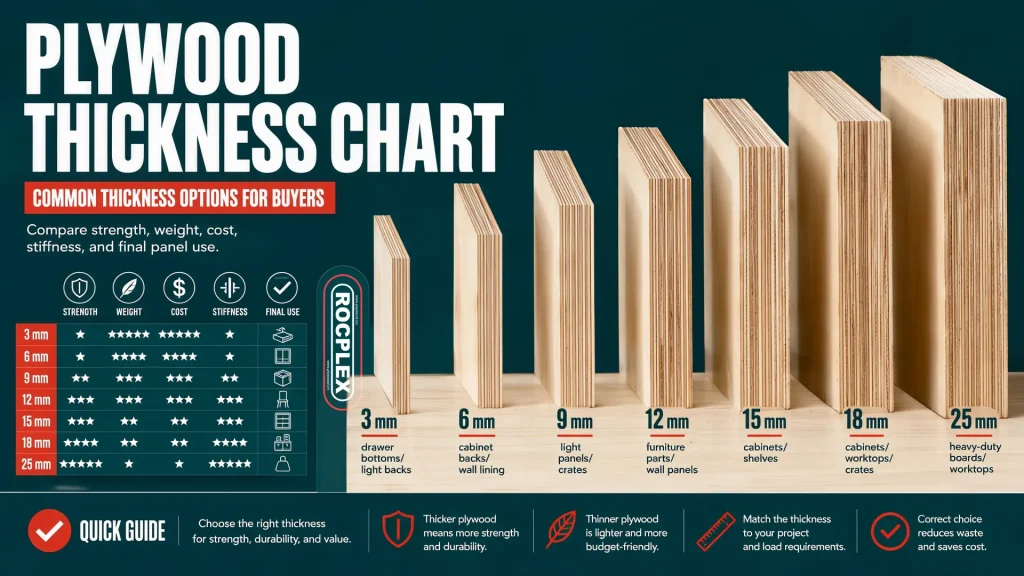
The table below gives common buying ranges. It is not a structural load table. Before approving a panel, buyers should confirm the grade, support condition, maker data, and project need.
| Common Thickness | Typical Buyer Uses | Main Check Before Approval | Common Risk |
|---|---|---|---|
| 3 mm to 4 mm | Drawer bottoms, light backing, curved work, face overlays | Full support, face quality, edge damage | Splitting, face breakage, weak fixing |
| 5.5 mm to 6 mm | Back panels, light furniture parts, packing, wall overlays | Core quality, nail holding, flatness | Core gaps, edge damage, movement |
| 9 mm | Wall lining, furniture parts, packing, rated bracing panels where suitable | Support spacing, face grade, panel rating where needed | Flexing, poor edge support, thickness change |
| 12 mm | Cabinet parts, shelves, wall panels, crates, indoor panel work | Screw holding, cut yield, actual thickness | Weak core, tear-out, uneven thickness |
| 15 mm | Furniture frames, floor layers, stronger packing, joinery parts | Support layout, glue, flatness | Heavy pallets, poor core control |
| 18 mm | Cabinets, shelves, worktops, furniture carcasses, heavy panels | Core density, screw holding, thickness range, weight | Overbuying, handling issues, slow stock |
| 21 mm to 22 mm | Heavy furniture parts, platforms, strong panels | Weight, support detail, bundle handling | Container weight limits, edge damage |
| 25 mm and above | Heavy flooring, tough site work, special formwork, project panels | Project data, handling plan, strong packing | High freight cost, hard lifting, pallet failure |
A buyer should not assume that thicker always means better. For example, a well-made 15 mm plywood panel can give better value than a poorly made 18 mm panel. The right choice depends on the full panel build.
Metric Thickness and Imperial Labels Need Care
Global buyers often compare metric plywood thicknesses with North American labels. However, product labels, actual measurements, stated sizes, and panel groups are not always the same.
| Metric Reference | Approximate Imperial Reference | Buyer Check |
|---|---|---|
| 9 mm | About 3/8 inch | Confirm actual thickness and panel grade |
| 12 mm | About 15/32 inch or 1/2 inch | Do not treat both labels as the same |
| 15 mm | About 19/32 inch | Confirm thickness range and core build |
| 18 mm | About 23/32 inch or 3/4 inch | Check the required actual thickness |
| 21 mm to 22 mm | About 7/8 inch | Confirm weight, support, and handling |
| 25 mm | About 1 inch | Confirm bundle weight and job need |
North American panel groups link to specific ratings and intended uses. Therefore, buyers should not copy an imperial label into an export order without checking the actual panel spec.
Likewise, a metric thickness does not prove a structural rating by itself. The panel still needs the correct mark, product data, support plan, and use conditions.
Core Quality Changes the Value of Thickness
Core density changes panel strength and weight
Thickness is easy to see. Core quality is often hidden. Yet the core changes how the plywood feels and works.
A dense hardwood or eucalyptus core may feel different from a lighter poplar core. Birch build can offer another balance of strength, machining, and repeat quality. Combi core can suit buyers that need a balance between cost and use.
Therefore, buyers should ask more than “How thick is the panel?” They should also ask what is inside the panel.
Questions buyers should ask before approval
- What core species are used?
- How are core gaps checked?
- What glue system is used?
- What moisture range is targeted before packing?
- What actual thickness range is allowed?
- How is flatness checked?
- How many veneer layers are used?
This is where a plywood thickness chart becomes a real buying tool. It moves the discussion from one visible number to the full panel build.
Actual Thickness and Allowed Range Matter
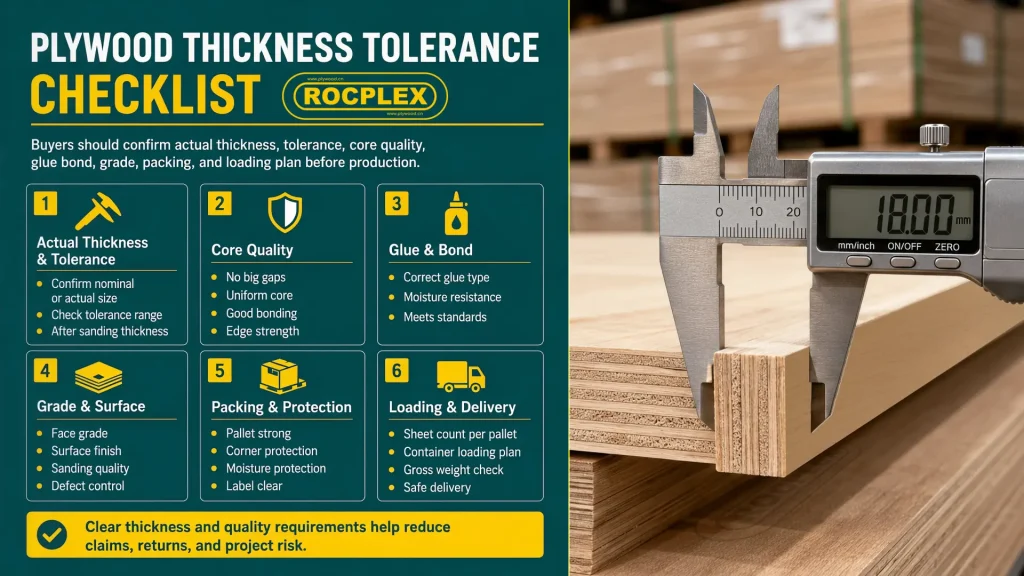
Stated thickness is the ordered category. Actual thickness is what arrives at the factory, warehouse, or jobsite.
This difference matters in CNC cutting, lamination, cabinet build, edge banding, flooring build-up, formwork joints, and any line that needs repeat machine settings.
For example, one 18 mm panel may machine well. However, a later batch may cause problems if it varies too much. As a result, the factory may need to reset machines, the installer may see poor fit, and the wholesaler may face customer claims.
For this reason, buyers should write a clear allowed thickness range into the RFQ. The supplier should confirm that range before production starts.
Compare Cost by Useful Result
Plywood cost does not rise only because the panel gets thicker. Core species, veneer quality, glue, face grade, moisture control, pressing, sanding, packing, and freight also change the price.
When a thinner panel can save money
A thinner panel can be the right buying choice when the panel has close support, the job has low load, and the sheet is not exposed to hard handling. In that case, it may reduce material cost, pallet weight, and freight.
For example, backing panels, light drawer parts, overlays, and some packing parts may not need a thick panel. However, the buyer still needs to check face quality, core gaps, and fixing needs.
When a cheaper thin panel costs more
A thin panel can cost more when it bends, breaks, splits, or creates extra waste. It can also cost more when it needs added support, more labour, or early replacement.
Therefore, buyers should compare cost by useful result. For a furniture factory, this may mean cost per finished part. For a wholesaler, it may mean cost per clean saleable sheet. For a formwork buyer, it may mean cost per pour. For a packing buyer, it may mean cost per finished crate.
The related Plywood Price Guide explains how core, glue, face grade, packing, and freight risk affect total buying cost.
Thickness Must Fit the Delivery Route
A plywood panel should not be chosen only for the final job. It must also survive the trip from the factory to the buyer.
Thicker plywood adds bundle weight. Therefore, it affects pallet strength, forklift use, container weight limits, warehouse storage, truck loading, manual handling, corner protection, and safe unloading.
This matters most for dense hardwood plywood, birch plywood, thick formwork panels, and heavy-use boards. A container can reach its weight limit before it looks full.
Before shipment, buyers should also confirm unloading order for mixed cargo. Heavy sheets should not damage lighter products. In addition, long sheets should not create unsafe pressure near the container doors. The Container Loading Guide explains these delivery checks in more detail.
A Better RFQ for Plywood Thickness
A good RFQ should explain what the panel needs to do.
Instead of writing “18 mm plywood price please,” use a clearer request.
18 mm plywood for cabinet carcass work, 1220 × 2440 mm, controlled actual thickness range, furniture-grade face, stable core, good screw holding, low moisture before packing, export pallet protection, and container loading photos required.
This gives the supplier a clear instruction. It also gives the buyer a fair way to compare quotes.
Buyer Matrix Before You Approve Thickness
| Buyer Type | First Thickness Question | Second Check | Main Risk |
|---|---|---|---|
| Furniture factory | Will the panel machine and assemble well? | Face quality, thickness range, screw holding | Waste, machine reset, poor edge finish |
| Builder or installer | Does the panel match the support and fixing layout? | Product grade and moisture risk | Flexing, poor fit, site rework |
| Formwork buyer | Does the panel fit the formwork system and reuse goal? | Film, edge seal, glue, panel stiffness | Face damage, short reuse life |
| Wholesaler | Will this thickness sell well in the local market? | Pallet look and stock range | Slow stock, damaged bundles |
| Packing buyer | Does the panel give enough strength at the right cost? | Nail holding, cut yield, freight weight | Weak crates, high material cost |
Common Thickness Mistakes Buyers Should Avoid
Most plywood thickness mistakes are buying mistakes, not factory mistakes.
- Choosing thickness without checking the core.
- Assuming stated thickness equals actual thickness.
- Using a general chart as a structural design table.
- Choosing the thickest panel without checking handling cost.
- Buying thin plywood only to reduce sheet price.
- Ignoring panel direction and support spacing.
- Forgetting pallet and container weight limits.
- Treating one sample as proof of full-batch control.
- Confirming thickness range after the goods arrive.
A better order starts with a full product description. As a result, the supplier has less room to guess and the buyer has more control over the final result.
How ROC Supports Plywood Thickness Selection
ROC supports buyers who need plywood-led engineered wood supply. Plywood remains the main product line, while OSB, MDF, particle board, LVL timber, H20 beams, I joists, and related products support wider sourcing needs.
For buyers using this plywood thickness chart, ROC can help assess thickness, panel format, core, glue, face grade, allowed range, packing, pallet design, container loading, and repeat supply planning.
A furniture buyer may need smooth faces and stable thickness. A formwork buyer may need stronger glue, sealed edges, and better cost per pour. Meanwhile, a wholesaler may need a practical thickness range with clean pallets and steady stock. Each buyer needs a different thickness choice.
Read What Is Plywood for product basics, Plywood Sheets Guide for sheet choice, and Plywood Sizes for panel format planning.
FAQ
What is the most common plywood thickness?
Common plywood thicknesses include 3 mm, 6 mm, 9 mm, 12 mm, 15 mm, 18 mm, 21 mm, and 25 mm. However, the best choice depends on the job, support, core quality, and handling needs.
Is 18 mm plywood always stronger than 15 mm plywood?
Not always in a useful buying sense. Thickness affects stiffness. However, core quality, veneer build, glue, support spacing, and panel direction also affect how the panel works.
What plywood thickness is best for cabinets?
Many cabinet programs use 12 mm, 15 mm, or 18 mm plywood. The best choice depends on the part, screw holding, machining, face quality, actual thickness, and design needs.
Why does actual plywood thickness matter?
Actual thickness affects CNC cutting, edge banding, assembly, lamination, formwork joints, flooring build-up, and machine settings. Therefore, buyers should state an allowed range before production.
Can I use a plywood thickness chart for structural design?
No. A thickness chart helps first selection. Structural work still needs the right project design, panel rating, span data, fixing details, and maker data.
Does thicker plywood cost more to ship?
Usually yes. Thicker panels add weight. As a result, bundle weight, pallet needs, freight cost, handling effort, and container weight limits may all increase.
Official References for Further Reading
Post time: Jul-01-2026