

MDF Board Sizes for Cutting Yield and Factory Control
MDF board sizes are often treated as fixed stock measurements. A supplier lists the length, width, and thickness. Then, the buyer chooses the closest format and compares the price per sheet.
A furniture factory sees the same board differently.
It sees cabinet sides, door fronts, shelves, drawer parts, wall panels, routed profiles, and offcuts. Therefore, the useful size is not only the nominal sheet shown on the invoice. Instead, it is the clean rectangle that remains after trimming, saw kerf, surface checks, and nesting.
A larger board may improve output. However, it may also exceed the CNC bed, slow handling, raise surface-damage risk, or produce poor yield for a certain part shape.
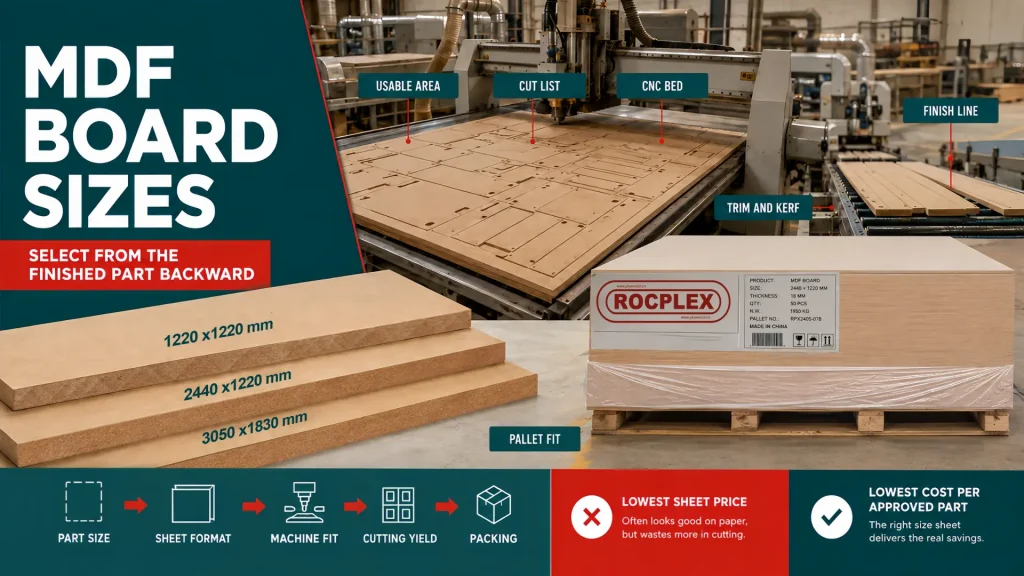
For this reason, MDF board sizes should be selected from the finished component backward. The sheet format comes later.
MDF Board Sizes in One Factory Rule
Choose the board that produces the highest number of approved parts through the factory’s real production route.
That means checking five points:
- The largest repeating part
- The saw or CNC machine limit
- The trim and saw-kerf allowance
- The surface and finishing route
- The pallet and handling system
First, define the cut list. Next, test the part layout on each available sheet. Then, confirm that the factory can lift, cut, coat, store, and pack that format.
The lowest price per square metre does not always produce the lowest cost per finished part. Therefore, sheet price should never be reviewed alone.
Define the Usable Rectangle Before Buying MDF Sheet Sizes
A nominal sheet is not the same as usable cutting area.
Most factories need some edge trim. They also lose material at each saw cut. In addition, a surface defect or damaged corner may remove part of the planned cutting field.
Allow for Trim Kerf and Part Spacing
A practical cut plan should include edge-trim allowance, saw-blade or router width, space between parts, décor direction, surface inspection zones, tool space, labels, and damage allowance where needed.
For example, a 2440 × 1220 mm sheet should not be treated as a perfect 2440 × 1220 mm cutting field. First, the factory must confirm its trim and machining rules.
As a result, two buyers can receive the same nominal MDF sheet sizes but achieve different usable output.
Write the Actual Size Range Into the Order
“Standard tolerance” is not clear enough for an international order.
Instead, the buyer should state the nominal size, product standard, and accepted actual range. The same rule applies to thickness.
For example, a factory that routes grooves or joins door parts may need tighter thickness control. In contrast, a basic backing-panel user may accept a wider range.
Therefore, dimensional limits should follow the production process rather than a vague market habit.
The official ANSI A208.2 MDF property and dimension tables provide useful background for panel controls.
Start With the Largest Repeating Part
The most useful item in a cut list is often the largest part that repeats many times.
A single unusual panel may not justify changing the whole board format. However, a cabinet side used hundreds of times can control the cost of the order.
First, group parts by size. Next, separate them by finish. Then, test raw MDF, painted MDF, veneered MDF, and melamine-faced MDF as different cutting families.
This prevents one common mistake: choosing one board size for every factory component.
The Machine Bed Sets the First Limit
A sheet has no value if the machine cannot load or process it.
- CNC bed length and width
- Panel-saw opening
- Beam-saw loading width
- Vacuum-zone layout
- Automatic loader limit
- Dust-extraction clearance
- Operator reach and lift method
- Space needed to turn the sheet
A 2800 × 2070 mm panel may offer a large cutting field. However, it is not useful on a production cell built for 2440 × 1220 mm boards.
Likewise, a 3050 mm sheet may suit tall cabinet parts. Yet it may block the route between the pallet and saw.
The Finish Line Sets the Second Limit
The saw is not the only size gate.
After cutting, a panel may pass through a press, spray booth, sanding line, UV line, wrapping station, or edge-banding cell.
Therefore, the buyer should check the smallest machine limit across the full route. A board that fits the saw but not the press can create extra cutting and handling.
The best MDF board dimensions must fit every main stage, not only the first machine. The related What Is MDF Board guide explains MDF structure and machining behaviour.
Match Standard MDF Sizes to Production Type
MDF is supplied in several market formats. However, regular stock varies by mill, country, thickness, product type, and surface finish.
| MDF sheet format | Typical factory role | Main advantage | Main point to check |
|---|---|---|---|
| 2440 × 1220 mm | General furniture, joinery, export stock, manual or semi-auto lines | Easy handling and wide market use | May create more waste on long parts |
| 2800 × 2070 mm | European furniture production and large nesting layouts | Large field for mixed components | Requires larger machines and lifting systems |
| 3050 × 1220 mm | Tall doors, wall panels, long cabinet parts, and shopfitting | Reduces length joints and end waste | Long pallets need better support |
| 3050 × 1300 mm | Long components needing extra width | Adds more nesting choices | Confirm press and machine opening |
| 3660 × 2070 mm | High-volume industrial cutting | High output per loading cycle | Heavy handling and special storage |
| 4100 × 2070 mm | Selected long-format industrial work | Supports very long components | Usually needs dedicated equipment |
Regular Stock and Made-to-Order Formats
Some standard MDF sizes are regular mill products. Others need a minimum production volume.
Therefore, the RFQ should ask which formats are regular stock, which formats need a production run, which thicknesses are available, and whether the same format can be repeated later.
In addition, confirm whether the same format is available in raw, melamine-faced, moisture-resistant, or other MDF types.
For product background, see the official Composite Panel Association MDF information.
Test MDF Panel Sizes With a Real Nesting Trial
A bigger sheet does not always create better yield.
Assume a factory needs repeated parts measuring 720 × 560 mm.
On a 2440 × 1220 mm sheet, six parts can fit in a simple three-by-two layout. Before trimming and saw loss, those parts use about 81% of the sheet area.
Now compare a 2800 × 2070 mm sheet. Depending on orientation, the same part may fit nine or ten times. However, the percentage of usable sheet area can still be lower.
Therefore, MDF panel sizes must be tested with the actual part shape.
| Buying view | Weak decision | Better decision |
|---|---|---|
| Sheet area | A larger panel must be more efficient | Test the actual nesting plan |
| Price | The lowest square-metre price must win | Compare cost per approved part |
| Loading | More area per sheet means faster output | Check loading time and sheet mass |
| Offcut | Every remaining piece has value | Match it to another planned part |
| Production | One format should serve every job | Use practical sheet families |
Offcuts Need a Planned Second Use
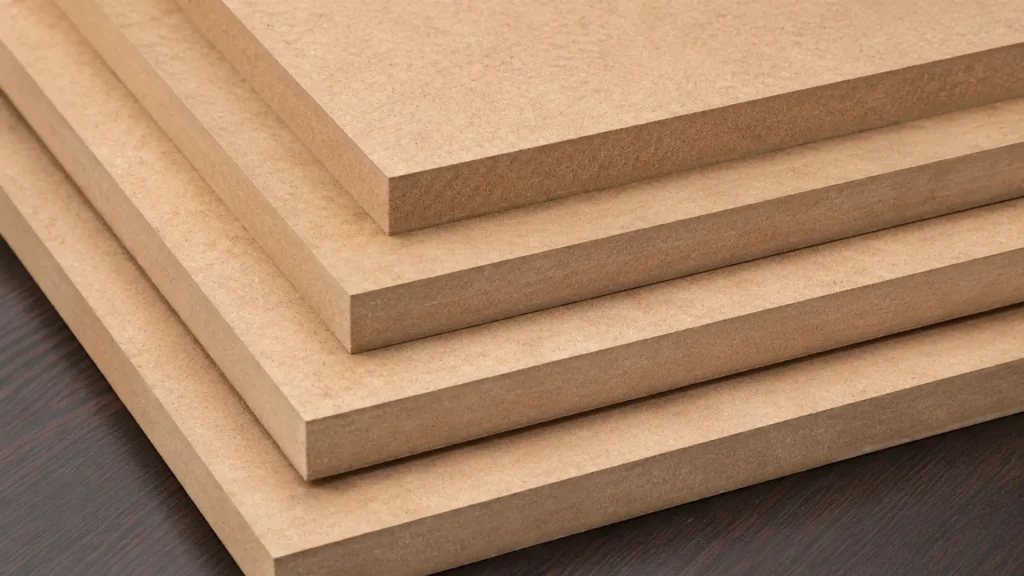
An offcut has value only when it can enter another known job.
Otherwise, it becomes delayed waste beside the machine. It takes storage space, needs tracking, and may be damaged before later use.
As a result, MDF board sizes affect work flow, offcut storage, job tracking, and the number of material moves.
MDF Thickness Changes the Production Route
Thickness affects more than board weight. It also changes cutting speed, tool choice, edge finish, press time, screw length, packing height, pallet mass, and manual handling.
| Thickness range | Common production role | Main control point |
|---|---|---|
| 3–6 mm | Back panels, inserts, templates, and light decorative parts | Flat storage and bow control |
| 8–12 mm | Wall panels, drawer parts, and routed details | Edge finish and fixing method |
| 15–19 mm | Cabinet parts, shelves, doors, and furniture components | Thickness range and machining |
| 22–25 mm | Thick shelves, doors, counters, and routed profiles | Weight, edge work, and sag risk |
| 30 mm and above | Deep profiles and specialist furniture | Tool reach, press time, and handling |
Thin Panels Need Flat Storage
Thin MDF can be easy to cut and move. However, it is also more sensitive to poor support.
Therefore, thin sheets should remain flat during storage, transport, and machine feeding.
Furniture Thickness Needs Process Control
Many cabinet and furniture parts use medium thickness ranges. Yet the correct choice still depends on part size, fixing, support, and machining.
For this reason, the nominal thickness should be paired with an accepted actual range.
Thick MDF Changes Handling and Tooling
Thicker panels add mass quickly. In addition, deep routing may need longer tools and slower cutting.
Therefore, thick MDF should be checked against the machine, pallet, forklift, and operator limits before ordering.
The Plywood Weight Chart provides a useful method for connecting panel dimensions, density, sheet mass, and pallet planning.
Melamine Faces Change MDF Board Dimensions Planning
Raw MDF can often be turned during cutting without concern for décor direction. Melamine-faced MDF may not offer that freedom.
Décor Direction Reduces Rotation Options
A woodgrain décor may need every visible part to face the same direction. Therefore, cabinet doors and side panels cannot always be rotated to improve nesting.
As a result, the largest sheet may not create the best yield.
- Décor direction
- One-sided or two-sided facing
- Surface texture
- Protective film
- Backing or balancing layer
- Colour batch
- Press plate size
- Edge-trim allowance
Surface Damage Changes the Usable Area
A damaged corner on raw MDF may affect only a small hidden component. In contrast, the same damage on a decorative face may remove several visible parts.
Therefore, the value of the surface should be included in the MDF sheet sizes decision.
MDF Board Sizes Need a Packing Plan
Large panels require more than longer bearers.
They also need enough support to remain flat. Poor bearer spacing can allow a bundle to sag. Meanwhile, tight straps can crush edges.
Keep the Bundle Flat
When MDF board sizes increase, the packing system must also change.
- More timber bearers
- Better bearer spacing
- A different forklift entry direction
- Stronger corner guards
- Wider top and bottom protection
- More warehouse space
Therefore, pack design should be approved together with sheet size.
Check Destination Handling
A large board may fit the container but fail at the destination warehouse.
For example, the forklift may have short forks. Likewise, the factory door or turning area may not accept the bundle.
Therefore, confirm sheets per pack, gross pack weight, loading direction, rack length, unloading equipment, and internal handling space.
The Container Loading Guide explains pallet support, cargo balance, door protection, and unloading access.
Write MDF Sheet Sizes From Part to Pallet
A weak request says:
Raw MDF, 18 mm, standard size.
That wording does not define the real product.
Instead, a stronger RFQ could read:
Raw MDF for cabinet and furniture parts, nominal size 2440 × 1220 × 18 mm, accepted actual length, width, and thickness range stated in the quotation, smooth sanded faces, density and emission requirement confirmed, cutting layout based on 720 × 560 mm repeating parts, flat export packing, agreed sheets per pack, gross pack weight, bearer layout, corner protection, and loading photos required.
For melamine MDF, also state the décor code, texture, grain direction, face arrangement, protective film, colour-batch rule, and trim allowance.
Therefore, the MDF sheet sizes section of an RFQ should connect the finished part with the full supply route.
The Plywood vs MDF comparison helps buyers decide whether MDF suits the planned component before fixing its dimensions.
Approve MDF Panel Sizes Inside the Machine Cell
The first inspection should not end beside the container.
Instead, take boards from more than one part of the pack. Then, move them through the real production route.
| Inspection point | What it shows |
|---|---|
| Length and width | Whether the sheet fits the cut and machine plan |
| Thickness at several points | Whether routed and joined parts will match |
| Diagonal and squareness | Whether the panel will align during cutting |
| Flatness | Whether vacuum loading remains stable |
| Surface condition | Whether visible parts can use the planned area |
| Edge quality | Whether packing or handling caused damage |
| Trial nesting | Whether the expected yield is realistic |
| First machining result | Whether cutting and routing remain clean |
| Pack label and count | Whether batch control matches the order |
Sample More Than the Top Sheet
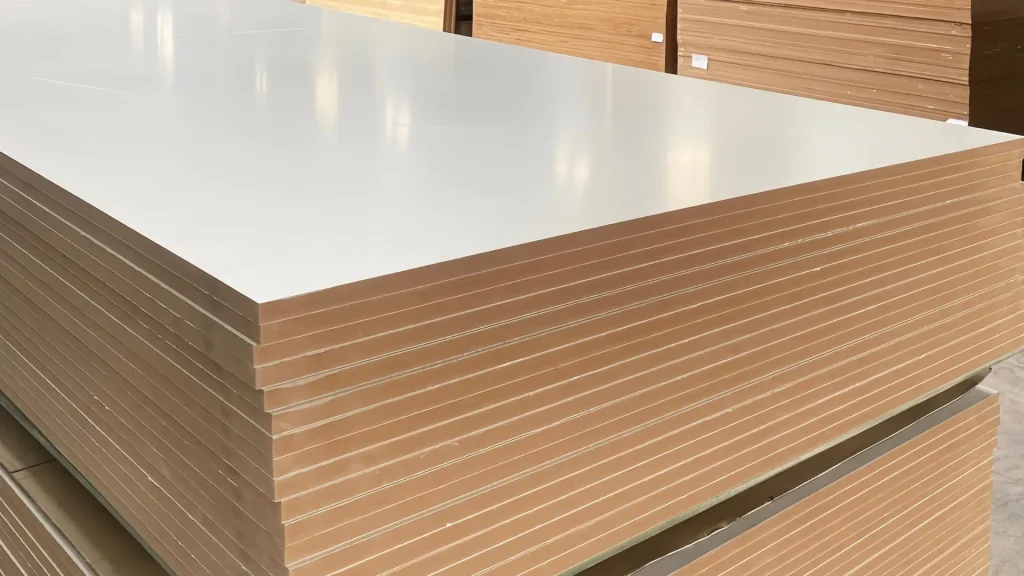
A clean top sheet does not prove that the full pack is consistent.
Therefore, compare samples from the top, middle, and lower parts of selected bundles.
Run the Board Through the Real Process
Finally, complete a machine trial.
The trial confirms whether the selected MDF panel sizes match the loading path, vacuum bed, cutting program, surface route, and finishing line.
Only then should the buyer release the full batch for production.
How ROC Supports MDF Size Control
For MDF board sizes, ROC can help buyers connect the finished cut list with sheet format, thickness, surface type, density request, machine limits, bundle design, and container plan.
A furniture factory may need a large board for mixed nesting. In contrast, a cabinet maker may prefer 2440 × 1220 mm panels for easier material flow.
Meanwhile, a shopfitting buyer may need 3050 mm sheets for long wall or door parts.
Therefore, the best format is not the biggest available panel. It is the one that creates stable output, safe handling, and repeatable buying results.
FAQ
What Are the Most Common MDF Board Sizes?
Common MDF board sizes include 2440 × 1220 mm, 2800 × 2070 mm, 3050 × 1220 mm, and 3050 × 1300 mm. In addition, some mills offer larger industrial panels. Stock depends on the mill, market, thickness, and MDF type.
Is a Larger MDF Sheet Always More Efficient?
No. Yield depends on the finished part size, direction, trim, saw kerf, machine bed, and useful offcuts. Therefore, a smaller sheet can produce better percentage yield for some parts.
What MDF Thickness Is Used for Furniture?
Furniture factories use several thicknesses. For example, thin boards may suit backs, while 15–19 mm panels often suit cabinet parts. However, the final choice should follow the part design and product data.
Are MDF Sheet Sizes Exact?
The quoted sizes are nominal. Actual sheets are supplied within an agreed range. Therefore, buyers should state accepted length, width, thickness, diagonal, and squareness limits.
Do Raw MDF and Melamine MDF Use the Same Cutting Plan?
Not always. Melamine MDF may have décor direction, texture, visible-face rules, protective film, and higher surface value. As a result, the nesting plan can change.
What Should an MDF Order Include?
State the sheet size, thickness range, MDF type, density or grade, surface finish, emission need, pack quantity, gross weight, bearer layout, protection method, and inspection rule.
Official References for Further Reading
Post time: Aug-10-2026