

MDF for cabinets works best when a buyer stops treating the whole cabinet as one board application.
A finished cabinet contains several very different parts. The door face needs a smooth paint finish. A routed edge needs a clean cut. A hinge area needs reliable fixing. A shelf needs support. Meanwhile, a panel near a sink faces far more moisture than a wardrobe door.
Therefore, one MDF grade does not automatically suit every cabinet part.
Instead, split the cabinet into work zones. Then, select the MDF around the first likely failure point of each part. This approach makes cabinet buying more accurate and also gives the factory clearer quality targets.

MDF for Cabinets in One Practical Rule
Before choosing the board, ask one question: What must this exact cabinet part do after it leaves the CNC machine?
- Visible face
- Routed edge or profile
- Screw and hardware area
- Shelf or loaded part
- Moisture-risk area
First, identify the part. Next, identify its main risk. Then, select the MDF grade, thickness, surface, finish route, and fixing method.
As a result, the cabinet becomes a planned set of materials instead of one generic MDF order.
Start With the Surface Buyers Will See
For painted doors, the visible face carries much of the finished value.
MDF offers a smooth and even surface without natural knots or veneer grain. Therefore, it is widely used for painted cabinet doors, drawer fronts, wall panels, and routed furniture parts.
For technical background, see the Composite Panel Association MDF information.
Painted MDF Doors Need a Stable Surface
Paint can expose faults that are hard to notice on raw MDF.
For example, sanding marks, raised fibres, small surface dents, dirt, or damaged corners may become easier to see after primer and topcoat.
- Face smoothness
- Sanding quality
- Surface cleanliness
- Thickness range
- Flatness
- Corner condition
- Batch consistency
In addition, a premium painted-door sample should include the real primer and topcoat system. That gives the buyer a better approval reference than a raw board sample.
Dark and Gloss Paints Need Tighter Control
Dark colours and gloss finishes can make small surface faults more visible.
Therefore, the MDF surface, sanding steps, primer build, spray process, and curing conditions all matter.
A raw board may pass inspection. However, the finished door can still miss the visual standard.
Routed MDF Cabinet Doors Test the Inside of the Board
A flat surface tells only part of the story.
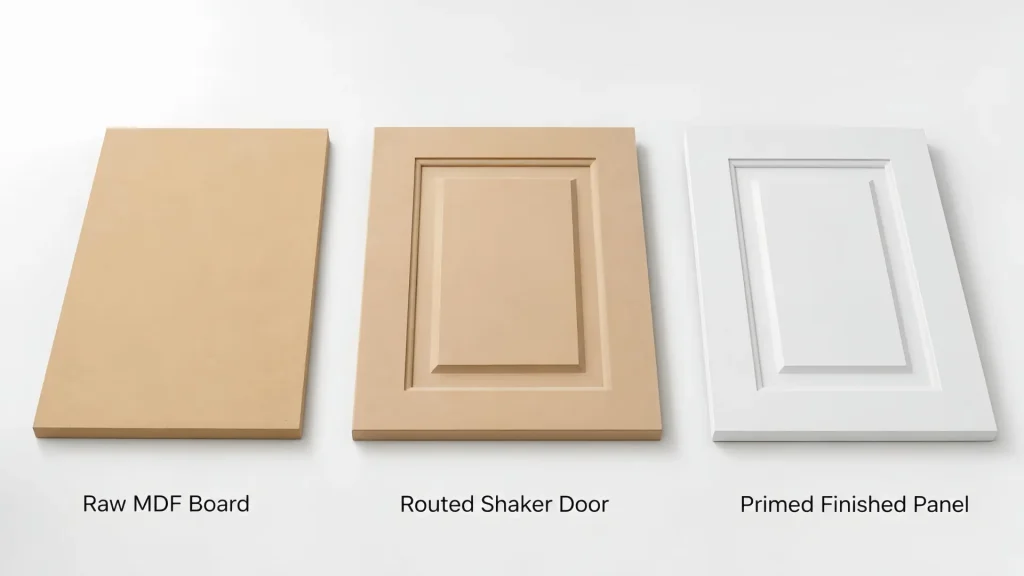
Shaker doors, grooves, moulded edges, and routed designs expose material below the face. Therefore, the inner fibre structure becomes part of the finished surface.
Deep Routing Raises the Quality Test
The deeper the cut, the more inner material becomes visible.
- Routed-edge smoothness
- Fibre breakout
- Profile shape
- Tool marks
- Soft local areas
- Thickness stability
- Primer result after routing
For example, a board may work well with a shallow groove but give a rougher result with a deep shaker profile. So, the trial panel should use the actual cutter and profile depth.
Test a Full Door Instead of a Small Sample
A hand sample cannot prove full CNC performance.
Instead, run one real door through cutting, routing, sanding, priming, and finishing. Then, inspect the completed part.
The related MDF Board Sizes Guide explains how sheet format and machine limits affect this production route.
Hardware Zones Need Their Own MDF Test
Cabinet hardware loads are very local.
A hinge screw does not test an entire sheet. It tests a small area close to the face or edge. Likewise, drawer runners and cabinet connectors place force in specific fixing zones.
Screw Holding Depends on More Than Density
MDF grades can differ in screw-holding ability. However, board density alone does not predict the whole connection.
- Screw type
- Screw diameter
- Pilot-hole size
- Distance from the edge
- Screw depth
- Number of screws
- Hardware shape
- Repeated removal and refitting
For example, a poor pilot hole can damage a good board. In contrast, a well-designed fixing can improve the result.
Therefore, test the real screw in the real panel.
Test the Hinge Area as a System
Cabinet hinges place repeated loads on the same fixing points.
So, use the real hinge cup, screws, drilling pattern, and door size in the trial. Then, open and close the door repeatedly and inspect the fixing zone.
Shelves Need a Different Buying Rule
A shelf does not work like a painted door.
Its main concerns are span, load, support, thickness, and long-term sag. Therefore, the door specification should not automatically become the shelf specification.
A thick MDF panel may give an excellent painted door. Yet the same board may need a centre support or front rail when used as a long shelf.
Doors are driven mainly by finish and machining. Shelves are driven mainly by load and support.
MDF for Kitchen Cabinets Needs a Moisture Map
A kitchen is not equally wet in every location.
A high wall cabinet may stay in a normal indoor setting. However, a sink base, dishwasher side, floor-level plinth, or utility panel can face more humidity and splash risk.
| Cabinet zone | Typical exposure | Better buying question |
|---|---|---|
| Dry interior area | Normal room humidity | Does standard MDF suit the finish and hardware? |
| Humid interior area | Higher humidity or occasional splash | Is moisture-resistant MDF more suitable? |
| Repeated wet area | Regular water contact or standing-water risk | Should another material be used? |
Moisture Resistant Does Not Mean Waterproof
Moisture-resistant MDF is made for defined humid interior conditions. However, it should not be treated as a waterproof board.
Edges, drilled holes, routed areas, coatings, joints, and sealing details still matter.
As a result, buyers should review the whole cabinet detail when water can stay against the panel.
Flat Cabinet Doors Need a Balanced Build
Flatness does not depend on MDF alone.
A large door can react when the two faces see different moisture or finish conditions. Likewise, a heavy coating or laminate on only one side can create an uneven build.
Review Both Faces of the Door
When one face receives a heavy coating, laminate, or overlay, the back should also be considered.
The two sides do not always need the same visible finish. However, the build should avoid unnecessary imbalance.
Store Door Blanks Flat
Good MDF can still become difficult to process after poor storage.
For that reason, door blanks should stay flat, dry, supported, and protected before CNC work and painting.

Choose MDF by Cabinet Part
| Cabinet part | Where MDF performs well | Main caution |
|---|---|---|
| Painted slab door | Smooth paint surface | Finish and flatness |
| Routed shaker door | Detailed machining | Route quality and moisture |
| Drawer front | Repeat machining and paint | Hardware and impact |
| Carcass side | Smooth surface and size consistency | Fixing and moisture zone |
| Shelf | Easy machining and finishing | Span and sag |
| Back panel | Thin smooth panel options | Support and fixing |
| Sink-base part | Possible with the right MDF grade | Higher moisture risk |
| Heavy hardware area | Accurate machining | Local fixing must be tested |
The Plywood vs MDF comparison is useful when another panel may better suit a specific cabinet part.
Write MDF for Cabinets Around the Finished Part
MDF for cabinets and painted door production, 18 mm nominal thickness, smooth sanded faces, controlled thickness range, clean routing for shaker-door profiles, approved hinge and screw trial with the intended hardware, stated emission requirement for the destination market, moisture-resistant MDF for identified humid areas, flat export packing, protected corners, and production samples finished with the planned paint system.
This wording connects the board with the real cabinet process. In addition, it gives different suppliers a clearer target.
For U.S. supply, see the EPA TSCA Title VI requirements for composite wood products.
Approve a Finished Cabinet Part
- Raw-board flatness
- CNC cut quality
- Routed edge
- Primer result
- Final paint surface
- Hinge drilling
- Screw fixing
- Corner condition
- Finished size
- Moisture-risk detail where needed
For painted doors, inspect the trial part under the same or similar light used for final factory quality checks.
For hardware-heavy parts, use the actual fitting. Likewise, for humid areas, test the chosen MDF together with the intended edge and finish system.
The Container Loading Guide also helps protect panel flatness, corners, and board condition during export handling.
How ROC Supports MDF for Cabinets
For MDF for cabinets, ROC can help buyers divide a cabinet program by finish, routing, hardware, load, and moisture risk.
A painted-door factory may need a smooth board with clean routing. Meanwhile, a cabinet maker may need tighter control around hinge and connector zones.
A kitchen program may also need moisture-resistant MDF only in selected areas instead of across the entire cabinet.
Therefore, the goal is not to buy the most expensive MDF for every part. The better goal is to place the right board in the right cabinet zone.
FAQ
Is MDF for Cabinets a Good Choice?
Yes. MDF for cabinets is widely used where smooth painted surfaces, detailed routing, and repeat production matter. However, the correct MDF grade should still match the part, hardware, load, and moisture risk.
Is MDF Good for Painted Cabinet Doors?
Yes. MDF cabinet doors offer a smooth and even base for paint. However, routed edges, sanding, primer, topcoat, and flatness still need control.
Should MDF for Kitchen Cabinets Be Moisture Resistant?
Not every cabinet part needs moisture-resistant MDF. Instead, identify the humid and splash-risk areas first. Then, use the suitable MDF grade where it adds value.
Does MDF Hold Cabinet Hinges Well?
MDF can work with cabinet hinges. However, the result depends on board grade, screw type, pilot hole, fixing depth, edge distance, and hinge design. Therefore, test the planned hardware system.
Is MDF Better Than Plywood for Cabinet Doors?
For painted and routed doors, MDF often provides a smoother and more even machining surface. In contrast, plywood may suit parts where veneer appearance, edge build, or other needs matter more.
What Should Buyers Specify for MDF Cabinet Doors?
Specify the MDF grade, thickness range, surface quality, routed profile, hardware trial, moisture need, emission rule, paint system, packing method, and finished-part approval standard.
Official References for Further Reading
- Composite Panel Association MDF product information
- Composite Panel Association standards information
- U.S. EPA TSCA Title VI formaldehyde standards
Post time: Aug-24-2026