

Plywood sizes affect much more than the footprint of a panel. They affect cutting yield, pallet design, freight cost, machine setup, site handling, joint layout, stock turnover, and the number of clean sheets a buyer can still sell after delivery.
That is why a plywood order should not begin with a supplier stock list. It should begin with the finished part, the installation layout, or the customer’s required format. A common sheet may be easy to buy, yet still create waste, extra joints, difficult handling, or slow moving stock.
The right panel is not always the largest sheet or the lowest priced sheet. It is the panel that works through cutting, production, loading, delivery, and final use. This plywood sizes guide explains how buyers can choose panel dimensions with better control and fewer surprises.
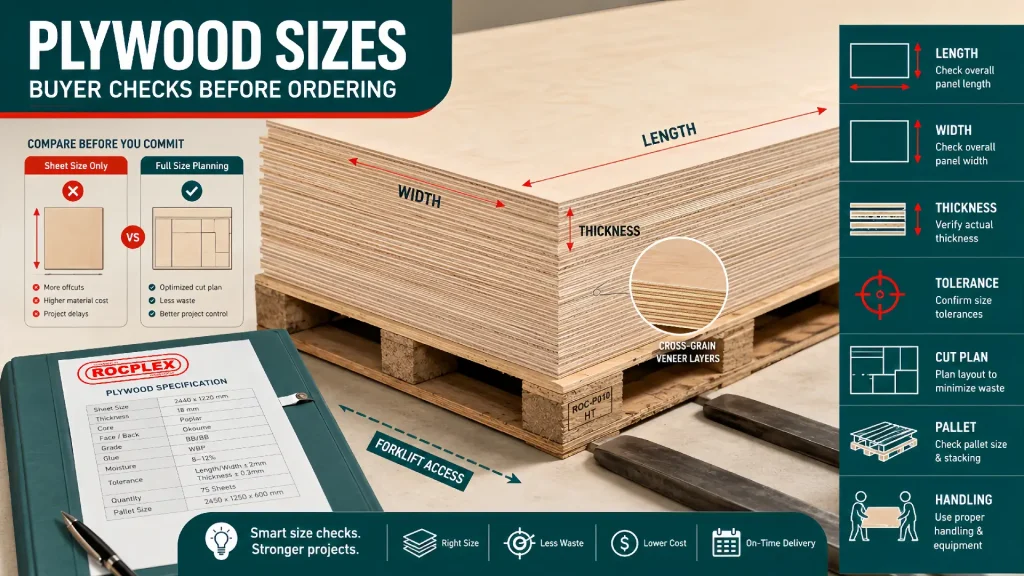
Plywood Sizes in One Practical Answer
Plywood sizes should be selected from the final use backward. Buyers need to confirm length, width, thickness, tolerance, panel direction, cutting plan, handling method, pallet size, and supply availability before comparing prices.
Start With the Finished Part Not the Stock Sheet
The best starting point is the finished result. A furniture factory should begin with cabinet parts, door sizes, drawer pieces, nesting plans, and edge banding needs. A formwork buyer should begin with slab layout, wall height, joint lines, beam spacing, stripping method, and planned reuse. A distributor should begin with the formats local builders, factories, and retailers can move and reorder.
This reverse method is more useful than asking for the most common panel. It shows where waste is likely to appear before the order is placed. It also shows whether a longer or wider panel can remove cuts, reduce joints, or improve the finished look.
For example, a longer plywood panel may remove one horizontal joint in a wall lining project. That can save time and improve appearance. However, the same panel may not fit through a warehouse door, onto a local truck, or into a small workshop. The sheet is only useful when the whole supply path can support it.
This is the first rule in a serious plywood sizes decision. Start with the finished work, then work back to the stock sheet.
The Difference Between a Trade Size and an Order Size
Many plywood sizes are known as trade formats. They are familiar to buyers, easy to describe, and often stocked by suppliers. However, a trade size is not always the exact size that should appear in a purchase order.
The purchase order should state the agreed nominal dimensions, the allowed tolerance, the thickness range, and the intended use. It should also state whether the buyer needs a panel for structural work, furniture production, decorative use, packaging, formwork, or resale stock.
For example, “18 mm plywood” is not a complete instruction. It leaves too much room for different cores, different actual thicknesses, different face grades, and different glue systems.
A clearer request would be: “18 mm plywood for CNC cut cabinet parts, 1220 × 2440 mm nominal size, controlled thickness tolerance, smooth sanded face, stable core, clean packing, and export pallet protection.”
That request gives the supplier a usable standard. It also lets the buyer compare quotations fairly.
Read Length Width Thickness and Direction Together
A plywood specification has more than three numbers. Length, width, and thickness are the visible dimensions. Yet panel direction, face grade, core structure, glue bond, edge quality, and thickness tolerance often decide whether that panel size will work in practice.
For structural uses, panel orientation can matter. Buyers should confirm the strength axis, span rating, support layout, fixing pattern, and the manufacturer’s product data before choosing a panel direction. A panel should never be selected for a structural job by thickness alone.
For furniture and interior work, the key issues may be different. Cutting layout, visible grain direction, surface repair, board flatness, screw holding, machining, and finished edge quality can matter more than structural direction.
This is why a clear request should state the intended use as well as the panel dimension. “18 mm plywood” is not a complete buying instruction. “18 mm furniture plywood for CNC cut cabinet parts with a clean face and controlled thickness” is much clearer.
Choose Plywood Sizes From the Final Cut Backward
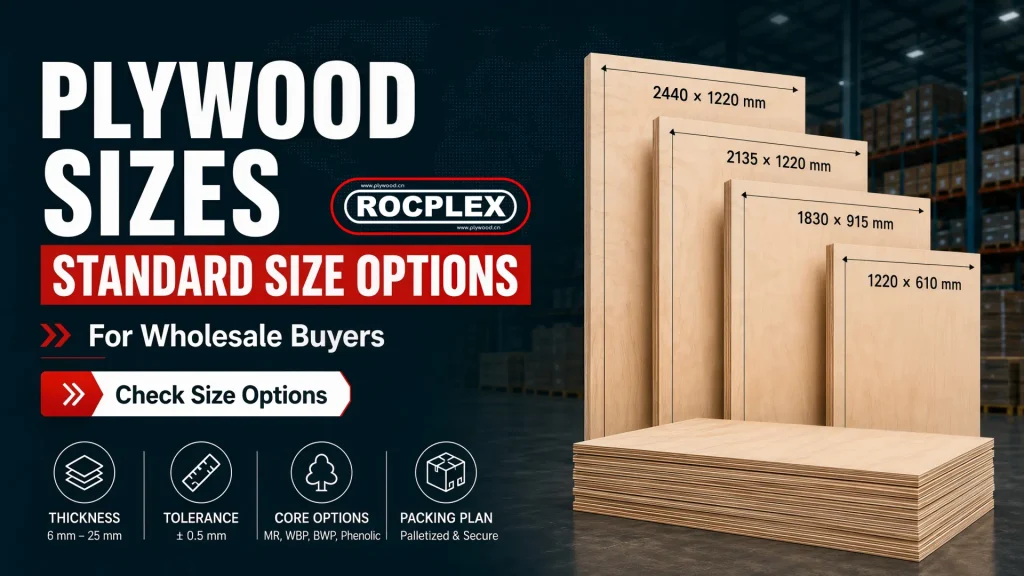
Buyers often see cutting waste only after panels reach the factory. By then, the sheet format is fixed. A better approach is to map the main finished parts onto several possible panel formats before buying.
Start with the largest repeated part. Then add saw kerf, trimming allowance, edge banding allowance, defect allowance, and grain direction where needed. The remaining area shows whether the sheet format creates useful offcuts or expensive waste.
In furniture production, this can change the cost of a full program. Wall and ceiling work, it can reduce joints. In packaging, it can improve crate output. In formwork, it can reduce cutting and preserve panel reuse value.
A strong plywood sizes guide looks at yield before price. A lower sheet price does not help if the format creates more waste, slower machining, or extra labour on site.
How Plywood Sizes Vary by Market and Supply Chain
There is no single global plywood format. Markets developed around different building systems, machinery, transport rules, stock programs, and local buying habits. Buyers should treat common sizes as trade formats, not as a universal rule.
| Market or supply context | Common sheet format examples | Buying point to confirm |
|---|---|---|
| North American panel trade | 4 × 8 ft, 4 × 9 ft, 4 × 10 ft | Confirm nominal dimensions, actual tolerance, grade, and panel rating |
| Australian sheet product supply | About 1200 mm wide with 1800 mm, 2100 mm, 2400 mm, or 2700 mm lengths | Confirm exact product size, grade, thickness, and project requirement |
| Furniture and interior programs | Mill specific panel formats based on cutting plans | Confirm nesting yield, surface grade, machining, and stock availability |
| Project and formwork supply | Panel size matched to wall, slab, or system layout | Confirm handling, joint layout, reuse plan, and packing method |
| Export container orders | Standard or custom sheets based on loading limits | Confirm pallet footprint, gross weight, container payload, and destination handling |
North American 4 × 8, 4 × 9, and 4 × 10 foot formats are widely used in panel specifications. In metric purchasing documents, buyers may see approximate trade equivalents around 1220 mm wide and 2440 mm, 2745 mm, or 3050 mm long. However, a conversion is not a contract dimension. The supplier should always state the exact nominal size and the accepted tolerance.
Australian sheet product buyers may work with widths around 1200 mm and common lengths such as 2400 mm or 2700 mm. Even then, availability can vary by product type, supplier, grade, and project need. Buyers should confirm the actual product range before quoting it to customers.
Thickness Is a Performance Decision
Thickness affects stiffness, weight, screw holding, cutting quality, pallet weight, freight, and final cost. However, thickness should not be chosen in isolation. A thicker panel with poor core quality may perform worse than a well made panel with controlled veneers and better bonding.
Thin plywood can suit backing, drawer bottoms, curved work, light packaging, and decorative applications. Mid range thicknesses are often used for cabinets, shelving, furniture parts, wall lining, and general panel work. Thicker plywood may suit industrial platforms, flooring, heavy packaging, formwork, and jobs with higher load demands.
The key is not to buy the thickest panel. The key is to buy the right thickness for the span, support, fixing method, edge condition, screw holding, cutting plan, and customer expectation.
Nominal Thickness and Actual Thickness Are Different Questions
Nominal thickness is the ordered product category. Actual thickness is the measured panel result. The difference matters in CNC work, laminating, edge processing, cabinet assembly, formwork joints, flooring build up, and projects where panels meet other materials.
Buyers should ask for a stated thickness tolerance instead of accepting vague wording such as “standard thickness.” The correct tolerance depends on the product, intended use, standard, and market expectation. It should be written into the purchase specification.
Thickness control also affects stock consistency. A wholesaler may receive one clean container but face problems on the next if actual thickness changes. A furniture factory may need to reset machines. A formwork contractor may see uneven joints and extra sealing work.
For this reason, plywood sizes must be read with tolerance and flatness requirements. The panel dimension is only useful when the supplier can repeat it across the full order.
Plywood Sizes Have a Cost Footprint
Every sheet format creates a cost footprint. Larger panels may improve cutting yield and reduce joints. At the same time, they can raise pallet weight, increase breakage risk, slow warehouse handling, and reduce the number of workers who can move the sheet safely.
Smaller panels may be easier to handle and fit more local delivery routes. Yet they can create more joints, more offcuts, more labour, and a higher cost per usable square metre. Neither option is always better.
Buyers should compare the total effect. This includes purchase price, cutting yield, labour, freight, pallet design, warehouse movement, damage allowance, and resale speed. The same logic appears in the plywood price guide, where the best value is measured by usable result rather than sheet price alone.
Warehouse and Container Limits Can Change the Best Panel Size
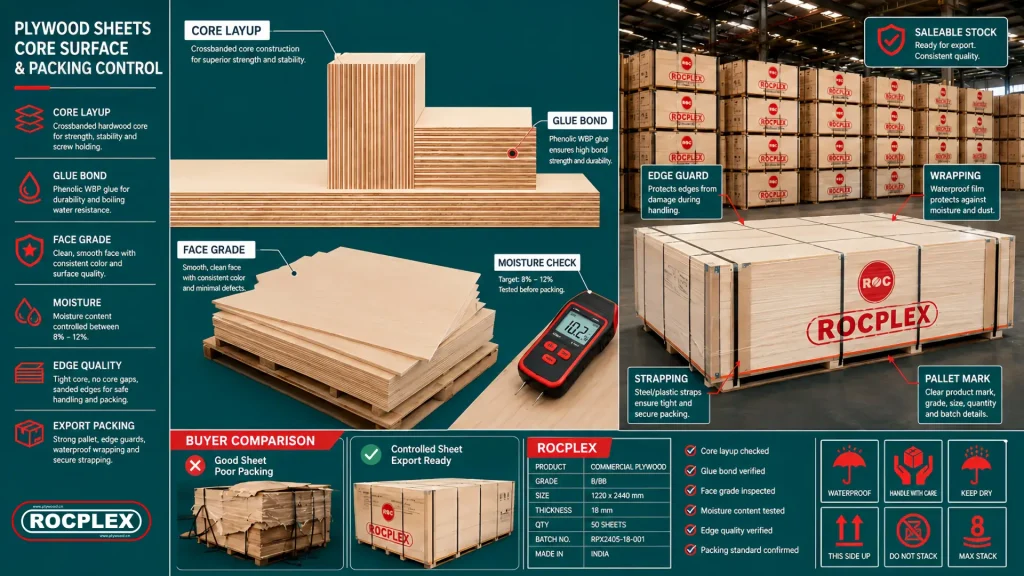
A size that works well in the factory can fail in the supply chain. Buyers should check warehouse racking, loading bays, forklift fork length, door openings, local truck size, manual handling limits, and customer unloading conditions.
Container loading adds another layer. Sheet length affects pallet design. Panel thickness and density affect bundle weight. Dense hardwood panels can reach payload limits before the container appears full. Long sheets may need different loading control and may be harder to unload safely at destination.
Before confirming plywood sheet sizes for export, buyers should also decide how the customer will unload the cargo. A clean container plan protects more than freight efficiency. It protects corners, edges, faces, pallets, and saleable stock. See the container loading guide for the loading checks that should sit beside the panel specification.
Buyer Matrix for Common Plywood Size Decisions
Different buyers should approach sheet selection from different angles. The same plywood size can create value for one buyer and waste for another.
| Buyer type | First size question | Second check | Main risk |
|---|---|---|---|
| Furniture factory | Does the format improve nesting yield? | Can machinery handle the sheet? | Offcuts, face defects, thickness variation |
| Formwork contractor | Does the panel reduce joints in the formwork layout? | Can workers handle it safely? | Damage, difficult stripping, short reuse life |
| Builder or installer | Does the format fit the wall, floor, roof, or lining layout? | Does it match the support and fixing plan? | Extra joints, poor fit, site waste |
| Wholesaler | Will local buyers recognise and reorder the format? | Will pallets fit the warehouse and delivery route? | Slow stock, damage, difficult resale |
| Packaging buyer | How many finished crates or parts come from each sheet? | Does the panel hold nails and fasteners well? | Waste, weak crates, unstable output |
Turn Plywood Sizes Into an Orderable Specification
A clear request for quotation should remove supplier guesswork. It should state what the sheet must do, not only what it should measure.
- Final application and buyer market.
- Exact nominal length and width.
- Nominal thickness and accepted tolerance.
- Face and back grade.
- Core type, core quality, and glue requirement.
- Panel direction or strength axis where relevant.
- Surface finish, coating, film, or sanding requirement.
- Moisture level before packing where needed.
- Pallet footprint, bundle height, wrapping, corner protection, and marks.
- Container loading method, destination handling method, and photo record.
This turns a basic plywood sizes request into a controlled buying instruction. It also makes supplier quotations easier to compare fairly.
Common Plywood Size Mistakes That Create Hidden Cost
Most size problems begin with an incomplete brief. Buyers choose what is easy to source, then try to force that panel into a job that needs another format. The result is often waste, extra cuts, difficult handling, or customer complaints.
- Choosing the largest sheet without checking safe handling.
- Using trade conversions as exact contract dimensions.
- Ignoring actual thickness tolerance.
- Choosing a sheet format before preparing a cutting plan.
- Ignoring grain or strength direction where relevant.
- Ordering a size that does not fit warehouse doors or delivery vehicles.
- Comparing sheet price without comparing usable yield.
- Assuming a supplier can repeat a custom format without checking lead time and minimum order quantity.
These mistakes are avoidable. Buyers who define the finished use, the panel specification, and the delivery path before ordering usually see less waste, fewer claims, and stronger stock performance.
How ROC Supports Plywood Size Planning
ROC supports buyers who need a plywood led engineered wood supply system. Plywood remains the main product line, while OSB, MDF, particle board, LVL timber, H20 beams, I joists, and related products support wider sourcing needs.
For buyers reviewing plywood sizes, ROC can help assess panel format, thickness, core, glue, face grade, tolerance, packing, pallet design, loading method, and repeat supply planning. The aim is to match the sheet to the buyer’s cutting plan, handling limits, and market demand.
Buyers comparing panel formats can also read the plywood sheets guide for wider sheet selection logic, what is plywood for product basics, and types of plywood for common product categories.
For project, wholesale, or factory orders, send the finished part size, cutting plan, required thickness, preferred sheet format, packing method, and destination details. This allows the product specification and loading plan to be reviewed together before production begins.
FAQ
What are the most common plywood sizes?
Common plywood sizes vary by market. Many buyers use 1220 × 2440 mm as a common export format. North American panel trade often uses 4 × 8 ft, 4 × 9 ft, and 4 × 10 ft formats. Australian sheet products are often supplied in widths around 1200 mm and lengths such as 1800 mm, 2100 mm, 2400 mm, or 2700 mm.
What is the standard plywood size in millimetres?
1220 × 2440 mm is one of the most common export plywood sheet formats. However, it is not the only standard. The best size depends on the country, final use, project layout, machinery, and supplier capability.
How do I choose the right plywood sheet size?
Start with the finished part or installation layout. Then check cutting yield, machinery, handling, pallet size, freight, warehouse access, site conditions, and supplier availability.
Does a larger plywood sheet always reduce cost?
No. Larger sheets can reduce joints and cutting waste. However, they can also raise handling difficulty, breakage risk, pallet weight, freight cost, and warehouse limits.
Why does plywood thickness tolerance matter?
Thickness tolerance affects CNC work, laminating, edging, cabinet assembly, formwork joints, flooring build up, and repeat stock consistency. Buyers should state the required tolerance in the purchase order.
Should plywood size be checked before container loading?
Yes. Sheet length, width, thickness, density, pallet size, bundle weight, and destination unloading method all affect container loading safety and damage risk.
Official References for Further Reading
Post time: Jun-26-2026