

Plywood grades are often treated as a simple ranking from good to poor. That view creates costly buying mistakes. A grade tells buyers about the visible veneer surface. However, it does not automatically confirm the core, glue bond, thickness range, flatness, or final job use.
A panel can have a clean face and still contain core gaps. It can have a lower back face and still work well inside a cabinet. It can be sold as BB/BB, yet the buyer may expect a repair level the factory never agreed to control.
For this reason, buyers should treat plywood grades as a set of surface and use rules. The best grade is not always the cleanest face. Instead, it is the grade that gives the right look, cut result, yield, and saleable value without paying for features the job does not need.
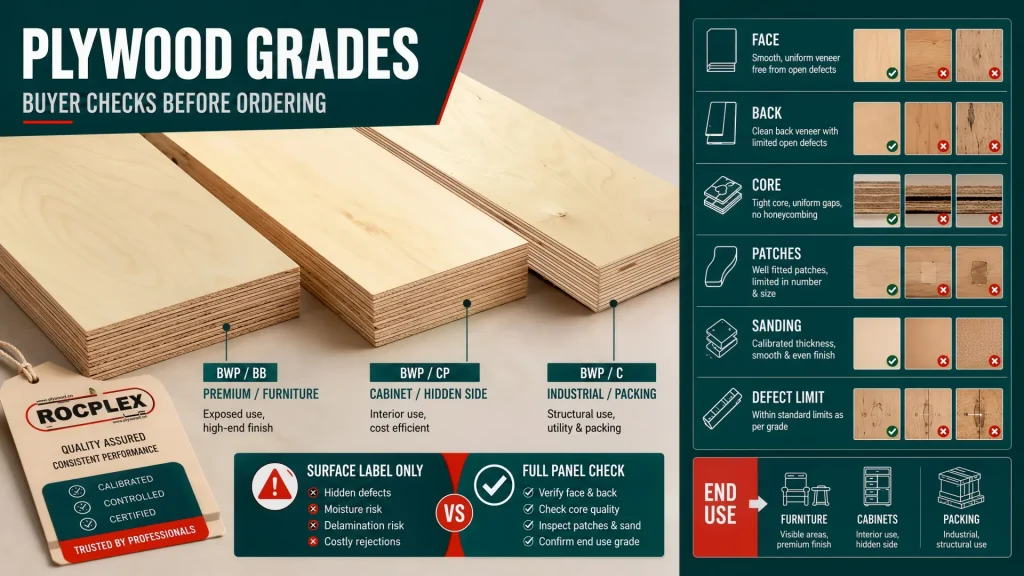
Plywood Grades in One Buyer Rule
Choose a panel by answering four questions: which side will the customer see, what knots, patches, grain marks, and sanding marks can the job accept, what must the core and glue do behind the face, and whether the supplier can repeat the same result across the full order.
The grade should fit the job. Therefore, a clear furniture door, a hidden cabinet back, a packing crate, and a formwork panel should not use the same surface rules.
Face Back and Core Need Separate Checks
A grade is often a surface promise. It is not a full panel promise. Therefore, buyers should assess the face, back, and core as separate parts of the same buying decision.
What the Visible Surface Must Deliver
Plywood face grades matter when the panel stays visible after cutting, clear finishing, coating, laminating, or edge work. A cleaner face may have fewer patches, tighter knots, steadier grain, smoother sanding, and fewer open defects.
However, the word “clean” is not enough for an order. Buyers should state whether they allow football patches, filled knots, sound knots, pinholes, veneer overlaps, grain splits, colour shift, or sanding marks.
For example, a furniture factory may accept natural grain shift. A painted door maker may care less about grain but need a smooth and even face. By contrast, a decorative panel buyer may reject small patches because the wood grain remains visible.
What the Hidden Side Can Accept
Plywood back grades often matter less when the panel faces a wall, cabinet interior, packing frame, or another hidden area. As a result, a face and back combination can lower cost while keeping the visible side suitable for the job.
For example, a cleaner face with a lower back grade can work well for one-side furniture parts, wall lining, drawer fronts, and cabinet panels. The buyer gets value from the visible side without paying for a matching face on the hidden side.
However, a lower back grade does not automatically mean weak glue or poor strength. It mainly changes what can be accepted on the less visible side. The full panel build still needs separate checks.
Why the Inner Build Still Matters
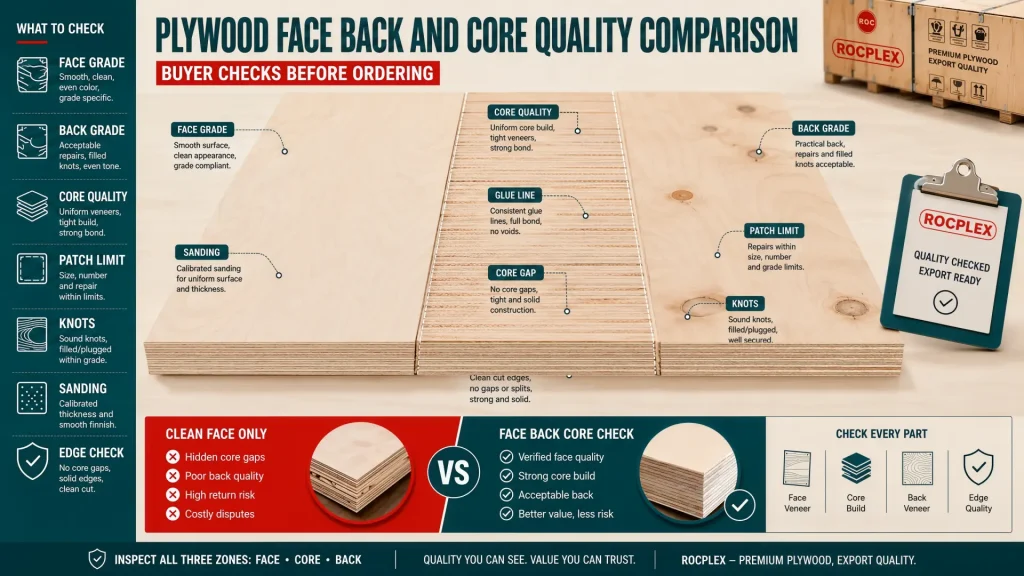
Core quality is rarely shown by the face grade. Yet it affects screw holding, cutting, edge finish, flatness, panel weight, and long-term stability.
A clean face over a poor core can create trouble during CNC cutting, drilling, routing, edge banding, or repeat handling. Core gaps can also create weak edges and poor fixing zones.
Therefore, plywood grades should always be ordered with a core rule. Buyers should state whether they need full core, limited core gaps, patched core, hardwood core, poplar core, combi core, or another agreed panel build.
When Paired Labels Need Written Rules
Many panels use paired grade terms. Common examples include A/A, A/B, B/B, B/BB, BB/BB, BB/CC, BB/CP, C/D, and C+/C. These terms are useful. However, they are not a single global language.
One factory may use BB to mean a smooth face with limited patches. Another may use BB for a face with more repair, wider grain shift, or more sound knots. Likewise, one supplier may use CC for a back face with filled defects, while another uses it in a different way.
For this reason, paired plywood grades should never stand alone in a purchase order.
Buyers should ask for a written defect rule that explains the grade. The supplier should state the maximum patch size and patch count, whether knots are open, filled, sound, or repaired, whether face splits, pinholes, overlaps, or grain cracks are allowed, the required sanding level, face veneer type where needed, allowed colour and grain shift, and which panel face must meet the agreed grade.
This turns a trade label into an orderable product rule.
Match the Panel to the End Use
| Buyer use | Grade focus | What matters most | Common buying error |
|---|---|---|---|
| Clear-finished furniture | Clean face and controlled grain | Veneer look, patch rule, sanding, colour range | Buying by BB label alone |
| Painted cabinet parts | Smooth face and stable core | Sanding, flatness, repair quality, thickness range | Paying for grain that will be painted |
| Cabinet carcasses | Practical face and usable back | Core stability, screw holding, cut edge quality | Ordering two clean faces when one side is hidden |
| Wall lining and shopfitting | Face matched to the final finish | Face repair, grain look, panel flatness | Ignoring panel direction and cut layout |
| Packing and crate panels | Fit-for-use surface and strong core | Core, glue, nail holding, cost per part | Paying for furniture-grade faces |
| Formwork plywood | Film face and panel build | Film quality, glue bond, edge sealing, reuse result | Treating veneer grade as the main formwork check |
| Wholesale stock | Grade range matched to local demand | Steady appearance, pallet condition, repeat supply | Mixing different factory grade rules |
The table shows why plywood grades should follow final use. A better-looking face does not always create more value. In many cases, the right grade is the one that meets the job while avoiding extra cost.
For wider panel selection, buyers can also read the Plywood Sheets Guide, Plywood Thickness Chart, and Plywood Sizes Guide before setting a stock program.
Surface Labels Do Not Prove Performance
Plywood panel grades help buyers compare surface quality. However, they do not prove every other panel property.
For example, a face grade does not automatically prove structural rating, glue bond type, moisture resistance, fire rating, emission level, FSC or PEFC claim, actual thickness range, core density, panel flatness, or formwork reuse cycle.
This matters because trade names can sound complete when they are not. Terms such as “marine grade,” “structural grade,” “commercial grade,” “BB grade,” and “premium grade” should always be checked against full product details.
Therefore, buyers should keep surface grade separate from job performance needs. A good product sheet states both.
Convert an Approved Sample Into an Order Standard
A sample helps buyers check face look, grain, sanding, edge build, and general feel. However, a sample alone does not control a full container.
Create the Reference Panel
Once the sample is approved, the buyer should write down what makes it acceptable. This creates a practical plywood grade guide for the order.
The written reference should include face grade, back grade, core build, actual thickness range, sanding level, patch rule, allowed defects, panel size, glue need, and packing method.
The supplier should then use that approved panel as the reference for the full batch.
This step protects both sides. The buyer has a clear approval point. Meanwhile, the supplier has a written target instead of a vague request for “good quality.”
Agree Defect Limits Before Production
A useful order should clearly state what is accepted and what is rejected.
For example, the buyer may accept small filled knots on the back but reject open knots on the face. The buyer may accept colour shift but reject face splits. The buyer may accept patches in hidden cabinet parts but reject them in clear-finished furniture panels.
When these rules are clear, inspection becomes faster. As a result, claims are also easier to handle because both sides can compare the goods against the same agreed standard.
Inspect the Shipment Against the Approval
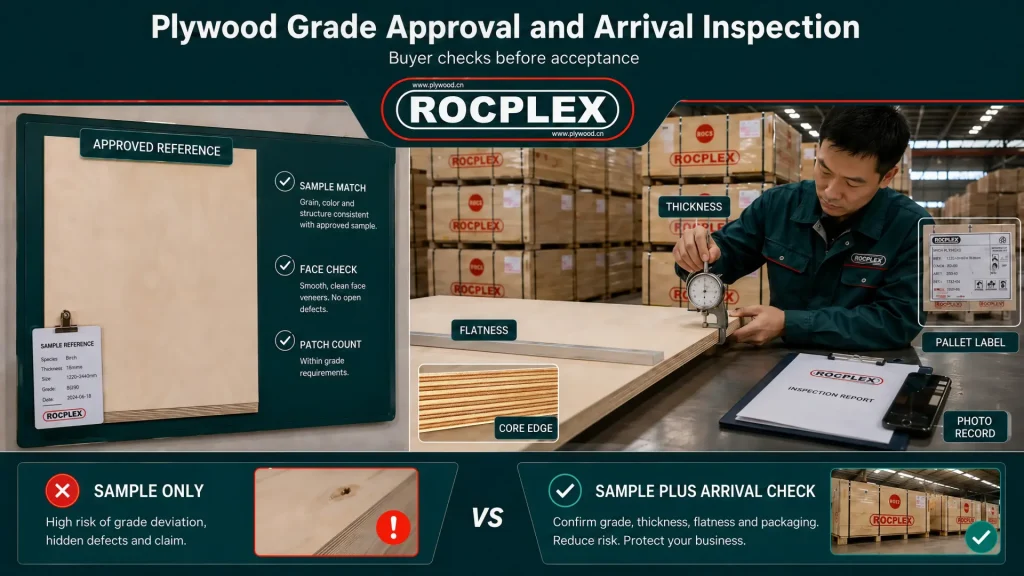
Plywood grades should be checked when the goods arrive, not only when the sample is approved.
Start with bundles from different pallet positions. Then inspect both faces, the edges, thickness, flatness, sanding, patches, knots, core exposure, and packing condition.
The goal is not to reject normal timber variation. Instead, the goal is to confirm that the shipment matches the agreed face, back, and core rules.
- Compare plywood face grades with the approved reference panel.
- Check plywood back grades on hidden-side panels.
- Count patches and open defects in a sample group.
- Check corner and edge damage.
- Measure thickness at several points.
- Inspect cut edges for core gaps.
- Check panel flatness after unwrapping.
- Record pallet labels, bundle marks, and photos.
- Separate transport damage from factory-grade issues.
The Container Loading Guide is also useful because weak pallet protection can damage a clean face before the buyer sees it.
Write the Order So Factories Cannot Guess
A buyer should not write only “BB/BB plywood price please.” That request leaves too much room for different face rules, core builds, repairs, and packing methods.
Instead, the order should describe the plywood veneer grades and the full panel build.
18 mm plywood for clear-finished furniture components, 1220 × 2440 mm, BB/BB face and back grade, limited football patches, no open face knots, no face splits, smooth sanding, stable hardwood or combi core, controlled actual thickness range, low moisture before packing, export pallet protection, and order-specific inspection photos.
This gives the supplier a clear target. It also gives the buyer a fair basis for comparing several quotes.
After the panel details are fixed, use the Plywood Price Guide to compare useful value instead of sheet price alone.
Mistakes That Raise Claim Risk
Most plywood grade problems begin before the order is placed.
- Buying by grade name without a defect rule.
- Assuming BB means the same thing at every factory.
- Checking the face while ignoring the core.
- Paying for two clean faces when only one side is visible.
- Using face grade as proof of structural use.
- Accepting a sample without writing the approval standard.
- Ignoring actual thickness range and flatness.
- Checking only the top sheets after delivery.
- Mixing transport damage with factory-grade issues.
A better plywood grade guide starts with a written product rule. Therefore, the supplier has less room to guess and the buyer has more control over the final result.
How ROC Supports Repeat Panel Supply
ROC supports buyers who need plywood-led engineered wood supply. Plywood remains the main product line, while OSB, MDF, particle board, LVL timber, H20 beams, I joists, and related products support wider sourcing needs.
For plywood grades, ROC can help buyers define face and back expectations, core rules, glue needs, thickness range, sanding level, packing method, inspection points, and repeat supply control.
A furniture buyer may need a clean face and steady machining. A wholesaler may need a practical BB/CC or BB/CP range that local customers can sell quickly. Meanwhile, a formwork buyer may need film, edge sealing, and glue bond control more than veneer appearance.
Before approving a new panel, define what the customer will see, what the panel must do, and what the factory must repeat.
FAQ
What Do Plywood Grades Mean?
Plywood grades usually describe face and back veneer condition. They may cover patches, knots, sanding, grain look, and visible defects. However, plywood grades do not automatically confirm core quality, glue bond, thickness range, or structural rating.
Is BB/BB Better Than BB/CC?
BB/BB usually aims for a cleaner result on both faces. BB/CC can offer better value where one face is visible and the other is hidden. However, the written defect rule matters more than the letters alone.
Does a Clean Face Guarantee a Good Core?
No. Plywood face grades and core quality are separate checks. A panel can have a clean face but still have core gaps, weak edges, or poor screw holding.
Which Panel Finish Works Best for Furniture?
The best grade depends on the finish. Clear-finished furniture often needs a cleaner face and controlled grain. Painted furniture may need smooth sanding and a stable core more than decorative veneer.
Can Surface Labels Prove Structural Use?
No. Plywood panel grades do not replace the panel rating, product data, support plan, fixing details, or required standards for structural use.
What Belongs in a Purchase Order?
State the face and back grade, accepted defects, patch limits, sanding level, core build, glue need, thickness range, panel size, packing method, and inspection requirements.
Official References for Further Reading
Post time: Jul-06-2026